

5 QCD on the Lattice
225
If the matrix element on the right-hand side is computed in a lattice simulation, then
the axial current defined in the discretized theory must be matched to its counterpart
in the continuum formulation. The details of the matching procedure depend on the
type of fermionic discretization and the chosen treatment to represent the heavylight axial current on the lattice (e.g. static approximation, NRQCD, etc.). If the
b-quark is treated in the static approximation, the axial current has a non-vanishing
anomalous dimension, and hence its running must be determined as well. Therefore,
the various techniques which have been developed to compute the renormalization
factors of local operators non-perturbatively, are of particular relevance also in the
study of heavy-light decay constants [189]. In particular, non-perturbative estimates
for the renormalization factor of the axial current, Z A , are required to ensure a
smooth convergence towards the continuum limit.
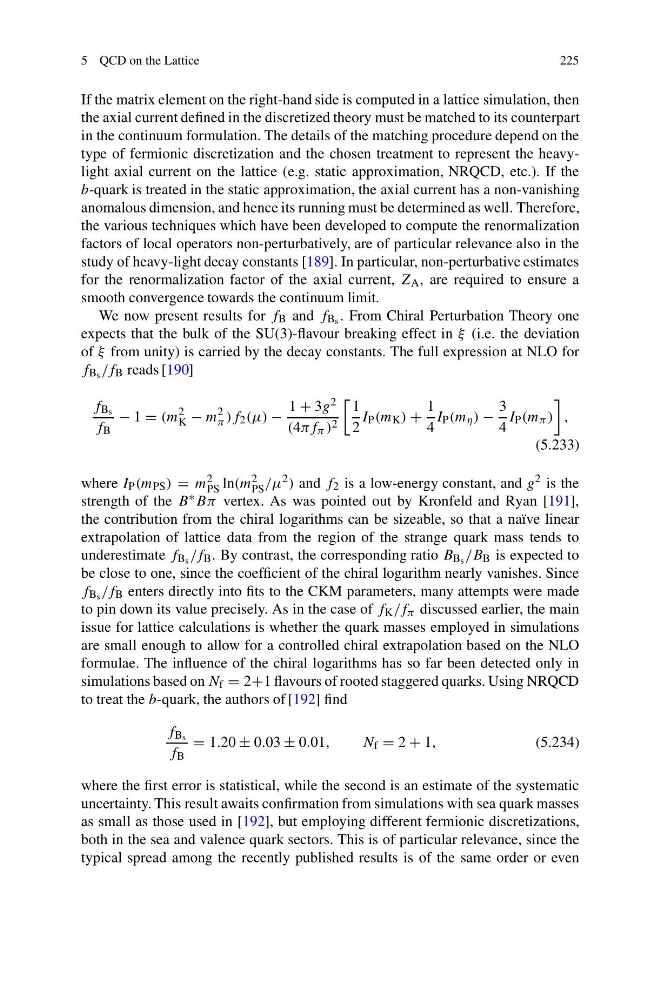
We now present results for f B and f B s . From Chiral Perturbation Theory one
expects that the bulk of the SU(3)-flavour breaking effect in ξ (i.e. the deviation
of ξ from unity) is carried by the decay constants. The full expression at NLO for
f B s /f B reads [190]
f B s
f B
− 1 = (m
2
K − m
2
π )f 2 (μ) −
1 + 3g 2
(4πf π ) 2
1
2
I P (m K ) +
1
4
I P (m η ) −
3
4
I P (m π )
,
(5.233)
where I P (m PS ) = m 2
PS ln(m 2
PS /μ 2 ) and f 2 is a low-energy constant, and g 2 is the
strength of the B ∗ Bπ vertex. As was pointed out by Kronfeld and Ryan [191],
the contribution from the chiral logarithms can be sizeable, so that a naïve linear
extrapolation of lattice data from the region of the strange quark mass tends to
underestimate f B s /f B . By contrast, the corresponding ratio B B s /B B is expected to
be close to one, since the coefficient of the chiral logarithm nearly vanishes. Since
f B s /f B enters directly into fits to the CKM parameters, many attempts were made
to pin down its value precisely. As in the case of f K /f π discussed earlier, the main
issue for lattice calculations is whether the quark masses employed in simulations
are small enough to allow for a controlled chiral extrapolation based on the NLO
formulae. The influence of the chiral logarithms has so far been detected only in
simulations based on N f = 2+1 flavours of rooted staggered quarks. Using NRQCD
to treat the b-quark, the authors of [192] find
f B s
f B
= 1.20 ± 0.03 ± 0.01,
N f = 2 + 1,
(5.234)
where the first error is statistical, while the second is an estimate of the systematic
uncertainty. This result awaits confirmation from simulations with sea quark masses
as small as those used in [192], but employing different fermionic discretizations,
both in the sea and valence quark sectors. This is of particular relevance, since the
typical spread among the recently published results is of the same order or even
225
If the matrix element on the right-hand side is computed in a lattice simulation, then
the axial current defined in the discretized theory must be matched to its counterpart
in the continuum formulation. The details of the matching procedure depend on the
type of fermionic discretization and the chosen treatment to represent the heavylight axial current on the lattice (e.g. static approximation, NRQCD, etc.). If the
b-quark is treated in the static approximation, the axial current has a non-vanishing
anomalous dimension, and hence its running must be determined as well. Therefore,
the various techniques which have been developed to compute the renormalization
factors of local operators non-perturbatively, are of particular relevance also in the
study of heavy-light decay constants [189]. In particular, non-perturbative estimates
for the renormalization factor of the axial current, Z A , are required to ensure a
smooth convergence towards the continuum limit.
We now present results for f B and f B s . From Chiral Perturbation Theory one
expects that the bulk of the SU(3)-flavour breaking effect in ξ (i.e. the deviation
of ξ from unity) is carried by the decay constants. The full expression at NLO for
f B s /f B reads [190]
f B s
f B
− 1 = (m
2
K − m
2
π )f 2 (μ) −
1 + 3g 2
(4πf π ) 2
1
2
I P (m K ) +
1
4
I P (m η ) −
3
4
I P (m π )
,
(5.233)
where I P (m PS ) = m 2
PS ln(m 2
PS /μ 2 ) and f 2 is a low-energy constant, and g 2 is the
strength of the B ∗ Bπ vertex. As was pointed out by Kronfeld and Ryan [191],
the contribution from the chiral logarithms can be sizeable, so that a naïve linear
extrapolation of lattice data from the region of the strange quark mass tends to
underestimate f B s /f B . By contrast, the corresponding ratio B B s /B B is expected to
be close to one, since the coefficient of the chiral logarithm nearly vanishes. Since
f B s /f B enters directly into fits to the CKM parameters, many attempts were made
to pin down its value precisely. As in the case of f K /f π discussed earlier, the main
issue for lattice calculations is whether the quark masses employed in simulations
are small enough to allow for a controlled chiral extrapolation based on the NLO
formulae. The influence of the chiral logarithms has so far been detected only in
simulations based on N f = 2+1 flavours of rooted staggered quarks. Using NRQCD
to treat the b-quark, the authors of [192] find
f B s
f B
= 1.20 ± 0.03 ± 0.01,
N f = 2 + 1,
(5.234)
where the first error is statistical, while the second is an estimate of the systematic
uncertainty. This result awaits confirmation from simulations with sea quark masses
as small as those used in [192], but employing different fermionic discretizations,
both in the sea and valence quark sectors. This is of particular relevance, since the
typical spread among the recently published results is of the same order or even