

5 QCD on the Lattice
215
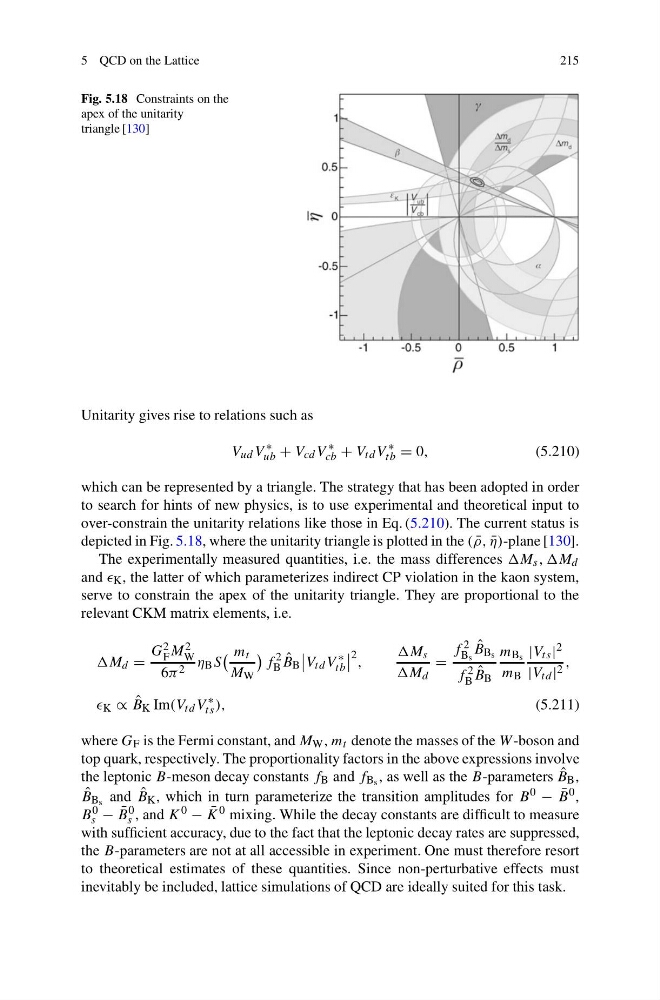
Fig. 5.18 Constraints on the
apex of the unitarity
triangle [130]
Unitarity gives rise to relations such as
V ud V
∗
ub + V cd V
∗
cb + V td V
∗
tb = 0,
(5.210)
which can be represented by a triangle. The strategy that has been adopted in order
to search for hints of new physics, is to use experimental and theoretical input to
over-constrain the unitarity relations like those in Eq. (5.210). The current status is
depicted in Fig. 5.18, where the unitarity triangle is plotted in the ( ¯
ρ, ¯
η)-plane [130].
The experimentally measured quantities, i.e. the mass differences s , ,M d
and K , the latter of which parameterizes indirect CP violation in the kaon system,
serve to constrain the apex of the unitarity triangle. They are proportional to the
relevant CKM matrix elements, i.e.
d =
G 2
F M 2
W
6π 2 η B S
m t
M W
f
2
B
ˆ
B B
V td V
∗
tb
2 ,
s
d
=
f 2
B s
ˆ
B B s
f 2
B
ˆ
B B
m B s
m B
|V ts | 2
|V td | 2 ,
K ∝ ˆ
B K Im(V td V
∗
ts ),
(5.211)
where G F is the Fermi constant, and M W , m t denote the masses of the W -boson and
top quark, respectively. The proportionality factors in the above expressions involve
the leptonic B-meson decay constants f B and f B s , as well as the B-parameters ˆ
B B ,
ˆ
B B s and ˆ
B K , which in turn parameterize the transition amplitudes for B 0 − ¯
B 0 ,
B 0
s − ¯
B 0
s , and K 0 − ¯
K 0 mixing. While the decay constants are difficult to measure
with sufficient accuracy, due to the fact that the leptonic decay rates are suppressed,
the B-parameters are not at all accessible in experiment. One must therefore resort
to theoretical estimates of these quantities. Since non-perturbative effects must
inevitably be included, lattice simulations of QCD are ideally suited for this task.
215
Fig. 5.18 Constraints on the
apex of the unitarity
triangle [130]
Unitarity gives rise to relations such as
V ud V
∗
ub + V cd V
∗
cb + V td V
∗
tb = 0,
(5.210)
which can be represented by a triangle. The strategy that has been adopted in order
to search for hints of new physics, is to use experimental and theoretical input to
over-constrain the unitarity relations like those in Eq. (5.210). The current status is
depicted in Fig. 5.18, where the unitarity triangle is plotted in the ( ¯
ρ, ¯
η)-plane [130].
The experimentally measured quantities, i.e. the mass differences s , ,M d
and K , the latter of which parameterizes indirect CP violation in the kaon system,
serve to constrain the apex of the unitarity triangle. They are proportional to the
relevant CKM matrix elements, i.e.
d =
G 2
F M 2
W
6π 2 η B S
m t
M W
f
2
B
ˆ
B B
V td V
∗
tb
2 ,
s
d
=
f 2
B s
ˆ
B B s
f 2
B
ˆ
B B
m B s
m B
|V ts | 2
|V td | 2 ,
K ∝ ˆ
B K Im(V td V
∗
ts ),
(5.211)
where G F is the Fermi constant, and M W , m t denote the masses of the W -boson and
top quark, respectively. The proportionality factors in the above expressions involve
the leptonic B-meson decay constants f B and f B s , as well as the B-parameters ˆ
B B ,
ˆ
B B s and ˆ
B K , which in turn parameterize the transition amplitudes for B 0 − ¯
B 0 ,
B 0
s − ¯
B 0
s , and K 0 − ¯
K 0 mixing. While the decay constants are difficult to measure
with sufficient accuracy, due to the fact that the leptonic decay rates are suppressed,
the B-parameters are not at all accessible in experiment. One must therefore resort
to theoretical estimates of these quantities. Since non-perturbative effects must
inevitably be included, lattice simulations of QCD are ideally suited for this task.