

214
H. Wittig
are subject to different systematics, the overall picture is rather consistent, with values for the condensate centering around (250 MeV) 3 . As for many other quantities,
the influence of lattice artefacts and renormalization effects must be studied in more
detail, especially in the case of fully dynamical calculations. It is also important
to mention that analytic non-perturbative approaches to the strong interaction, such
QCD sum rules, also give broadly consistent results with lattice simulations within
the quoted uncertainties (see e.g. [126–128] and references therein). This completes
the consistent picture of chiral symmetry and its spontaneous breaking in QCD.
5.7 Hadronic Weak Matrix Elements
The experimental programme at the B-factories BaBar and Belle, as well as many
other experiments at high-energy colliders, such as the Tevatron and LEP, have
greatly enhanced the accuracy of many observables related to flavour physics and the
Cabibbo–Kobayashi–Maskawa (CKM) matrix. The main motivation for studying
flavour physics is to gain a proper understanding of CP violation and, in turn,
the matter-antimatter asymmetry which is apparently manifest in the universe. CP
violation is incorporated into the Standard Model via a complex phase in the CKM
matrix, and therefore a precise knowledge of its elements is required to decide
whether or not additional sources of CP violation must be considered.
In order to make these statements more precise we recall some basic definitions.
As is well known, the CKM matrix V CKM relates flavour to mass eigenstates. For
flavour-changing charged current transitions between up- and down-type quarks this
implies that, in addition to the dominant transitions like u ↔ d, c ↔ s and t ↔ b,
there are further transitions of lesser strength. The CKM matrix is therefore expected
to possess a hierarchical structure, with the diagonal elements V ud , V cs and V tb
being of order one. An approximate parameterization that takes this into account
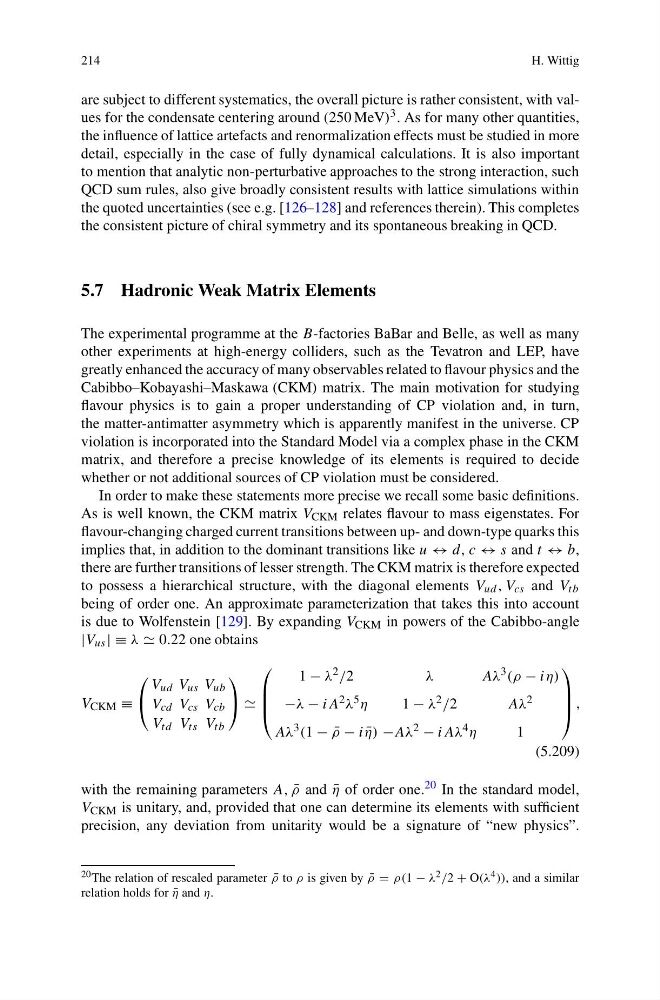
is due to Wolfenstein [129]. By expanding V CKM in powers of the Cabibbo-angle
|V us | ≡ λ 0.22 one obtains
V CKM ≡
⎛
⎝
V ud V us V ub
V cd V cs V cb
V td V ts V tb
⎞
⎠
⎛
⎜
⎜
⎝
1 − λ 2 /2
λ
A λ 3 (ρ − iη)
−λ − iA 2 λ 5 η
1 − λ 2 /2
Aλ 2
Aλ 3 (1 − ¯
ρ − i ¯
η) −Aλ 2 − iAλ 4 η
1
⎞
⎟
⎟
⎠ ,
(5.209)
with the remaining parameters A, ¯
ρ and ¯
η of order one. 20 In the standard model,
V CKM is unitary, and, provided that one can determine its elements with sufficient
precision, any deviation from unitarity would be a signature of “new physics”.
20 The relation of rescaled parameter ¯
ρ to ρ is given by ¯
ρ = ρ(1 − λ 2 /2 + O(λ 4 )), and a similar
relation holds for ¯
η and η.
H. Wittig
are subject to different systematics, the overall picture is rather consistent, with values for the condensate centering around (250 MeV) 3 . As for many other quantities,
the influence of lattice artefacts and renormalization effects must be studied in more
detail, especially in the case of fully dynamical calculations. It is also important
to mention that analytic non-perturbative approaches to the strong interaction, such
QCD sum rules, also give broadly consistent results with lattice simulations within
the quoted uncertainties (see e.g. [126–128] and references therein). This completes
the consistent picture of chiral symmetry and its spontaneous breaking in QCD.
5.7 Hadronic Weak Matrix Elements
The experimental programme at the B-factories BaBar and Belle, as well as many
other experiments at high-energy colliders, such as the Tevatron and LEP, have
greatly enhanced the accuracy of many observables related to flavour physics and the
Cabibbo–Kobayashi–Maskawa (CKM) matrix. The main motivation for studying
flavour physics is to gain a proper understanding of CP violation and, in turn,
the matter-antimatter asymmetry which is apparently manifest in the universe. CP
violation is incorporated into the Standard Model via a complex phase in the CKM
matrix, and therefore a precise knowledge of its elements is required to decide
whether or not additional sources of CP violation must be considered.
In order to make these statements more precise we recall some basic definitions.
As is well known, the CKM matrix V CKM relates flavour to mass eigenstates. For
flavour-changing charged current transitions between up- and down-type quarks this
implies that, in addition to the dominant transitions like u ↔ d, c ↔ s and t ↔ b,
there are further transitions of lesser strength. The CKM matrix is therefore expected
to possess a hierarchical structure, with the diagonal elements V ud , V cs and V tb
being of order one. An approximate parameterization that takes this into account
is due to Wolfenstein [129]. By expanding V CKM in powers of the Cabibbo-angle
|V us | ≡ λ 0.22 one obtains
V CKM ≡
⎛
⎝
V ud V us V ub
V cd V cs V cb
V td V ts V tb
⎞
⎠
⎛
⎜
⎜
⎝
1 − λ 2 /2
λ
A λ 3 (ρ − iη)
−λ − iA 2 λ 5 η
1 − λ 2 /2
Aλ 2
Aλ 3 (1 − ¯
ρ − i ¯
η) −Aλ 2 − iAλ 4 η
1
⎞
⎟
⎟
⎠ ,
(5.209)
with the remaining parameters A, ¯
ρ and ¯
η of order one. 20 In the standard model,
V CKM is unitary, and, provided that one can determine its elements with sufficient
precision, any deviation from unitarity would be a signature of “new physics”.
20 The relation of rescaled parameter ¯
ρ to ρ is given by ¯
ρ = ρ(1 − λ 2 /2 + O(λ 4 )), and a similar
relation holds for ¯
η and η.