

184
H. Wittig
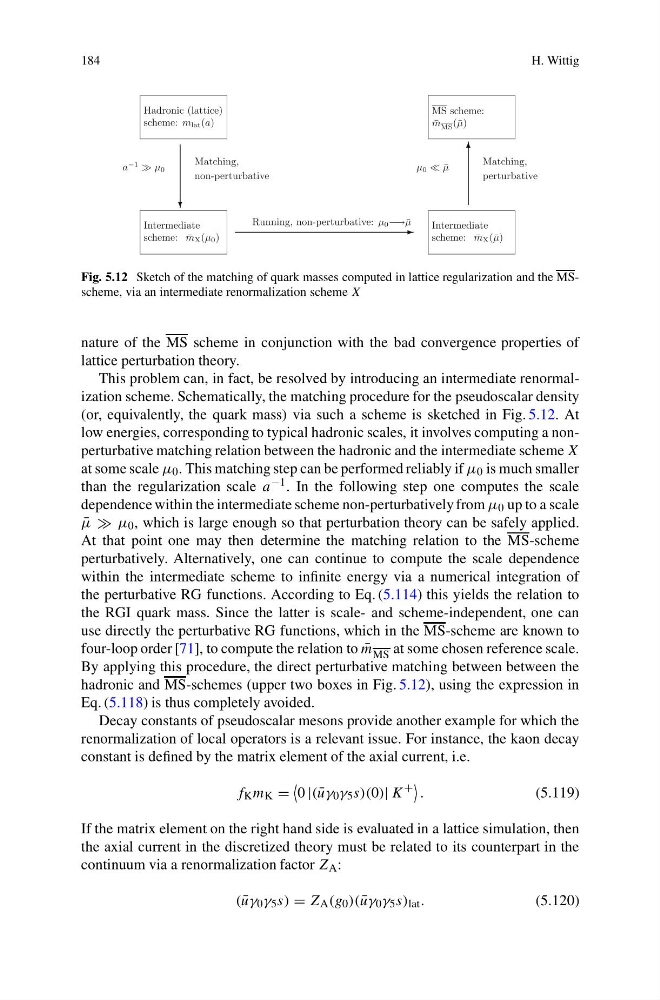
Fig. 5.12 Sketch of the matching of quark masses computed in lattice regularization and the MSscheme, via an intermediate renormalization scheme X
nature of the MS scheme in conjunction with the bad convergence properties of
lattice perturbation theory.
This problem can, in fact, be resolved by introducing an intermediate renormalization scheme. Schematically, the matching procedure for the pseudoscalar density
(or, equivalently, the quark mass) via such a scheme is sketched in Fig. 5.12. At
low energies, corresponding to typical hadronic scales, it involves computing a nonperturbative matching relation between the hadronic and the intermediate scheme X
at some scale μ 0 . This matching step can be performed reliably if μ 0 is much smaller
than the regularization scale a −1 . In the following step one computes the scale
dependence within the intermediate scheme non-perturbatively from μ 0 up to a scale
¯
μ μ 0 , which is large enough so that perturbation theory can be safely applied.
At that point one may then determine the matching relation to the MS-scheme
perturbatively. Alternatively, one can continue to compute the scale dependence
within the intermediate scheme to infinite energy via a numerical integration of
the perturbative RG functions. According to Eq. (5.114) this yields the relation to
the RGI quark mass. Since the latter is scale- and scheme-independent, one can
use directly the perturbative RG functions, which in the MS-scheme are known to
four-loop order [71], to compute the relation to ¯
m MS at some chosen reference scale.
By applying this procedure, the direct perturbative matching between between the
hadronic and MS-schemes (upper two boxes in Fig. 5.12), using the expression in
Eq. (5.118) is thus completely avoided.
Decay constants of pseudoscalar mesons provide another example for which the
renormalization of local operators is a relevant issue. For instance, the kaon decay
constant is defined by the matrix element of the axial current, i.e.
f K m K =
0 |( ¯
uγ 0 γ 5 s)(0)| K
+
.
(5.119)
If the matrix element on the right hand side is evaluated in a lattice simulation, then
the axial current in the discretized theory must be related to its counterpart in the
continuum via a renormalization factor Z A :
( ¯
uγ 0 γ 5 s) = Z A (g 0 )( ¯
uγ 0 γ 5 s) lat .
(5.120)
H. Wittig
Fig. 5.12 Sketch of the matching of quark masses computed in lattice regularization and the MSscheme, via an intermediate renormalization scheme X
nature of the MS scheme in conjunction with the bad convergence properties of
lattice perturbation theory.
This problem can, in fact, be resolved by introducing an intermediate renormalization scheme. Schematically, the matching procedure for the pseudoscalar density
(or, equivalently, the quark mass) via such a scheme is sketched in Fig. 5.12. At
low energies, corresponding to typical hadronic scales, it involves computing a nonperturbative matching relation between the hadronic and the intermediate scheme X
at some scale μ 0 . This matching step can be performed reliably if μ 0 is much smaller
than the regularization scale a −1 . In the following step one computes the scale
dependence within the intermediate scheme non-perturbatively from μ 0 up to a scale
¯
μ μ 0 , which is large enough so that perturbation theory can be safely applied.
At that point one may then determine the matching relation to the MS-scheme
perturbatively. Alternatively, one can continue to compute the scale dependence
within the intermediate scheme to infinite energy via a numerical integration of
the perturbative RG functions. According to Eq. (5.114) this yields the relation to
the RGI quark mass. Since the latter is scale- and scheme-independent, one can
use directly the perturbative RG functions, which in the MS-scheme are known to
four-loop order [71], to compute the relation to ¯
m MS at some chosen reference scale.
By applying this procedure, the direct perturbative matching between between the
hadronic and MS-schemes (upper two boxes in Fig. 5.12), using the expression in
Eq. (5.118) is thus completely avoided.
Decay constants of pseudoscalar mesons provide another example for which the
renormalization of local operators is a relevant issue. For instance, the kaon decay
constant is defined by the matrix element of the axial current, i.e.
f K m K =
0 |( ¯
uγ 0 γ 5 s)(0)| K
+
.
(5.119)
If the matrix element on the right hand side is evaluated in a lattice simulation, then
the axial current in the discretized theory must be related to its counterpart in the
continuum via a renormalization factor Z A :
( ¯
uγ 0 γ 5 s) = Z A (g 0 )( ¯
uγ 0 γ 5 s) lat .
(5.120)