

5 QCD on the Lattice
183
5.5.1 Non-perturbative Renormalization
To illustrate the problem of matching hadronic and perturbative schemes like MS,
it is instructive to discuss the determination of the light quark masses. A convenient
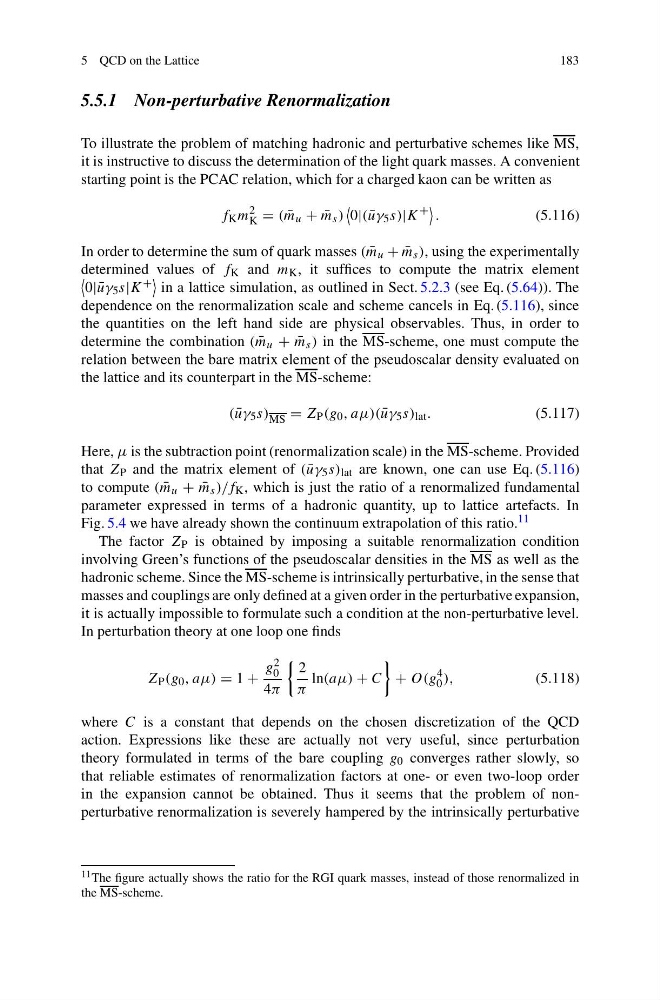
starting point is the PCAC relation, which for a charged kaon can be written as
f K m
2
K = ( ¯
m u + ¯
m s )
0|( ¯
uγ 5 s)|K
+
.
(5.116)
In order to determine the sum of quark masses ( ¯
m u + ¯
m s ), using the experimentally
determined values of f K and m K , it suffices to compute the matrix element
0| ¯
uγ 5 s|K +
in a lattice simulation, as outlined in Sect. 5.2.3 (see Eq. (5.64)). The
dependence on the renormalization scale and scheme cancels in Eq. (5.116), since
the quantities on the left hand side are physical observables. Thus, in order to
determine the combination ( ¯
m u + ¯
m s ) in the MS-scheme, one must compute the
relation between the bare matrix element of the pseudoscalar density evaluated on
the lattice and its counterpart in the MS-scheme:
( ¯
uγ 5 s) MS = Z P (g 0 , aμ)( ¯
uγ 5 s) lat .
(5.117)
Here, μ is the subtraction point (renormalization scale) in the MS-scheme. Provided
that Z P and the matrix element of ( ¯
uγ 5 s) lat are known, one can use Eq. (5.116)
to compute ( ¯
m u + ¯
m s )/f K , which is just the ratio of a renormalized fundamental
parameter expressed in terms of a hadronic quantity, up to lattice artefacts. In
Fig. 5.4 we have already shown the continuum extrapolation of this ratio. 11
The factor Z P is obtained by imposing a suitable renormalization condition
involving Green’s functions of the pseudoscalar densities in the MS as well as the
hadronic scheme. Since the MS-scheme is intrinsically perturbative, in the sense that
masses and couplings are only defined at a given order in the perturbative expansion,
it is actually impossible to formulate such a condition at the non-perturbative level.
In perturbation theory at one loop one finds
Z P (g 0 , aμ) = 1 +
g 2
0
4π
2
π
ln(aμ) + C
+ O(g
4
0 ),
(5.118)
where C is a constant that depends on the chosen discretization of the QCD
action. Expressions like these are actually not very useful, since perturbation
theory formulated in terms of the bare coupling g 0 converges rather slowly, so
that reliable estimates of renormalization factors at one- or even two-loop order
in the expansion cannot be obtained. Thus it seems that the problem of nonperturbative renormalization is severely hampered by the intrinsically perturbative
11 The figure actually shows the ratio for the RGI quark masses, instead of those renormalized in
the MS-scheme.
183
5.5.1 Non-perturbative Renormalization
To illustrate the problem of matching hadronic and perturbative schemes like MS,
it is instructive to discuss the determination of the light quark masses. A convenient
starting point is the PCAC relation, which for a charged kaon can be written as
f K m
2
K = ( ¯
m u + ¯
m s )
0|( ¯
uγ 5 s)|K
+
.
(5.116)
In order to determine the sum of quark masses ( ¯
m u + ¯
m s ), using the experimentally
determined values of f K and m K , it suffices to compute the matrix element
0| ¯
uγ 5 s|K +
in a lattice simulation, as outlined in Sect. 5.2.3 (see Eq. (5.64)). The
dependence on the renormalization scale and scheme cancels in Eq. (5.116), since
the quantities on the left hand side are physical observables. Thus, in order to
determine the combination ( ¯
m u + ¯
m s ) in the MS-scheme, one must compute the
relation between the bare matrix element of the pseudoscalar density evaluated on
the lattice and its counterpart in the MS-scheme:
( ¯
uγ 5 s) MS = Z P (g 0 , aμ)( ¯
uγ 5 s) lat .
(5.117)
Here, μ is the subtraction point (renormalization scale) in the MS-scheme. Provided
that Z P and the matrix element of ( ¯
uγ 5 s) lat are known, one can use Eq. (5.116)
to compute ( ¯
m u + ¯
m s )/f K , which is just the ratio of a renormalized fundamental
parameter expressed in terms of a hadronic quantity, up to lattice artefacts. In
Fig. 5.4 we have already shown the continuum extrapolation of this ratio. 11
The factor Z P is obtained by imposing a suitable renormalization condition
involving Green’s functions of the pseudoscalar densities in the MS as well as the
hadronic scheme. Since the MS-scheme is intrinsically perturbative, in the sense that
masses and couplings are only defined at a given order in the perturbative expansion,
it is actually impossible to formulate such a condition at the non-perturbative level.
In perturbation theory at one loop one finds
Z P (g 0 , aμ) = 1 +
g 2
0
4π
2
π
ln(aμ) + C
+ O(g
4
0 ),
(5.118)
where C is a constant that depends on the chosen discretization of the QCD
action. Expressions like these are actually not very useful, since perturbation
theory formulated in terms of the bare coupling g 0 converges rather slowly, so
that reliable estimates of renormalization factors at one- or even two-loop order
in the expansion cannot be obtained. Thus it seems that the problem of nonperturbative renormalization is severely hampered by the intrinsically perturbative
11 The figure actually shows the ratio for the RGI quark masses, instead of those renormalized in
the MS-scheme.