

172
H. Wittig
splittings, such as m K ∗ − m K , are underestimated by 10–15% (4–6σ ), depending on
whether m K or m φ was used to fix the strange quark mass.
The findings reported by CP-PACS, which were based on unimproved Wilson
fermions, have been broadly confirmed by other collaborations employing different lattice actions [48–51]. Thereby, the universality of the continuum limit of
quenched QCD has been established: although different discretizations may yield
statistically inconsistent results at non-zero lattice spacing, they converge to a
common continuum limit, provided that the same hadronic renormalization scheme
has been employed. The latter requirement is important, as there is considerable
freedom in choosing a particular scheme. This leads to ambiguities in the quenched
approximation, since different quantities are affected in different way by quark
loops. In Ref. [51] it was found that, by using only stable or narrow states to define
the hadronic renormalization scheme, the discrepancies between the quenched and
experimental spectra could be shifted to the broad resonances, ρ, , N ∗ , while the
agreement for states like K, φ, N, , could be improved. Yet this observation does
not alter the conclusion that the quenched approximation is unable to reproduce the
spectrum of light hadrons with an accuracy better than 10%.
The obvious question is whether sea quark effects can account for the observed
deviation between the quenched and experimental spectra. Owing to the larger
numerical effort required to simulate QCD with dynamical quarks, unquenched
studies have not yet reached the same level of control over systematic effects—
notably lattice artefacts and chiral extrapolations—compared with the quenched
benchmark [47]. Thus, a “definitive” unquenched calculation of the light hadron
spectrum is still lacking, and thus we refrain from presenting an overview of recent
results.
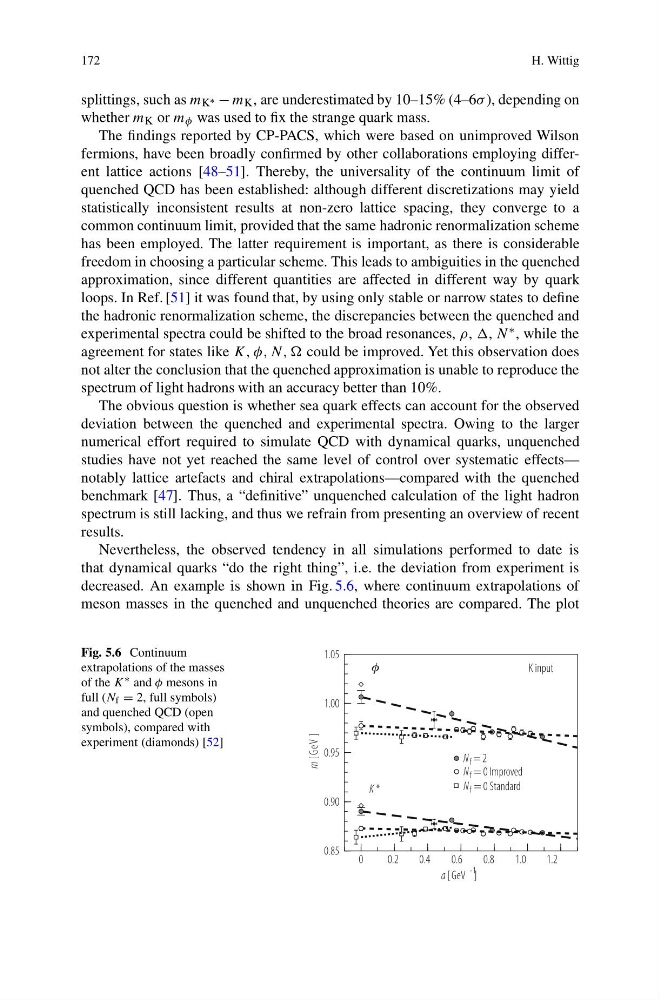
Nevertheless, the observed tendency in all simulations performed to date is
that dynamical quarks “do the right thing”, i.e. the deviation from experiment is
decreased. An example is shown in Fig. 5.6, where continuum extrapolations of
meson masses in the quenched and unquenched theories are compared. The plot
Fig. 5.6 Continuum
extrapolations of the masses
of the K ∗ and φ mesons in
full (N f = 2, full symbols)
and quenched QCD (open
symbols), compared with
experiment (diamonds) [52]
a [ GeV ]
-1
m ]
V
e
G
[
N f = 2
N f = 0 Improved
N f = 0 Standard
K input
1.05
1.00
0.95
0.90
0.85
0
0.2
0.4
0.6
0.8
1.0
1.2
K *
H. Wittig
splittings, such as m K ∗ − m K , are underestimated by 10–15% (4–6σ ), depending on
whether m K or m φ was used to fix the strange quark mass.
The findings reported by CP-PACS, which were based on unimproved Wilson
fermions, have been broadly confirmed by other collaborations employing different lattice actions [48–51]. Thereby, the universality of the continuum limit of
quenched QCD has been established: although different discretizations may yield
statistically inconsistent results at non-zero lattice spacing, they converge to a
common continuum limit, provided that the same hadronic renormalization scheme
has been employed. The latter requirement is important, as there is considerable
freedom in choosing a particular scheme. This leads to ambiguities in the quenched
approximation, since different quantities are affected in different way by quark
loops. In Ref. [51] it was found that, by using only stable or narrow states to define
the hadronic renormalization scheme, the discrepancies between the quenched and
experimental spectra could be shifted to the broad resonances, ρ, , N ∗ , while the
agreement for states like K, φ, N, , could be improved. Yet this observation does
not alter the conclusion that the quenched approximation is unable to reproduce the
spectrum of light hadrons with an accuracy better than 10%.
The obvious question is whether sea quark effects can account for the observed
deviation between the quenched and experimental spectra. Owing to the larger
numerical effort required to simulate QCD with dynamical quarks, unquenched
studies have not yet reached the same level of control over systematic effects—
notably lattice artefacts and chiral extrapolations—compared with the quenched
benchmark [47]. Thus, a “definitive” unquenched calculation of the light hadron
spectrum is still lacking, and thus we refrain from presenting an overview of recent
results.
Nevertheless, the observed tendency in all simulations performed to date is
that dynamical quarks “do the right thing”, i.e. the deviation from experiment is
decreased. An example is shown in Fig. 5.6, where continuum extrapolations of
meson masses in the quenched and unquenched theories are compared. The plot
Fig. 5.6 Continuum
extrapolations of the masses
of the K ∗ and φ mesons in
full (N f = 2, full symbols)
and quenched QCD (open
symbols), compared with
experiment (diamonds) [52]
a [ GeV ]
-1
m ]
V
e
G
[
N f = 2
N f = 0 Improved
N f = 0 Standard
K input
1.05
1.00
0.95
0.90
0.85
0
0.2
0.4
0.6
0.8
1.0
1.2
K *