

5 QCD on the Lattice
171
The quenched approximation has been widely used to compute a number of
quantities that are of great phenomenological interest. However, these results
are of limited value, since the inherent quenching error is left undetermined. A
precise calculation of the masses of the lowest lying hadrons in quenched QCD
will expose the typical magnitude of the systematic error incurred by neglecting
dynamical quark effects. To this end, several calculations of the quenched light
hadron spectrum, using different lattice actions, have been performed [46–51].
In Ref. [47], the CP-PACS Collaboration presented a comprehensive study of
the masses of the lowest pseudoscalar and vector mesons, as well as octet and
decuplet baryons. The Wilson fermion action without O(a) improvement was
used at four different values of the lattice spacing, and a continuum extrapolation
linear in a has been performed for all quantities. CP-PACS adopted a hadronic
renormalization scheme in which the lattice scale was fixed using the mass of
the ρ-meson. The average up and down quark mass was set using m π . In order
to fix m s , either the kaon mass (“K”-input) or the mass of the φ-meson (“φ”input) was used. Chiral extrapolations were either based on the form expected from
quenched Chiral Perturbation Theory at NLO (see Eq. (5.82)), or on the leadingorder formula supplemented by a quadratic term in the quark mass. The resulting
(small) differences in the extrapolated values were added as systematic errors in the
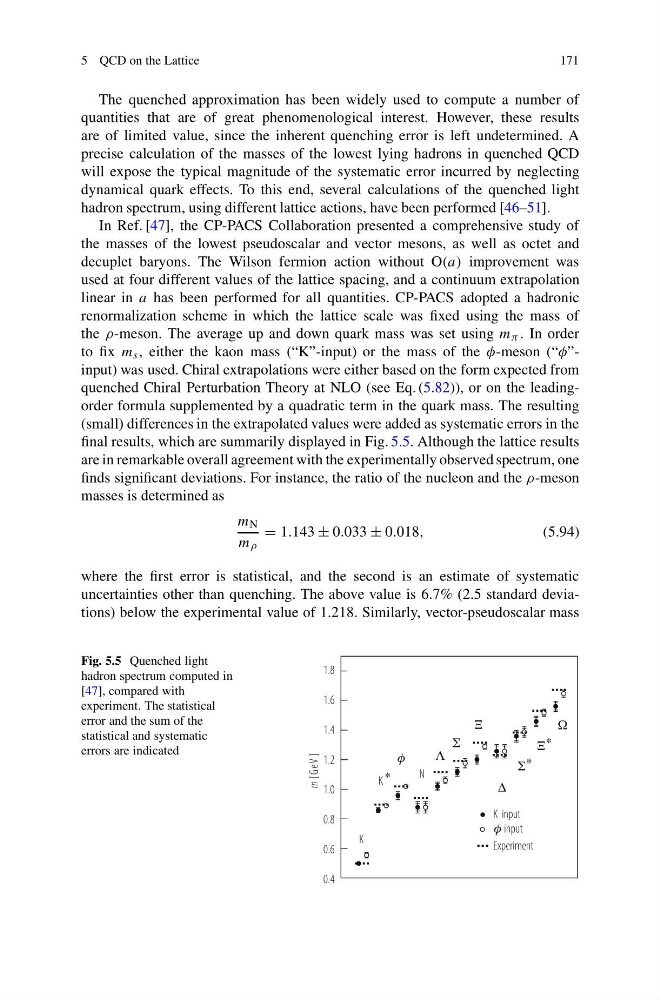
final results, which are summarily displayed in Fig. 5.5. Although the lattice results
are in remarkable overall agreement with the experimentally observed spectrum, one
finds significant deviations. For instance, the ratio of the nucleon and the ρ-meson
masses is determined as
m N
m ρ
= 1.143 ± 0.033 ± 0.018,
(5.94)
where the first error is statistical, and the second is an estimate of systematic
uncertainties other than quenching. The above value is 6.7% (2.5 standard deviations) below the experimental value of 1.218. Similarly, vector-pseudoscalar mass
Fig. 5.5 Quenched light
hadron spectrum computed in
[47], compared with
experiment. The statistical
error and the sum of the
statistical and systematic
errors are indicated
m ]
V
e
G
[
K input
input
Experiment
1.8
1.6
1.4
1.2
1.0
0.8
0.6
0.4
K
K
N
171
The quenched approximation has been widely used to compute a number of
quantities that are of great phenomenological interest. However, these results
are of limited value, since the inherent quenching error is left undetermined. A
precise calculation of the masses of the lowest lying hadrons in quenched QCD
will expose the typical magnitude of the systematic error incurred by neglecting
dynamical quark effects. To this end, several calculations of the quenched light
hadron spectrum, using different lattice actions, have been performed [46–51].
In Ref. [47], the CP-PACS Collaboration presented a comprehensive study of
the masses of the lowest pseudoscalar and vector mesons, as well as octet and
decuplet baryons. The Wilson fermion action without O(a) improvement was
used at four different values of the lattice spacing, and a continuum extrapolation
linear in a has been performed for all quantities. CP-PACS adopted a hadronic
renormalization scheme in which the lattice scale was fixed using the mass of
the ρ-meson. The average up and down quark mass was set using m π . In order
to fix m s , either the kaon mass (“K”-input) or the mass of the φ-meson (“φ”input) was used. Chiral extrapolations were either based on the form expected from
quenched Chiral Perturbation Theory at NLO (see Eq. (5.82)), or on the leadingorder formula supplemented by a quadratic term in the quark mass. The resulting
(small) differences in the extrapolated values were added as systematic errors in the
final results, which are summarily displayed in Fig. 5.5. Although the lattice results
are in remarkable overall agreement with the experimentally observed spectrum, one
finds significant deviations. For instance, the ratio of the nucleon and the ρ-meson
masses is determined as
m N
m ρ
= 1.143 ± 0.033 ± 0.018,
(5.94)
where the first error is statistical, and the second is an estimate of systematic
uncertainties other than quenching. The above value is 6.7% (2.5 standard deviations) below the experimental value of 1.218. Similarly, vector-pseudoscalar mass
Fig. 5.5 Quenched light
hadron spectrum computed in
[47], compared with
experiment. The statistical
error and the sum of the
statistical and systematic
errors are indicated
m ]
V
e
G
[
K input
input
Experiment
1.8
1.6
1.4
1.2
1.0
0.8
0.6
0.4
K
K
N