

152
H. Wittig
However, in a real lattice simulation of domain wall fermions, one has to work
with a finite value of N 5 , so that the decoupling of chiral modes is not exact.
One expects, though, an exponential suppression of the remnant chiral symmetry
breaking effects, and this has been confirmed in several simulations. Furthermore,
the rate of suppression may be accelerated by optimizing the choice of lattice action
for the gauge fields. Hence, the domain wall formulation of QCD offers a method
to realize almost exact chiral symmetry at non-zero lattice spacing at the expense of
simulating a five-dimensional theory.
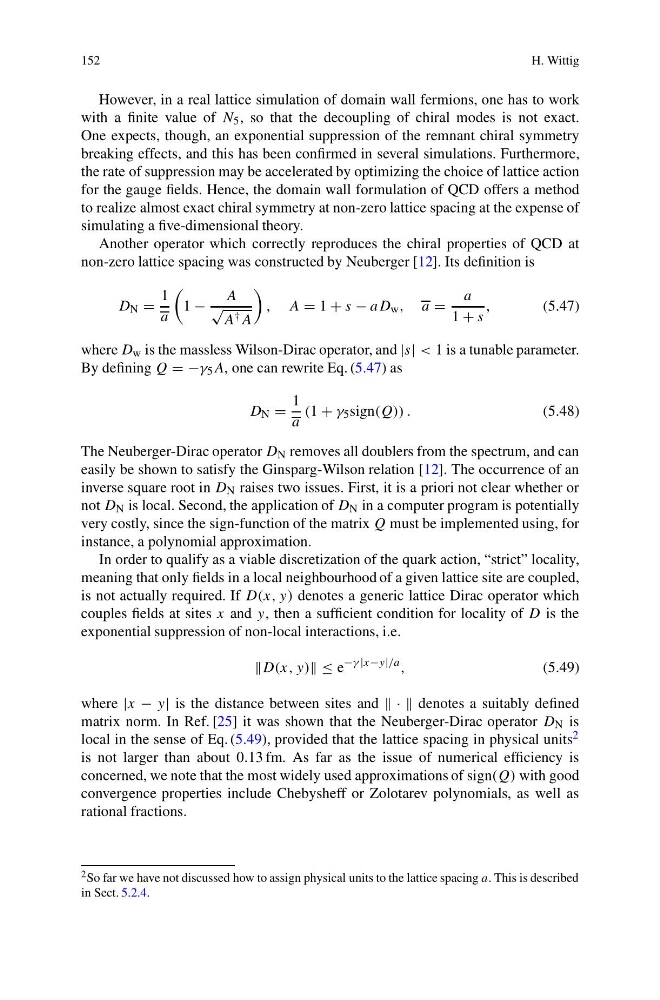
Another operator which correctly reproduces the chiral properties of QCD at
non-zero lattice spacing was constructed by Neuberger [12]. Its definition is
D N =
1
a
1 −
A
√
A † A
, A = 1 + s − aD w , a =
a
1 + s
,
(5.47)
where D w is the massless Wilson-Dirac operator, and |s| < 1 is a tunable parameter.
By defining Q = −γ 5 A, one can rewrite Eq. (5.47) as
D N =
1
a
(1 + γ 5 sign(Q)) .
(5.48)
The Neuberger-Dirac operator D N removes all doublers from the spectrum, and can
easily be shown to satisfy the Ginsparg-Wilson relation [12]. The occurrence of an
inverse square root in D N raises two issues. First, it is a priori not clear whether or
not D N is local. Second, the application of D N in a computer program is potentially
very costly, since the sign-function of the matrix Q must be implemented using, for
instance, a polynomial approximation.
In order to qualify as a viable discretization of the quark action, “strict” locality,
meaning that only fields in a local neighbourhood of a given lattice site are coupled,
is not actually required. If D(x, y) denotes a generic lattice Dirac operator which
couples fields at sites x and y, then a sufficient condition for locality of D is the
exponential suppression of non-local interactions, i.e.
D(x, y) ≤ e
−γ |x−y|/a ,
(5.49)
where |x − y| is the distance between sites and · · denotes a suitably defined
matrix norm. In Ref. [25] it was shown that the Neuberger-Dirac operator D N is
local in the sense of Eq. (5.49), provided that the lattice spacing in physical units 2
is not larger than about 0.13 fm. As far as the issue of numerical efficiency is
concerned, we note that the most widely used approximations of sign(Q) with good
convergence properties include Chebysheff or Zolotarev polynomials, as well as
rational fractions.
2 So far we have not discussed how to assign physical units to the lattice spacing a. This is described
in Sect. 5.2.4.
H. Wittig
However, in a real lattice simulation of domain wall fermions, one has to work
with a finite value of N 5 , so that the decoupling of chiral modes is not exact.
One expects, though, an exponential suppression of the remnant chiral symmetry
breaking effects, and this has been confirmed in several simulations. Furthermore,
the rate of suppression may be accelerated by optimizing the choice of lattice action
for the gauge fields. Hence, the domain wall formulation of QCD offers a method
to realize almost exact chiral symmetry at non-zero lattice spacing at the expense of
simulating a five-dimensional theory.
Another operator which correctly reproduces the chiral properties of QCD at
non-zero lattice spacing was constructed by Neuberger [12]. Its definition is
D N =
1
a
1 −
A
√
A † A
, A = 1 + s − aD w , a =
a
1 + s
,
(5.47)
where D w is the massless Wilson-Dirac operator, and |s| < 1 is a tunable parameter.
By defining Q = −γ 5 A, one can rewrite Eq. (5.47) as
D N =
1
a
(1 + γ 5 sign(Q)) .
(5.48)
The Neuberger-Dirac operator D N removes all doublers from the spectrum, and can
easily be shown to satisfy the Ginsparg-Wilson relation [12]. The occurrence of an
inverse square root in D N raises two issues. First, it is a priori not clear whether or
not D N is local. Second, the application of D N in a computer program is potentially
very costly, since the sign-function of the matrix Q must be implemented using, for
instance, a polynomial approximation.
In order to qualify as a viable discretization of the quark action, “strict” locality,
meaning that only fields in a local neighbourhood of a given lattice site are coupled,
is not actually required. If D(x, y) denotes a generic lattice Dirac operator which
couples fields at sites x and y, then a sufficient condition for locality of D is the
exponential suppression of non-local interactions, i.e.
D(x, y) ≤ e
−γ |x−y|/a ,
(5.49)
where |x − y| is the distance between sites and · · denotes a suitably defined
matrix norm. In Ref. [25] it was shown that the Neuberger-Dirac operator D N is
local in the sense of Eq. (5.49), provided that the lattice spacing in physical units 2
is not larger than about 0.13 fm. As far as the issue of numerical efficiency is
concerned, we note that the most widely used approximations of sign(Q) with good
convergence properties include Chebysheff or Zolotarev polynomials, as well as
rational fractions.
2 So far we have not discussed how to assign physical units to the lattice spacing a. This is described
in Sect. 5.2.4.