

5 QCD on the Lattice
151
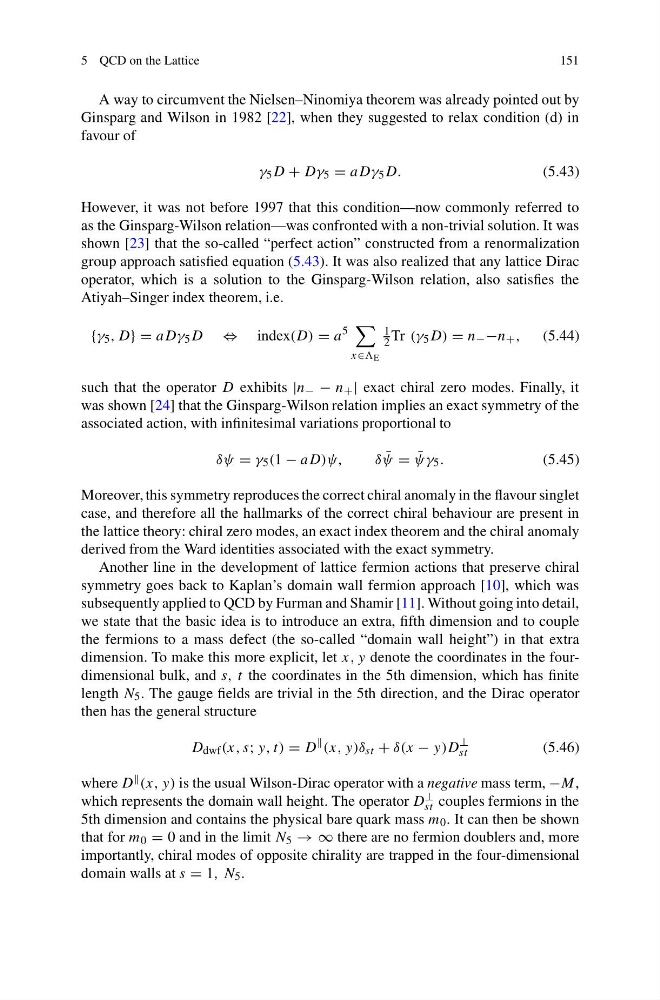
A way to circumvent the Nielsen–Ninomiya theorem was already pointed out by
Ginsparg and Wilson in 1982 [22], when they suggested to relax condition (d) in
favour of
γ 5 D + Dγ 5 = aDγ 5 D.
(5.43)
However, it was not before 1997 that this condition—now commonly referred to
as the Ginsparg-Wilson relation—was confronted with a non-trivial solution. It was
shown [23] that the so-called “perfect action” constructed from a renormalization
group approach satisfied equation (5.43). It was also realized that any lattice Dirac
operator, which is a solution to the Ginsparg-Wilson relation, also satisfies the
Atiyah–Singer index theorem, i.e.
{γ 5 , D} = aDγ 5 D ⇔ index(D) = a
5
x∈ E
1
2 Tr (γ 5 D) = n − −n + , (5.44)
such that the operator D exhibits |n − − n + | exact chiral zero modes. Finally, it
was shown [24] that the Ginsparg-Wilson relation implies an exact symmetry of the
associated action, with infinitesimal variations proportional to
δψ = γ 5 (1 − aD)ψ,
δ ¯
ψ = ¯
ψγ 5 .
(5.45)
Moreover, this symmetry reproduces the correct chiral anomaly in the flavour singlet
case, and therefore all the hallmarks of the correct chiral behaviour are present in
the lattice theory: chiral zero modes, an exact index theorem and the chiral anomaly
derived from the Ward identities associated with the exact symmetry.
Another line in the development of lattice fermion actions that preserve chiral
symmetry goes back to Kaplan’s domain wall fermion approach [10], which was
subsequently applied to QCD by Furman and Shamir [11]. Without going into detail,
we state that the basic idea is to introduce an extra, fifth dimension and to couple
the fermions to a mass defect (the so-called “domain wall height”) in that extra
dimension. To make this more explicit, let x, y denote the coordinates in the fourdimensional bulk, and s, t the coordinates in the 5th dimension, which has finite
length N 5 . The gauge fields are trivial in the 5th direction, and the Dirac operator
then has the general structure
D dwf (x, s; y, t) = D
(x, y)δ st + δ(x − y)D
⊥
st
(5.46)
where D (x, y) is the usual Wilson-Dirac operator with a negative mass term, −M,
which represents the domain wall height. The operator D ⊥
st couples fermions in the
5th dimension and contains the physical bare quark mass m 0 . It can then be shown
that for m 0 = 0 and in the limit N 5 → ∞ there are no fermion doublers and, more
importantly, chiral modes of opposite chirality are trapped in the four-dimensional
domain walls at s = 1, N 5 .
151
A way to circumvent the Nielsen–Ninomiya theorem was already pointed out by
Ginsparg and Wilson in 1982 [22], when they suggested to relax condition (d) in
favour of
γ 5 D + Dγ 5 = aDγ 5 D.
(5.43)
However, it was not before 1997 that this condition—now commonly referred to
as the Ginsparg-Wilson relation—was confronted with a non-trivial solution. It was
shown [23] that the so-called “perfect action” constructed from a renormalization
group approach satisfied equation (5.43). It was also realized that any lattice Dirac
operator, which is a solution to the Ginsparg-Wilson relation, also satisfies the
Atiyah–Singer index theorem, i.e.
{γ 5 , D} = aDγ 5 D ⇔ index(D) = a
5
x∈ E
1
2 Tr (γ 5 D) = n − −n + , (5.44)
such that the operator D exhibits |n − − n + | exact chiral zero modes. Finally, it
was shown [24] that the Ginsparg-Wilson relation implies an exact symmetry of the
associated action, with infinitesimal variations proportional to
δψ = γ 5 (1 − aD)ψ,
δ ¯
ψ = ¯
ψγ 5 .
(5.45)
Moreover, this symmetry reproduces the correct chiral anomaly in the flavour singlet
case, and therefore all the hallmarks of the correct chiral behaviour are present in
the lattice theory: chiral zero modes, an exact index theorem and the chiral anomaly
derived from the Ward identities associated with the exact symmetry.
Another line in the development of lattice fermion actions that preserve chiral
symmetry goes back to Kaplan’s domain wall fermion approach [10], which was
subsequently applied to QCD by Furman and Shamir [11]. Without going into detail,
we state that the basic idea is to introduce an extra, fifth dimension and to couple
the fermions to a mass defect (the so-called “domain wall height”) in that extra
dimension. To make this more explicit, let x, y denote the coordinates in the fourdimensional bulk, and s, t the coordinates in the 5th dimension, which has finite
length N 5 . The gauge fields are trivial in the 5th direction, and the Dirac operator
then has the general structure
D dwf (x, s; y, t) = D
(x, y)δ st + δ(x − y)D
⊥
st
(5.46)
where D (x, y) is the usual Wilson-Dirac operator with a negative mass term, −M,
which represents the domain wall height. The operator D ⊥
st couples fermions in the
5th dimension and contains the physical bare quark mass m 0 . It can then be shown
that for m 0 = 0 and in the limit N 5 → ∞ there are no fermion doublers and, more
importantly, chiral modes of opposite chirality are trapped in the four-dimensional
domain walls at s = 1, N 5 .