

142
H. Wittig
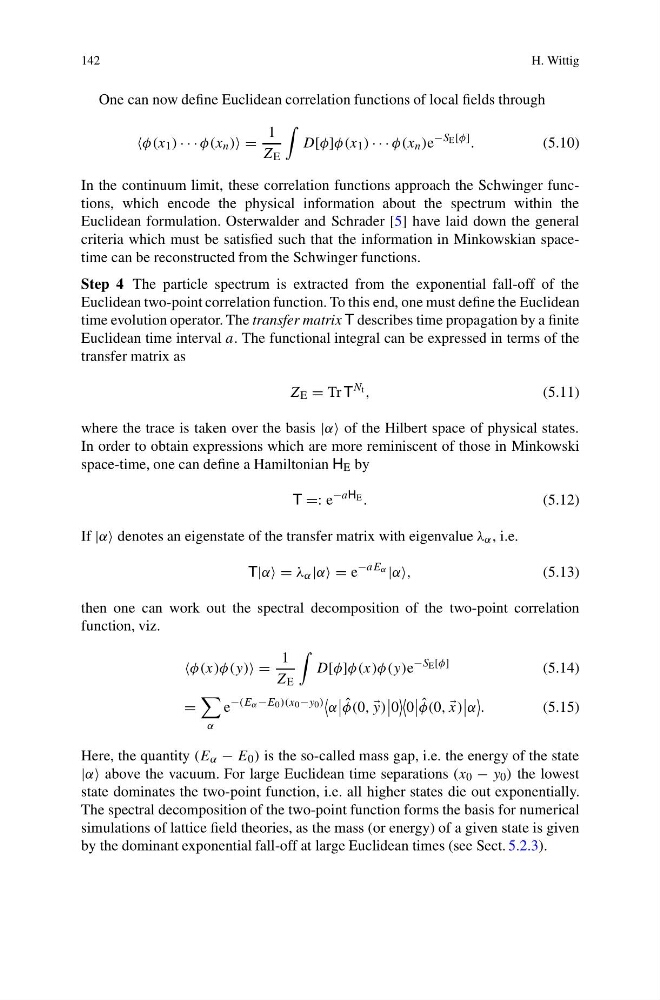
One can now define Euclidean correlation functions of local fields through
φ(x 1 ) · · · φ(x n ) =
1
Z E
D[φ]φ(x 1 ) · · · φ(x n )e
−S E [φ] .
(5.10)
In the continuum limit, these correlation functions approach the Schwinger functions, which encode the physical information about the spectrum within the
Euclidean formulation. Osterwalder and Schrader [5] have laid down the general
criteria which must be satisfied such that the information in Minkowskian spacetime can be reconstructed from the Schwinger functions.
Step 4 The particle spectrum is extracted from the exponential fall-off of the
Euclidean two-point correlation function. To this end, one must define the Euclidean
time evolution operator. The transfer matrix T describes time propagation by a finite
Euclidean time interval a. The functional integral can be expressed in terms of the
transfer matrix as
Z E = Tr T
N t ,
(5.11)
where the trace is taken over the basis |α of the Hilbert space of physical states.
In order to obtain expressions which are more reminiscent of those in Minkowski
space-time, one can define a Hamiltonian H E by
T =: e
−aH E .
(5.12)
If |α denotes an eigenstate of the transfer matrix with eigenvalue λ α , i.e.
T|α = λ α |α = e
−aE α |α
(5.13)
then one can work out the spectral decomposition of the two-point correlation
function, viz.
φ(x)φ(y) =
1
Z E
D[φ]φ(x)φ(y)e
−S E [φ]
(5.14)
=
α
e
−(E α −E 0 )(x 0 −y 0 )
α
ˆ
φ(0,
y)
0
0
ˆ
φ(0,
x)
α
.
(5.15)
Here, the quantity (E α − E 0 ) is the so-called mass gap, i.e. the energy of the state
|α above the vacuum. For large Euclidean time separations (x 0 − y 0 ) the lowest
state dominates the two-point function, i.e. all higher states die out exponentially.
The spectral decomposition of the two-point function forms the basis for numerical
simulations of lattice field theories, as the mass (or energy) of a given state is given
by the dominant exponential fall-off at large Euclidean times (see Sect. 5.2.3).
H. Wittig
One can now define Euclidean correlation functions of local fields through
φ(x 1 ) · · · φ(x n ) =
1
Z E
D[φ]φ(x 1 ) · · · φ(x n )e
−S E [φ] .
(5.10)
In the continuum limit, these correlation functions approach the Schwinger functions, which encode the physical information about the spectrum within the
Euclidean formulation. Osterwalder and Schrader [5] have laid down the general
criteria which must be satisfied such that the information in Minkowskian spacetime can be reconstructed from the Schwinger functions.
Step 4 The particle spectrum is extracted from the exponential fall-off of the
Euclidean two-point correlation function. To this end, one must define the Euclidean
time evolution operator. The transfer matrix T describes time propagation by a finite
Euclidean time interval a. The functional integral can be expressed in terms of the
transfer matrix as
Z E = Tr T
N t ,
(5.11)
where the trace is taken over the basis |α of the Hilbert space of physical states.
In order to obtain expressions which are more reminiscent of those in Minkowski
space-time, one can define a Hamiltonian H E by
T =: e
−aH E .
(5.12)
If |α denotes an eigenstate of the transfer matrix with eigenvalue λ α , i.e.
T|α = λ α |α = e
−aE α |α
(5.13)
then one can work out the spectral decomposition of the two-point correlation
function, viz.
φ(x)φ(y) =
1
Z E
D[φ]φ(x)φ(y)e
−S E [φ]
(5.14)
=
α
e
−(E α −E 0 )(x 0 −y 0 )
α
ˆ
φ(0,
y)
0
0
ˆ
φ(0,
x)
α
.
(5.15)
Here, the quantity (E α − E 0 ) is the so-called mass gap, i.e. the energy of the state
|α above the vacuum. For large Euclidean time separations (x 0 − y 0 ) the lowest
state dominates the two-point function, i.e. all higher states die out exponentially.
The spectral decomposition of the two-point function forms the basis for numerical
simulations of lattice field theories, as the mass (or energy) of a given state is given
by the dominant exponential fall-off at large Euclidean times (see Sect. 5.2.3).