

5 QCD on the Lattice
141
Thus, any space-time point is an integer multiple of the lattice spacing a. The total
number of lattice sites is N t × N 3
s , while the physical space-time volume is T × L 3 .
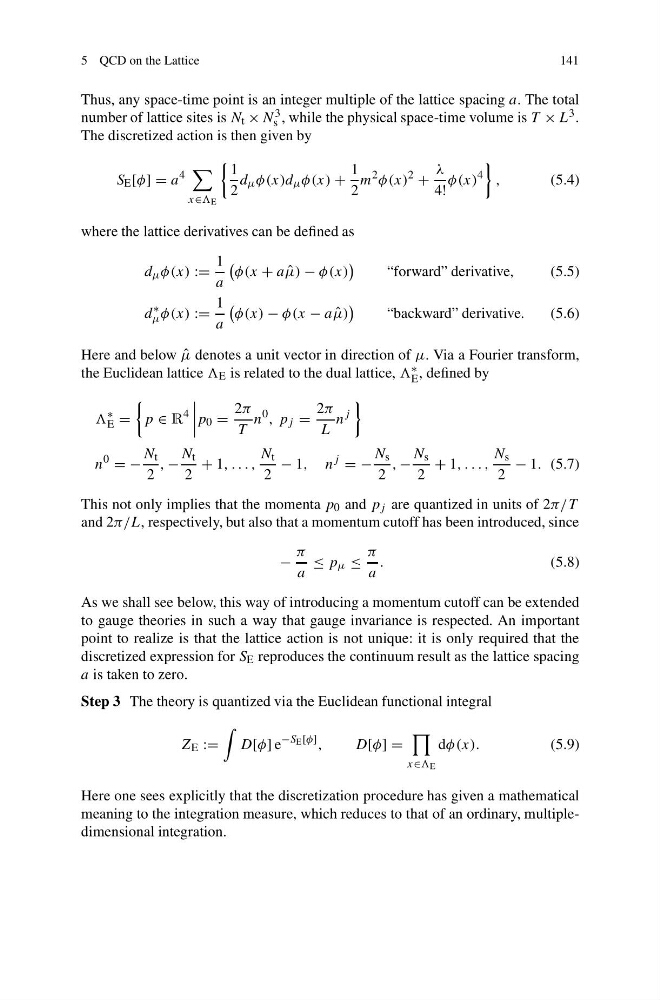
The discretized action is then given by
S E [φ] = a
4
x∈ E
1
2
d μ φ(x)d μ φ(x) +
1
2
m
2 φ(x)
2
+
λ
4!
φ(x)
4
,
(5.4)
where the lattice derivatives can be defined as
d μ φ(x) :=
1
a
φ(x + a ˆ
μ) − φ(x)
“forward” derivative,
(5.5)
d
∗
μ φ(x) :=
1
a
φ(x) − φ(x − a ˆ
μ)
“backward” derivative.
(5.6)
Here and below ˆ
μ denotes a unit vector in direction of μ. Via a Fourier transform,
the Euclidean lattice E is related to the dual lattice, ∗
E , defined by
∗
E =
p ∈ R
4
p 0 =
2π
T
n
0 , p j =
2π
L
n
j
n
0
= −
N t
2
, −
N t
2
+ 1, . . . ,
N t
2
− 1, n
j
= −
N s
2
, −
N s
2
+ 1, . . . ,
N s
2
− 1. (5.7)
This not only implies that the momenta p 0 and p j are quantized in units of 2π/T
and 2π/L, respectively, but also that a momentum cutoff has been introduced, since
−
π
a
≤ p μ ≤
π
a
.
(5.8)
As we shall see below, this way of introducing a momentum cutoff can be extended
to gauge theories in such a way that gauge invariance is respected. An important
point to realize is that the lattice action is not unique: it is only required that the
discretized expression for S E reproduces the continuum result as the lattice spacing
a is taken to zero.
Step 3 The theory is quantized via the Euclidean functional integral
Z E :=
D[φ] e
−S E [φ] ,
D[φ] =
x∈ E
dφ(x).
(5.9)
Here one sees explicitly that the discretization procedure has given a mathematical
meaning to the integration measure, which reduces to that of an ordinary, multipledimensional integration.
141
Thus, any space-time point is an integer multiple of the lattice spacing a. The total
number of lattice sites is N t × N 3
s , while the physical space-time volume is T × L 3 .
The discretized action is then given by
S E [φ] = a
4
x∈ E
1
2
d μ φ(x)d μ φ(x) +
1
2
m
2 φ(x)
2
+
λ
4!
φ(x)
4
,
(5.4)
where the lattice derivatives can be defined as
d μ φ(x) :=
1
a
φ(x + a ˆ
μ) − φ(x)
“forward” derivative,
(5.5)
d
∗
μ φ(x) :=
1
a
φ(x) − φ(x − a ˆ
μ)
“backward” derivative.
(5.6)
Here and below ˆ
μ denotes a unit vector in direction of μ. Via a Fourier transform,
the Euclidean lattice E is related to the dual lattice, ∗
E , defined by
∗
E =
p ∈ R
4
p 0 =
2π
T
n
0 , p j =
2π
L
n
j
n
0
= −
N t
2
, −
N t
2
+ 1, . . . ,
N t
2
− 1, n
j
= −
N s
2
, −
N s
2
+ 1, . . . ,
N s
2
− 1. (5.7)
This not only implies that the momenta p 0 and p j are quantized in units of 2π/T
and 2π/L, respectively, but also that a momentum cutoff has been introduced, since
−
π
a
≤ p μ ≤
π
a
.
(5.8)
As we shall see below, this way of introducing a momentum cutoff can be extended
to gauge theories in such a way that gauge invariance is respected. An important
point to realize is that the lattice action is not unique: it is only required that the
discretized expression for S E reproduces the continuum result as the lattice spacing
a is taken to zero.
Step 3 The theory is quantized via the Euclidean functional integral
Z E :=
D[φ] e
−S E [φ] ,
D[φ] =
x∈ E
dφ(x).
(5.9)
Here one sees explicitly that the discretization procedure has given a mathematical
meaning to the integration measure, which reduces to that of an ordinary, multipledimensional integration.