

4 QCD: The Theory of Strong Interactions
123
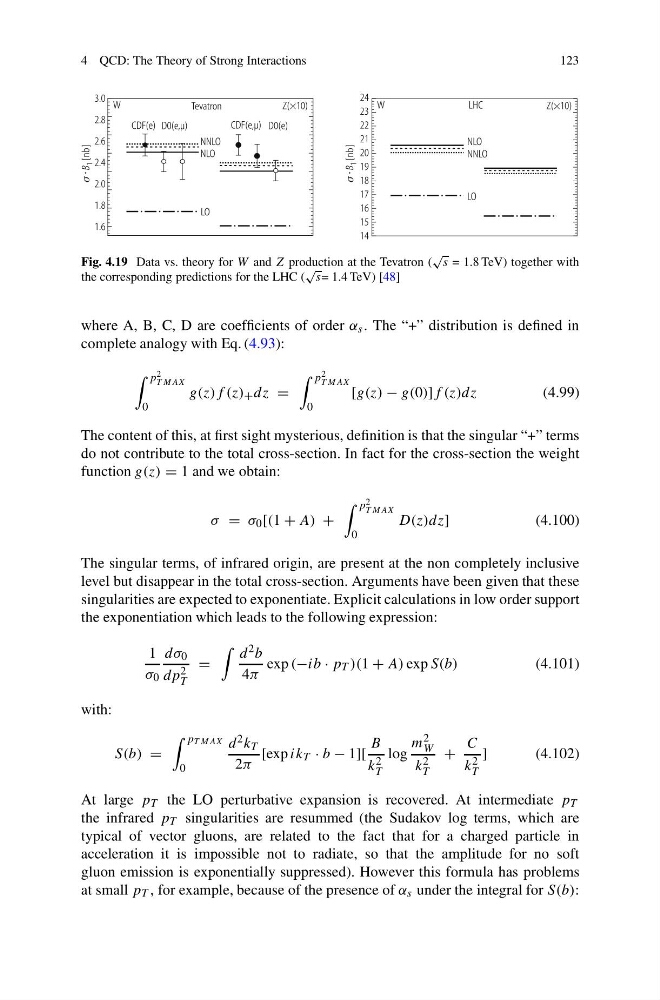
Fig. 4.19 Data vs. theory for W and Z production at the Tevatron (
√
s = 1.8 TeV) together with
the corresponding predictions for the LHC (
√
s= 1.4 TeV) [48]
where A, B, C, D are coefficients of order α s . The “+” distribution is defined in
complete analogy with Eq. (4.93):
p 2
T MAX
0
g(z)f (z) + dz =
p 2
T MAX
0
[g(z) − g(0)]f (z)dz
(4.99)
The content of this, at first sight mysterious, definition is that the singular “+” terms
do not contribute to the total cross-section. In fact for the cross-section the weight
function g(z) = 1 and we obtain:
σ = σ 0 [(1 + A) +
p 2
T MAX
0
D(z)dz]
(4.100)
The singular terms, of infrared origin, are present at the non completely inclusive
level but disappear in the total cross-section. Arguments have been given that these
singularities are expected to exponentiate. Explicit calculations in low order support
the exponentiation which leads to the following expression:
1
σ 0
dσ 0
dp 2
T
=
d 2 b
4π
exp (−ib · p T )(1 + A) exp S(b)
(4.101)
with:
S(b) =
p T MAX
0
d 2 k T
2π
[exp ik T · b − 1][
B
k 2
T
log
m 2
W
k 2
T
+
C
k 2
T
]
(4.102)
At large p T the LO perturbative expansion is recovered. At intermediate p T
the infrared p T singularities are resummed (the Sudakov log terms, which are
typical of vector gluons, are related to the fact that for a charged particle in
acceleration it is impossible not to radiate, so that the amplitude for no soft
gluon emission is exponentially suppressed). However this formula has problems
at small p T , for example, because of the presence of α s under the integral for S(b):
123
Fig. 4.19 Data vs. theory for W and Z production at the Tevatron (
√
s = 1.8 TeV) together with
the corresponding predictions for the LHC (
√
s= 1.4 TeV) [48]
where A, B, C, D are coefficients of order α s . The “+” distribution is defined in
complete analogy with Eq. (4.93):
p 2
T MAX
0
g(z)f (z) + dz =
p 2
T MAX
0
[g(z) − g(0)]f (z)dz
(4.99)
The content of this, at first sight mysterious, definition is that the singular “+” terms
do not contribute to the total cross-section. In fact for the cross-section the weight
function g(z) = 1 and we obtain:
σ = σ 0 [(1 + A) +
p 2
T MAX
0
D(z)dz]
(4.100)
The singular terms, of infrared origin, are present at the non completely inclusive
level but disappear in the total cross-section. Arguments have been given that these
singularities are expected to exponentiate. Explicit calculations in low order support
the exponentiation which leads to the following expression:
1
σ 0
dσ 0
dp 2
T
=
d 2 b
4π
exp (−ib · p T )(1 + A) exp S(b)
(4.101)
with:
S(b) =
p T MAX
0
d 2 k T
2π
[exp ik T · b − 1][
B
k 2
T
log
m 2
W
k 2
T
+
C
k 2
T
]
(4.102)
At large p T the LO perturbative expansion is recovered. At intermediate p T
the infrared p T singularities are resummed (the Sudakov log terms, which are
typical of vector gluons, are related to the fact that for a charged particle in
acceleration it is impossible not to radiate, so that the amplitude for no soft
gluon emission is exponentially suppressed). However this formula has problems
at small p T , for example, because of the presence of α s under the integral for S(b):