

4 QCD: The Theory of Strong Interactions
115
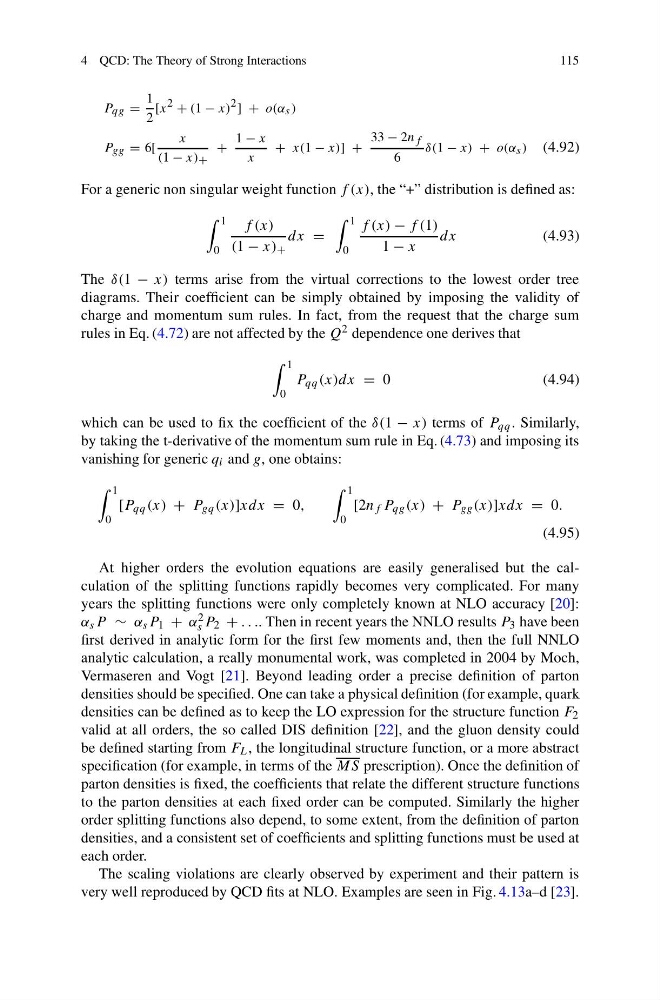
P qg =
1
2
[x 2 + (1 − x) 2 ] + o(α s )
P gg = 6[
x
(1 − x) +
+
1 − x
x
+ x(1 − x)] +
33 − 2n f
6
δ(1 − x) + o(α s ) (4.92)
For a generic non singular weight function f (x), the “+” distribution is defined as:
1
0
f (x)
(1 − x) +
dx =
1
0
f (x) − f (1)
1 − x
dx
(4.93)
The δ(1 − x) terms arise from the virtual corrections to the lowest order tree
diagrams. Their coefficient can be simply obtained by imposing the validity of
charge and momentum sum rules. In fact, from the request that the charge sum
rules in Eq. (4.72) are not affected by the Q 2 dependence one derives that
1
0
P qq (x)dx = 0
(4.94)
which can be used to fix the coefficient of the δ(1 − x) terms of P qq . Similarly,
by taking the t-derivative of the momentum sum rule in Eq. (4.73) and imposing its
vanishing for generic q i and g, one obtains:
1
0
[P qq (x) + P gq (x)]xdx = 0,
1
0
[2n f P qg (x) + P gg (x)]xdx = 0.
(4.95)
At higher orders the evolution equations are easily generalised but the calculation of the splitting functions rapidly becomes very complicated. For many
years the splitting functions were only completely known at NLO accuracy [20]:
α s P ∼ α s P 1 + α 2
s P 2 + . . .. Then in recent years the NNLO results P 3 have been
first derived in analytic form for the first few moments and, then the full NNLO
analytic calculation, a really monumental work, was completed in 2004 by Moch,
Vermaseren and Vogt [21]. Beyond leading order a precise definition of parton
densities should be specified. One can take a physical definition (for example, quark
densities can be defined as to keep the LO expression for the structure function F 2
valid at all orders, the so called DIS definition [22], and the gluon density could
be defined starting from F L , the longitudinal structure function, or a more abstract
specification (for example, in terms of the MS prescription). Once the definition of
parton densities is fixed, the coefficients that relate the different structure functions
to the parton densities at each fixed order can be computed. Similarly the higher
order splitting functions also depend, to some extent, from the definition of parton
densities, and a consistent set of coefficients and splitting functions must be used at
each order.
The scaling violations are clearly observed by experiment and their pattern is
very well reproduced by QCD fits at NLO. Examples are seen in Fig. 4.13a–d [23].
115
P qg =
1
2
[x 2 + (1 − x) 2 ] + o(α s )
P gg = 6[
x
(1 − x) +
+
1 − x
x
+ x(1 − x)] +
33 − 2n f
6
δ(1 − x) + o(α s ) (4.92)
For a generic non singular weight function f (x), the “+” distribution is defined as:
1
0
f (x)
(1 − x) +
dx =
1
0
f (x) − f (1)
1 − x
dx
(4.93)
The δ(1 − x) terms arise from the virtual corrections to the lowest order tree
diagrams. Their coefficient can be simply obtained by imposing the validity of
charge and momentum sum rules. In fact, from the request that the charge sum
rules in Eq. (4.72) are not affected by the Q 2 dependence one derives that
1
0
P qq (x)dx = 0
(4.94)
which can be used to fix the coefficient of the δ(1 − x) terms of P qq . Similarly,
by taking the t-derivative of the momentum sum rule in Eq. (4.73) and imposing its
vanishing for generic q i and g, one obtains:
1
0
[P qq (x) + P gq (x)]xdx = 0,
1
0
[2n f P qg (x) + P gg (x)]xdx = 0.
(4.95)
At higher orders the evolution equations are easily generalised but the calculation of the splitting functions rapidly becomes very complicated. For many
years the splitting functions were only completely known at NLO accuracy [20]:
α s P ∼ α s P 1 + α 2
s P 2 + . . .. Then in recent years the NNLO results P 3 have been
first derived in analytic form for the first few moments and, then the full NNLO
analytic calculation, a really monumental work, was completed in 2004 by Moch,
Vermaseren and Vogt [21]. Beyond leading order a precise definition of parton
densities should be specified. One can take a physical definition (for example, quark
densities can be defined as to keep the LO expression for the structure function F 2
valid at all orders, the so called DIS definition [22], and the gluon density could
be defined starting from F L , the longitudinal structure function, or a more abstract
specification (for example, in terms of the MS prescription). Once the definition of
parton densities is fixed, the coefficients that relate the different structure functions
to the parton densities at each fixed order can be computed. Similarly the higher
order splitting functions also depend, to some extent, from the definition of parton
densities, and a consistent set of coefficients and splitting functions must be used at
each order.
The scaling violations are clearly observed by experiment and their pattern is
very well reproduced by QCD fits at NLO. Examples are seen in Fig. 4.13a–d [23].