

104
G. Altarelli and S. Forte
J
q
g
g
g
q
J
+
+
+ . . . .
+ . . .
2
2
e +
e
J
+
+
J
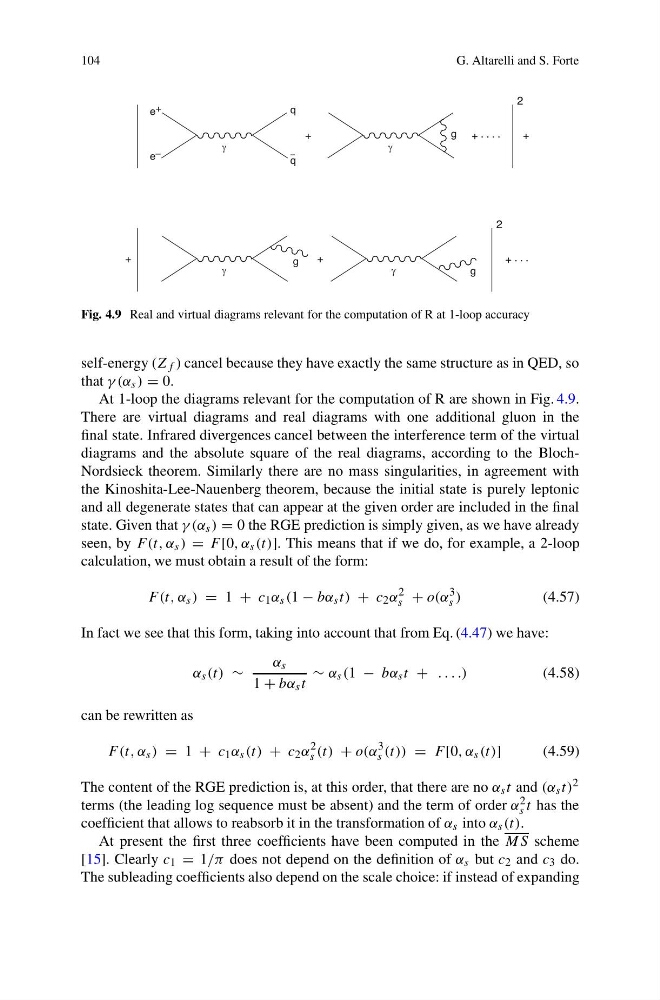
Fig. 4.9 Real and virtual diagrams relevant for the computation of R at 1-loop accuracy
self-energy (Z f ) cancel because they have exactly the same structure as in QED, so
that γ (α s ) = 0.
At 1-loop the diagrams relevant for the computation of R are shown in Fig. 4.9.
There are virtual diagrams and real diagrams with one additional gluon in the
final state. Infrared divergences cancel between the interference term of the virtual
diagrams and the absolute square of the real diagrams, according to the BlochNordsieck theorem. Similarly there are no mass singularities, in agreement with
the Kinoshita-Lee-Nauenberg theorem, because the initial state is purely leptonic
and all degenerate states that can appear at the given order are included in the final
state. Given that γ (α s ) = 0 the RGE prediction is simply given, as we have already
seen, by F (t, α s ) = F [0, α s (t)]. This means that if we do, for example, a 2-loop
calculation, we must obtain a result of the form:
F (t, α s ) = 1 + c 1 α s (1 − bα s t) + c 2 α
2
s + o(α
3
s )
(4.57)
In fact we see that this form, taking into account that from Eq. (4.47) we have:
α s (t) ∼
α s
1 + bα s t
∼ α s (1 − bα s t + . . . .)
(4.58)
can be rewritten as
F (t, α s ) = 1 + c 1 α s (t) + c 2 α
2
s (t) + o(α
3
s (t)) = F [0, α s (t)]
(4.59)
The content of the RGE prediction is, at this order, that there are no α s t and (α s t) 2
terms (the leading log sequence must be absent) and the term of order α 2
s t has the
coefficient that allows to reabsorb it in the transformation of α s into α s (t).
At present the first three coefficients have been computed in the MS scheme
[15]. Clearly c 1 = 1/π does not depend on the definition of α s but c 2 and c 3 do.
The subleading coefficients also depend on the scale choice: if instead of expanding
G. Altarelli and S. Forte
J
q
g
g
g
q
J
+
+
+ . . . .
+ . . .
2
2
e +
e
J
+
+
J
Fig. 4.9 Real and virtual diagrams relevant for the computation of R at 1-loop accuracy
self-energy (Z f ) cancel because they have exactly the same structure as in QED, so
that γ (α s ) = 0.
At 1-loop the diagrams relevant for the computation of R are shown in Fig. 4.9.
There are virtual diagrams and real diagrams with one additional gluon in the
final state. Infrared divergences cancel between the interference term of the virtual
diagrams and the absolute square of the real diagrams, according to the BlochNordsieck theorem. Similarly there are no mass singularities, in agreement with
the Kinoshita-Lee-Nauenberg theorem, because the initial state is purely leptonic
and all degenerate states that can appear at the given order are included in the final
state. Given that γ (α s ) = 0 the RGE prediction is simply given, as we have already
seen, by F (t, α s ) = F [0, α s (t)]. This means that if we do, for example, a 2-loop
calculation, we must obtain a result of the form:
F (t, α s ) = 1 + c 1 α s (1 − bα s t) + c 2 α
2
s + o(α
3
s )
(4.57)
In fact we see that this form, taking into account that from Eq. (4.47) we have:
α s (t) ∼
α s
1 + bα s t
∼ α s (1 − bα s t + . . . .)
(4.58)
can be rewritten as
F (t, α s ) = 1 + c 1 α s (t) + c 2 α
2
s (t) + o(α
3
s (t)) = F [0, α s (t)]
(4.59)
The content of the RGE prediction is, at this order, that there are no α s t and (α s t) 2
terms (the leading log sequence must be absent) and the term of order α 2
s t has the
coefficient that allows to reabsorb it in the transformation of α s into α s (t).
At present the first three coefficients have been computed in the MS scheme
[15]. Clearly c 1 = 1/π does not depend on the definition of α s but c 2 and c 3 do.
The subleading coefficients also depend on the scale choice: if instead of expanding