

34
2 Results and Discussion
H
O
H
HO
MeOH, 60 °C
(55 %)
H
O
H
Br
O
H
O
H
Br
O
AcON
AcO
(3a)
(b)
K 2 CO 3 (1 equiv),
CuSO 4 (5 equiv),
H 2 O/THF
7b
(dr 75:25)
8b
(dr > 20:1)
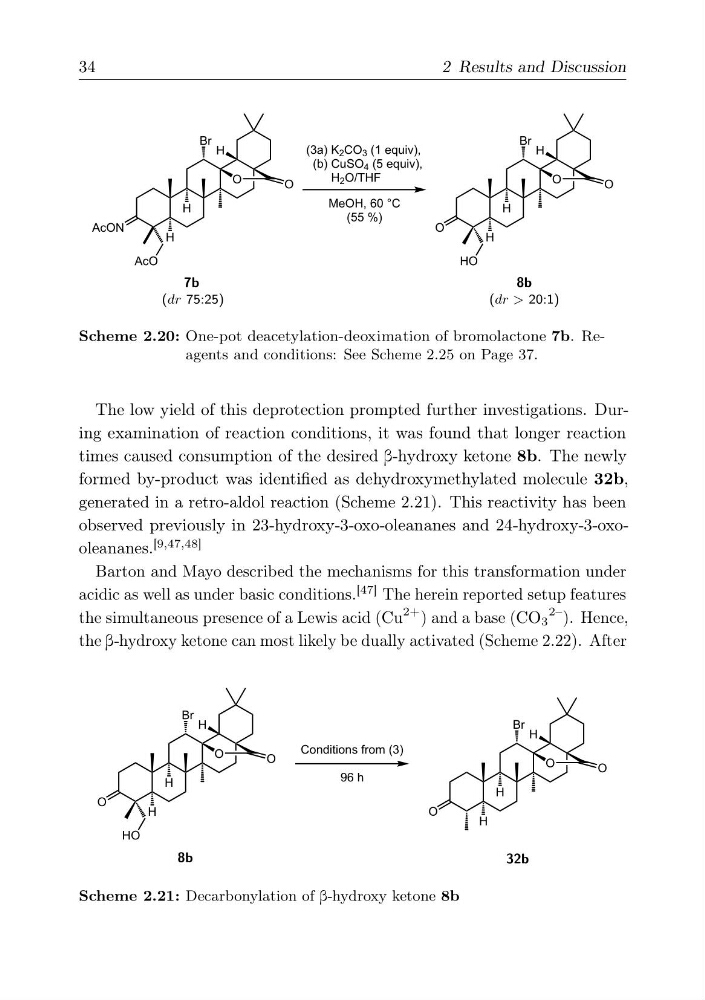
Scheme 2.20: One-pot deacetylation-deoximation of bromolactone 7b. Reagents and conditions: See Scheme 2.25 on Page 37.
The low yield of this deprotection prompted further investigations. During examination of reaction conditions, it was found that longer reaction
times caused consumption of the desired β-hydroxy ketone 8b. The newly
formed by-product was identified as dehydroxymethylated molecule 32b,
generated in a retro-aldol reaction (Scheme 2.21). This reactivity has been
observed previously in 23-hydroxy-3-oxo-oleananes and 24-hydroxy-3-oxooleananes.
[9,47,48]
Barton and Mayo described the mechanisms for this transformation under
acidic as well as under basic conditions.
[47] The herein reported setup features
the simultaneous presence of a Lewis acid (Cu
2+ ) and a base (CO 3
2– ). Hence,
the β-hydroxy ketone can most likely be dually activated (Scheme 2.22). After
O
H
HO
Conditions from (3)
O
H
H
O
H
Br
O
H
O
H
Br
O
96 h
8b
32b
Scheme 2.21: Decarbonylation of β-hydroxy ketone 8b
2 Results and Discussion
H
O
H
HO
MeOH, 60 °C
(55 %)
H
O
H
Br
O
H
O
H
Br
O
AcON
AcO
(3a)
(b)
K 2 CO 3 (1 equiv),
CuSO 4 (5 equiv),
H 2 O/THF
7b
(dr 75:25)
8b
(dr > 20:1)
Scheme 2.20: One-pot deacetylation-deoximation of bromolactone 7b. Reagents and conditions: See Scheme 2.25 on Page 37.
The low yield of this deprotection prompted further investigations. During examination of reaction conditions, it was found that longer reaction
times caused consumption of the desired β-hydroxy ketone 8b. The newly
formed by-product was identified as dehydroxymethylated molecule 32b,
generated in a retro-aldol reaction (Scheme 2.21). This reactivity has been
observed previously in 23-hydroxy-3-oxo-oleananes and 24-hydroxy-3-oxooleananes.
[9,47,48]
Barton and Mayo described the mechanisms for this transformation under
acidic as well as under basic conditions.
[47] The herein reported setup features
the simultaneous presence of a Lewis acid (Cu
2+ ) and a base (CO 3
2– ). Hence,
the β-hydroxy ketone can most likely be dually activated (Scheme 2.22). After
O
H
HO
Conditions from (3)
O
H
H
O
H
Br
O
H
O
H
Br
O
96 h
8b
32b
Scheme 2.21: Decarbonylation of β-hydroxy ketone 8b