

2.3 Optimisation of the Synthetic Sequence
31
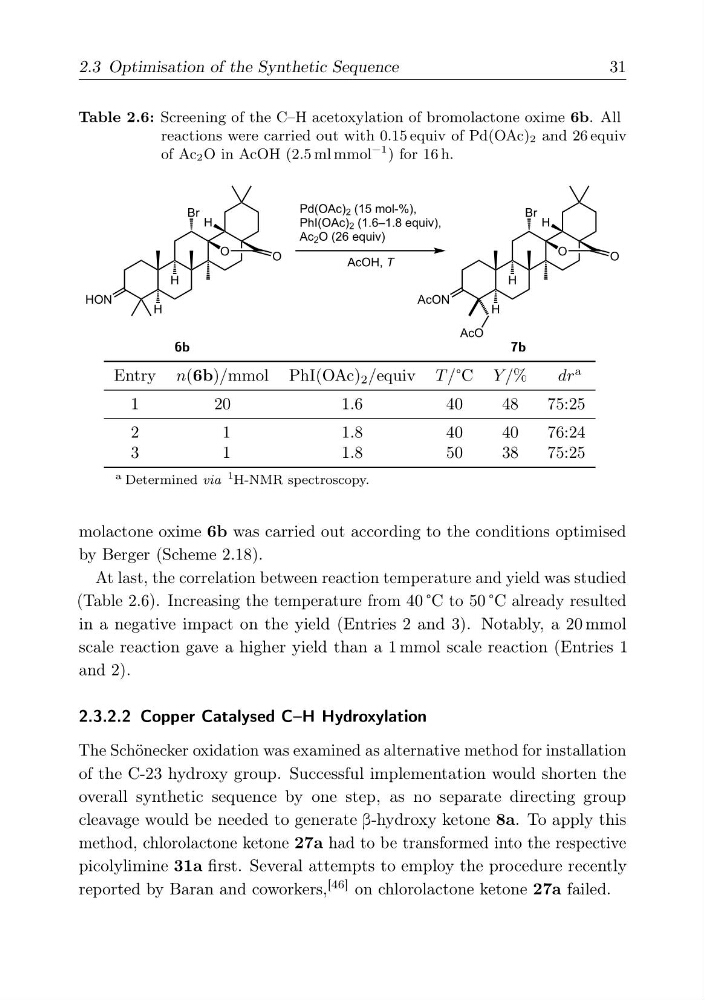
Table 2.6: Screening of the C–H acetoxylation of bromolactone oxime 6b. All
reactions were carried out with 0.15 equiv of Pd(OAc)2 and 26 equiv
of Ac2O in AcOH (2.5 ml mmol
−1 ) for 16 h.
H
H
O
H
Br
O
H
H
O
H
Br
O
HON
AcON
AcO
AcOH, T
Pd(OAc) 2 (15 mol-%),
PhI(OAc) 2 (1.6–1.8 equiv),
Ac 2 O (26 equiv)
6b
7b
Entry n(6b)/mmol PhI(OAc) 2 /equiv T /°C Y /%
dr
a
1
20
1.6
40
48
75:25
2
1
1.8
40
40
76:24
3
1
1.8
50
38
75:25
a Determined via
1
H-NMR spectroscopy.
molactone oxime 6b was carried out according to the conditions optimised
by Berger (Scheme 2.18).
At last, the correlation between reaction temperature and yield was studied
(Table 2.6). Increasing the temperature from 40 °C to 50 °C already resulted
in a negative impact on the yield (Entries 2 and 3). Notably, a 20 mmol
scale reaction gave a higher yield than a 1 mmol scale reaction (Entries 1
and 2).
2.3.2.2 Copper Catalysed C–H Hydroxylation
The Schönecker oxidation was examined as alternative method for installation
of the C-23 hydroxy group. Successful implementation would shorten the
overall synthetic sequence by one step, as no separate directing group
cleavage would be needed to generate β-hydroxy ketone 8a. To apply this
method, chlorolactone ketone 27a had to be transformed into the respective
picolylimine 31a first. Several attempts to employ the procedure recently
reported by Baran and coworkers,
[46] on chlorolactone ketone 27a failed.
31
Table 2.6: Screening of the C–H acetoxylation of bromolactone oxime 6b. All
reactions were carried out with 0.15 equiv of Pd(OAc)2 and 26 equiv
of Ac2O in AcOH (2.5 ml mmol
−1 ) for 16 h.
H
H
O
H
Br
O
H
H
O
H
Br
O
HON
AcON
AcO
AcOH, T
Pd(OAc) 2 (15 mol-%),
PhI(OAc) 2 (1.6–1.8 equiv),
Ac 2 O (26 equiv)
6b
7b
Entry n(6b)/mmol PhI(OAc) 2 /equiv T /°C Y /%
dr
a
1
20
1.6
40
48
75:25
2
1
1.8
40
40
76:24
3
1
1.8
50
38
75:25
a Determined via
1
H-NMR spectroscopy.
molactone oxime 6b was carried out according to the conditions optimised
by Berger (Scheme 2.18).
At last, the correlation between reaction temperature and yield was studied
(Table 2.6). Increasing the temperature from 40 °C to 50 °C already resulted
in a negative impact on the yield (Entries 2 and 3). Notably, a 20 mmol
scale reaction gave a higher yield than a 1 mmol scale reaction (Entries 1
and 2).
2.3.2.2 Copper Catalysed C–H Hydroxylation
The Schönecker oxidation was examined as alternative method for installation
of the C-23 hydroxy group. Successful implementation would shorten the
overall synthetic sequence by one step, as no separate directing group
cleavage would be needed to generate β-hydroxy ketone 8a. To apply this
method, chlorolactone ketone 27a had to be transformed into the respective
picolylimine 31a first. Several attempts to employ the procedure recently
reported by Baran and coworkers,
[46] on chlorolactone ketone 27a failed.