

1.2 C–H Activation
9
1.2.2 Catalytic C–H Oxidation
1.2.2.1 Palladium Catalysed C–H Acetoxylation
In 2004, Sanford and coworkers reported a modified version of Baldwin’s
method.
[2] This modification utilises catalytic palladium in combination
with stoichiometric amounts of an oxidant at elevated temperatures (80 to
100 °C). In the original publication, Sanford and coworkers employed (Diacetoxyiodo)benzene (PhI(OAc) 2 ), however, application of other oxidants
such as Oxone has been reported.
[30]
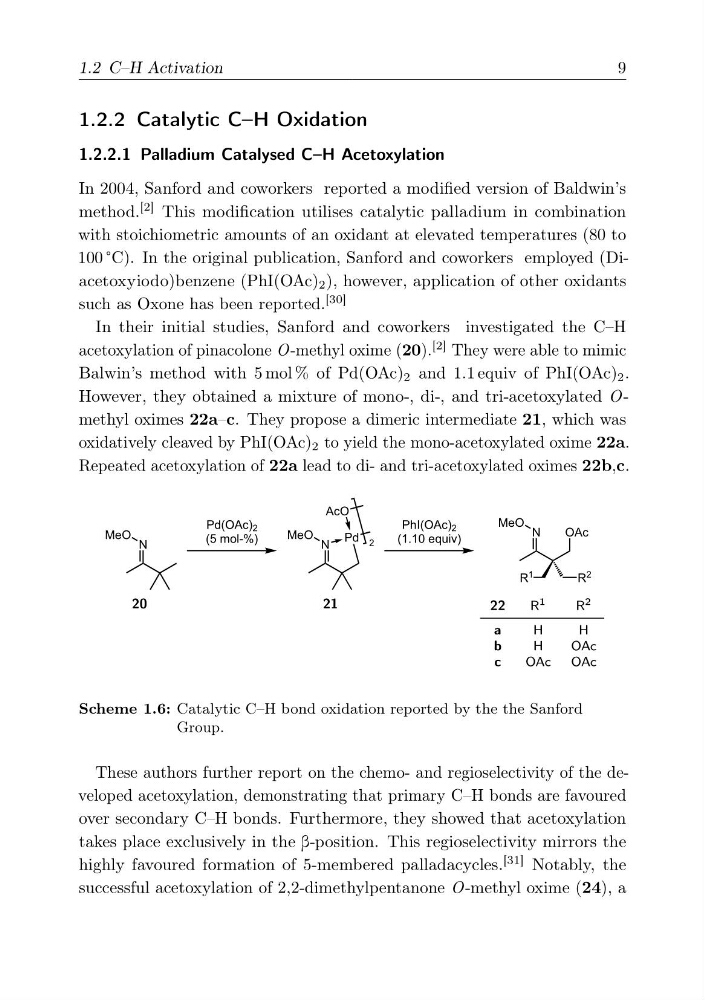
In their initial studies, Sanford and coworkers investigated the C–H
acetoxylation of pinacolone O -methyl oxime (20).
[2] They were able to mimic
Balwin’s method with 5 mol % of Pd(OAc) 2 and 1.1 equiv of PhI(OAc) 2 .
However, they obtained a mixture of mono-, di-, and tri-acetoxylated O -
methyl oximes 22a–c. They propose a dimeric intermediate 21, which was
oxidatively cleaved by PhI(OAc) 2 to yield the mono-acetoxylated oxime 22a.
Repeated acetoxylation of 22a lead to di- and tri-acetoxylated oximes 22b,c.
N
MeO
Pd(OAc) 2
(5 mol-%)
PhI(OAc) 2
(1.10 equiv)
N
MeO
Pd
AcO
N
MeO
OAc
R
2
R
1
2
20
21
22
R
1
R
2
a
H
H
b
H
OAc
c
OAc OAc
Scheme 1.6: Catalytic C–H bond oxidation reported by the the Sanford
Group.
These authors further report on the chemo- and regioselectivity of the developed acetoxylation, demonstrating that primary C–H bonds are favoured
over secondary C–H bonds. Furthermore, they showed that acetoxylation
takes place exclusively in the β-position. This regioselectivity mirrors the
highly favoured formation of 5-membered palladacycles.
[31] Notably, the
successful acetoxylation of 2,2-dimethylpentanone O -methyl oxime (24), a
9
1.2.2 Catalytic C–H Oxidation
1.2.2.1 Palladium Catalysed C–H Acetoxylation
In 2004, Sanford and coworkers reported a modified version of Baldwin’s
method.
[2] This modification utilises catalytic palladium in combination
with stoichiometric amounts of an oxidant at elevated temperatures (80 to
100 °C). In the original publication, Sanford and coworkers employed (Diacetoxyiodo)benzene (PhI(OAc) 2 ), however, application of other oxidants
such as Oxone has been reported.
[30]
In their initial studies, Sanford and coworkers investigated the C–H
acetoxylation of pinacolone O -methyl oxime (20).
[2] They were able to mimic
Balwin’s method with 5 mol % of Pd(OAc) 2 and 1.1 equiv of PhI(OAc) 2 .
However, they obtained a mixture of mono-, di-, and tri-acetoxylated O -
methyl oximes 22a–c. They propose a dimeric intermediate 21, which was
oxidatively cleaved by PhI(OAc) 2 to yield the mono-acetoxylated oxime 22a.
Repeated acetoxylation of 22a lead to di- and tri-acetoxylated oximes 22b,c.
N
MeO
Pd(OAc) 2
(5 mol-%)
PhI(OAc) 2
(1.10 equiv)
N
MeO
Pd
AcO
N
MeO
OAc
R
2
R
1
2
20
21
22
R
1
R
2
a
H
H
b
H
OAc
c
OAc OAc
Scheme 1.6: Catalytic C–H bond oxidation reported by the the Sanford
Group.
These authors further report on the chemo- and regioselectivity of the developed acetoxylation, demonstrating that primary C–H bonds are favoured
over secondary C–H bonds. Furthermore, they showed that acetoxylation
takes place exclusively in the β-position. This regioselectivity mirrors the
highly favoured formation of 5-membered palladacycles.
[31] Notably, the
successful acetoxylation of 2,2-dimethylpentanone O -methyl oxime (24), a