

16 Integration of Detectors into a Large Experiment: Examples from ATLAS. . .
777
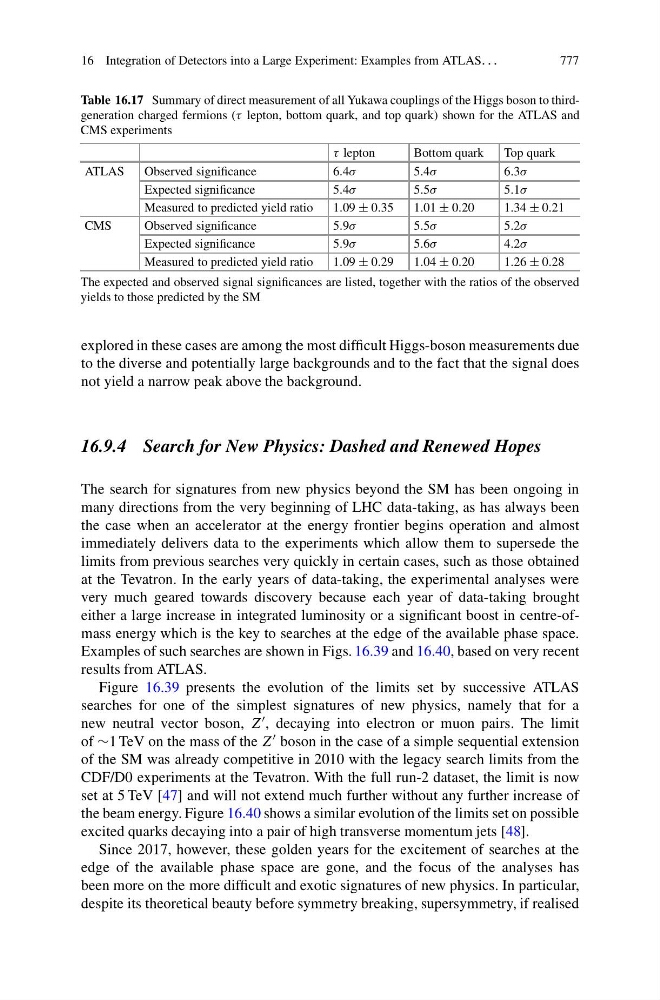
Table 16.17 Summary of direct measurement of all Yukawa couplings of the Higgs boson to thirdgeneration charged fermions (τ lepton, bottom quark, and top quark) shown for the ATLAS and
CMS experiments
τ lepton
Bottom quark
Top quark
ATLAS
Observed significance
6.4σ
5.4σ
6.3σ
Expected significance
5.4σ
5.5σ
5.1σ
Measured to predicted yield ratio
1.09 ± 0.35
1.01 ± 0.20
1.34 ± 0.21
CMS
Observed significance
5.9σ
5.5σ
5.2σ
Expected significance
5.9σ
5.6σ
4.2σ
Measured to predicted yield ratio
1.09 ± 0.29
1.04 ± 0.20
1.26 ± 0.28
The expected and observed signal significances are listed, together with the ratios of the observed
yields to those predicted by the SM
explored in these cases are among the most difficult Higgs-boson measurements due
to the diverse and potentially large backgrounds and to the fact that the signal does
not yield a narrow peak above the background.
16.9.4 Search for New Physics: Dashed and Renewed Hopes
The search for signatures from new physics beyond the SM has been ongoing in
many directions from the very beginning of LHC data-taking, as has always been
the case when an accelerator at the energy frontier begins operation and almost
immediately delivers data to the experiments which allow them to supersede the
limits from previous searches very quickly in certain cases, such as those obtained
at the Tevatron. In the early years of data-taking, the experimental analyses were
very much geared towards discovery because each year of data-taking brought
either a large increase in integrated luminosity or a significant boost in centre-ofmass energy which is the key to searches at the edge of the available phase space.
Examples of such searches are shown in Figs. 16.39 and 16.40, based on very recent
results from ATLAS.
Figure 16.39 presents the evolution of the limits set by successive ATLAS
searches for one of the simplest signatures of new physics, namely that for a
new neutral vector boson, Z , decaying into electron or muon pairs. The limit
of ∼1 TeV on the mass of the Z boson in the case of a simple sequential extension
of the SM was already competitive in 2010 with the legacy search limits from the
CDF/D0 experiments at the Tevatron. With the full run-2 dataset, the limit is now
set at 5 TeV [47] and will not extend much further without any further increase of
the beam energy. Figure 16.40 shows a similar evolution of the limits set on possible
excited quarks decaying into a pair of high transverse momentum jets [48].
Since 2017, however, these golden years for the excitement of searches at the
edge of the available phase space are gone, and the focus of the analyses has
been more on the more difficult and exotic signatures of new physics. In particular,
despite its theoretical beauty before symmetry breaking, supersymmetry, if realised