

772
D. Froidevaux
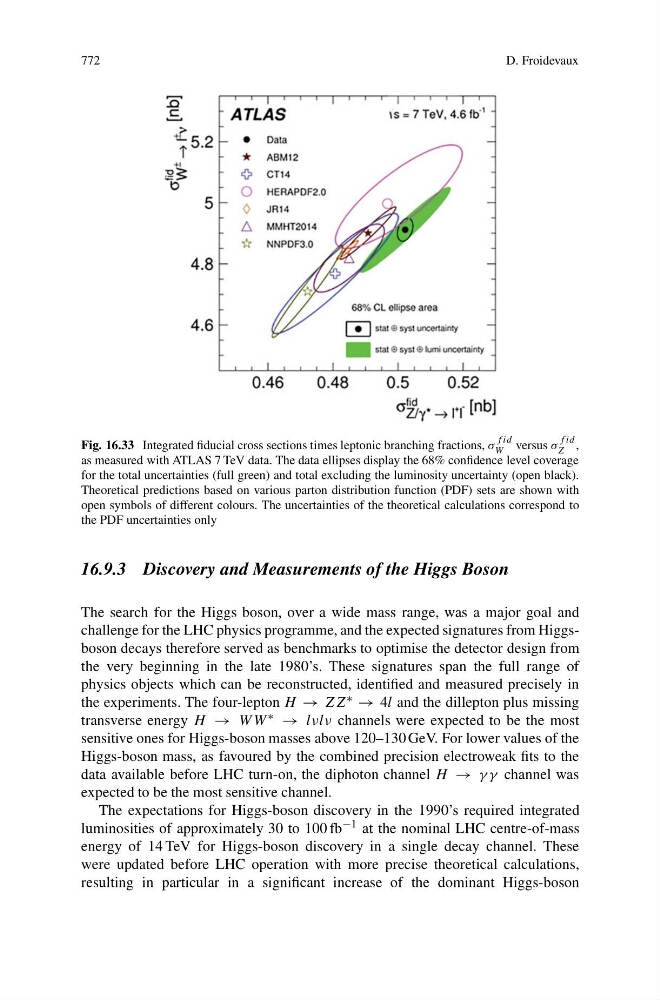
Fig. 16.33 Integrated fiducial cross sections times leptonic branching fractions, σ
f id
W versus σ
f id
Z ,
as measured with ATLAS 7 TeV data. The data ellipses display the 68% confidence level coverage
for the total uncertainties (full green) and total excluding the luminosity uncertainty (open black).
Theoretical predictions based on various parton distribution function (PDF) sets are shown with
open symbols of different colours. The uncertainties of the theoretical calculations correspond to
the PDF uncertainties only
16.9.3 Discovery and Measurements of the Higgs Boson
The search for the Higgs boson, over a wide mass range, was a major goal and
challenge for the LHC physics programme, and the expected signatures from Higgsboson decays therefore served as benchmarks to optimise the detector design from
the very beginning in the late 1980’s. These signatures span the full range of
physics objects which can be reconstructed, identified and measured precisely in
the experiments. The four-lepton H → ZZ ∗ → 4l and the dillepton plus missing
transverse energy H → W W ∗ → lνlν channels were expected to be the most
sensitive ones for Higgs-boson masses above 120–130 GeV. For lower values of the
Higgs-boson mass, as favoured by the combined precision electroweak fits to the
data available before LHC turn-on, the diphoton channel H → γ γ channel was
expected to be the most sensitive channel.
The expectations for Higgs-boson discovery in the 1990’s required integrated
luminosities of approximately 30 to 100 fb −1 at the nominal LHC centre-of-mass
energy of 14 TeV for Higgs-boson discovery in a single decay channel. These
were updated before LHC operation with more precise theoretical calculations,
resulting in particular in a significant increase of the dominant Higgs-boson