

3 Scintillation Detectors for Charged Particles and Photons
59
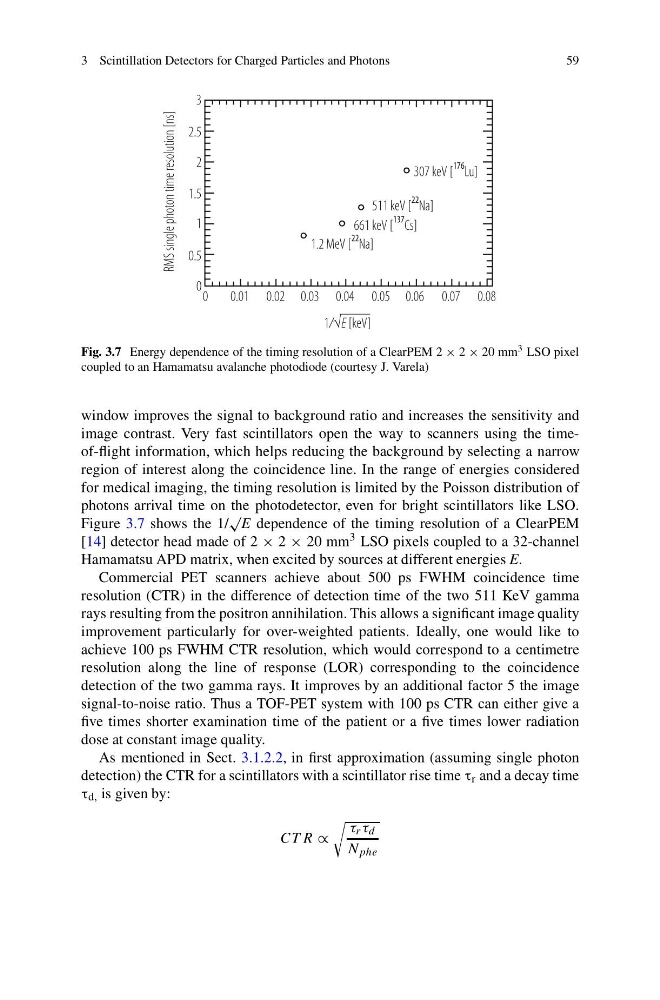
Fig. 3.7 Energy dependence of the timing resolution of a ClearPEM 2 × 2 × 20 mm 3 LSO pixel
coupled to an Hamamatsu avalanche photodiode (courtesy J. Varela)
window improves the signal to background ratio and increases the sensitivity and
image contrast. Very fast scintillators open the way to scanners using the timeof-flight information, which helps reducing the background by selecting a narrow
region of interest along the coincidence line. In the range of energies considered
for medical imaging, the timing resolution is limited by the Poisson distribution of
photons arrival time on the photodetector, even for bright scintillators like LSO.
Figure 3.7 shows the 1/
√
E dependence of the timing resolution of a ClearPEM
[14] detector head made of 2 × 2 × 20 mm 3 LSO pixels coupled to a 32-channel
Hamamatsu APD matrix, when excited by sources at different energies E.
Commercial PET scanners achieve about 500 ps FWHM coincidence time
resolution (CTR) in the difference of detection time of the two 511 KeV gamma
rays resulting from the positron annihilation. This allows a significant image quality
improvement particularly for over-weighted patients. Ideally, one would like to
achieve 100 ps FWHM CTR resolution, which would correspond to a centimetre
resolution along the line of response (LOR) corresponding to the coincidence
detection of the two gamma rays. It improves by an additional factor 5 the image
signal-to-noise ratio. Thus a TOF-PET system with 100 ps CTR can either give a
five times shorter examination time of the patient or a five times lower radiation
dose at constant image quality.
As mentioned in Sect. 3.1.2.2, in first approximation (assuming single photon
detection) the CTR for a scintillators with a scintillator rise time τ r and a decay time
τ d, is given by:
CT R ∝
τ r τ d
N phe
59
Fig. 3.7 Energy dependence of the timing resolution of a ClearPEM 2 × 2 × 20 mm 3 LSO pixel
coupled to an Hamamatsu avalanche photodiode (courtesy J. Varela)
window improves the signal to background ratio and increases the sensitivity and
image contrast. Very fast scintillators open the way to scanners using the timeof-flight information, which helps reducing the background by selecting a narrow
region of interest along the coincidence line. In the range of energies considered
for medical imaging, the timing resolution is limited by the Poisson distribution of
photons arrival time on the photodetector, even for bright scintillators like LSO.
Figure 3.7 shows the 1/
√
E dependence of the timing resolution of a ClearPEM
[14] detector head made of 2 × 2 × 20 mm 3 LSO pixels coupled to a 32-channel
Hamamatsu APD matrix, when excited by sources at different energies E.
Commercial PET scanners achieve about 500 ps FWHM coincidence time
resolution (CTR) in the difference of detection time of the two 511 KeV gamma
rays resulting from the positron annihilation. This allows a significant image quality
improvement particularly for over-weighted patients. Ideally, one would like to
achieve 100 ps FWHM CTR resolution, which would correspond to a centimetre
resolution along the line of response (LOR) corresponding to the coincidence
detection of the two gamma rays. It improves by an additional factor 5 the image
signal-to-noise ratio. Thus a TOF-PET system with 100 ps CTR can either give a
five times shorter examination time of the patient or a five times lower radiation
dose at constant image quality.
As mentioned in Sect. 3.1.2.2, in first approximation (assuming single photon
detection) the CTR for a scintillators with a scintillator rise time τ r and a decay time
τ d, is given by:
CT R ∝
τ r τ d
N phe