

3 Scintillation Detectors for Charged Particles and Photons
57
The energy resolution is driven by several factors and a detailed discussion is
given in Sect. 3.1.1. However, two important parameters are playing an essential
role. The first one is the light yield. One contribution to the energy resolution is
the statistical fluctuation of the number of photoelectrons, n pe , produced in the
photodetector. Therefore a high light yield will reduce this statistical contribution
like (n pe ) −1/2 .
The second parameter concerns the deviations from the linearity of response
at low energy. Most crystals exhibit a non-proportionality behaviour for energies
below 100 keV. The relative light yield can show either relative increase with
decreasing energy, as is the case for halide crystals, or a decrease, as for the majority
of oxides and fluorides. Only few crystals have an almost linear response down
to about 10 keV, such as YAlO 3 (YAP), LuAlO 3 (LuAP), LuYAlO 3 (LuYAP),
LaBr 3 . Given that the energy loss mechanisms—photoelectric, Compton scattering
and pair production—are energy dependent, the total energy deposit in a crystal
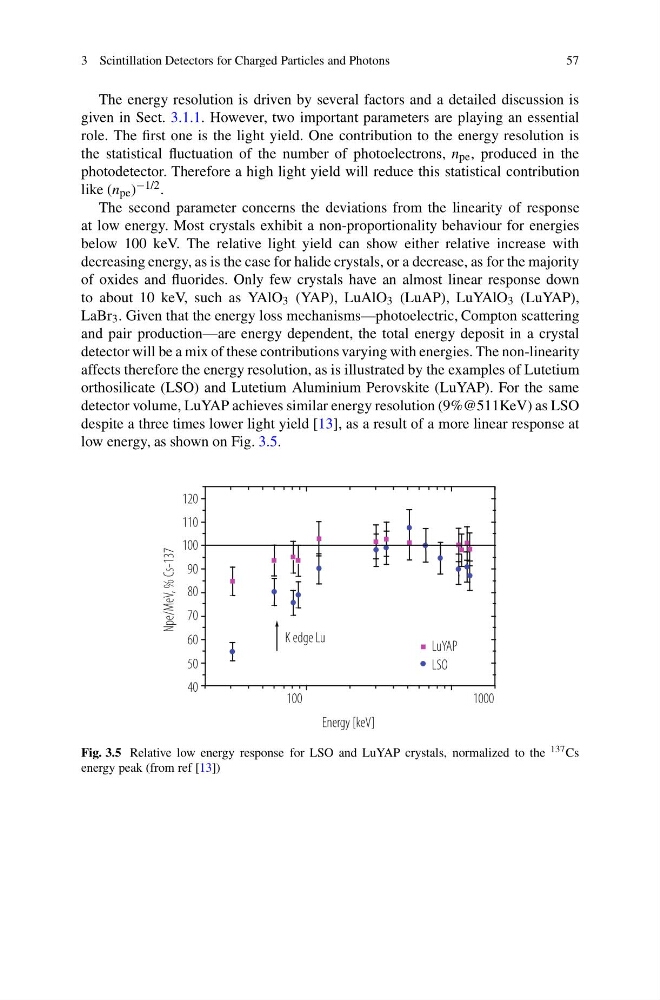
detector will be a mix of these contributions varying with energies. The non-linearity
affects therefore the energy resolution, as is illustrated by the examples of Lutetium
orthosilicate (LSO) and Lutetium Aluminium Perovskite (LuYAP). For the same
detector volume, LuYAP achieves similar energy resolution (9%@511KeV) as LSO
despite a three times lower light yield [13], as a result of a more linear response at
low energy, as shown on Fig. 3.5.
Fig. 3.5 Relative low energy response for LSO and LuYAP crystals, normalized to the 137 Cs
energy peak (from ref [13])
57
The energy resolution is driven by several factors and a detailed discussion is
given in Sect. 3.1.1. However, two important parameters are playing an essential
role. The first one is the light yield. One contribution to the energy resolution is
the statistical fluctuation of the number of photoelectrons, n pe , produced in the
photodetector. Therefore a high light yield will reduce this statistical contribution
like (n pe ) −1/2 .
The second parameter concerns the deviations from the linearity of response
at low energy. Most crystals exhibit a non-proportionality behaviour for energies
below 100 keV. The relative light yield can show either relative increase with
decreasing energy, as is the case for halide crystals, or a decrease, as for the majority
of oxides and fluorides. Only few crystals have an almost linear response down
to about 10 keV, such as YAlO 3 (YAP), LuAlO 3 (LuAP), LuYAlO 3 (LuYAP),
LaBr 3 . Given that the energy loss mechanisms—photoelectric, Compton scattering
and pair production—are energy dependent, the total energy deposit in a crystal
detector will be a mix of these contributions varying with energies. The non-linearity
affects therefore the energy resolution, as is illustrated by the examples of Lutetium
orthosilicate (LSO) and Lutetium Aluminium Perovskite (LuYAP). For the same
detector volume, LuYAP achieves similar energy resolution (9%@511KeV) as LSO
despite a three times lower light yield [13], as a result of a more linear response at
low energy, as shown on Fig. 3.5.
Fig. 3.5 Relative low energy response for LSO and LuYAP crystals, normalized to the 137 Cs
energy peak (from ref [13])