

52
P. Lecoq
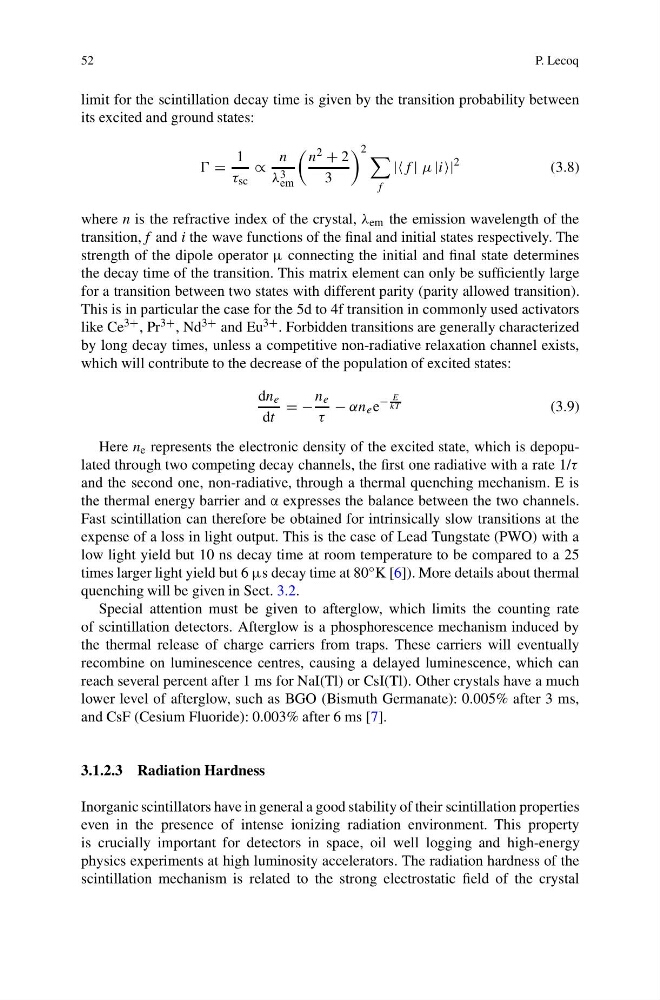
limit for the scintillation decay time is given by the transition probability between
its excited and ground states:
=
1
τ sc
∝
n
λ 3
em
n 2 + 2
3
2
f
||f | μ |i
2
(3.8)
where n is the refractive index of the crystal, λ em the emission wavelength of the
transition, f and i the wave functions of the final and initial states respectively. The
strength of the dipole operator μ connecting the initial and final state determines
the decay time of the transition. This matrix element can only be sufficiently large
for a transition between two states with different parity (parity allowed transition).
This is in particular the case for the 5d to 4f transition in commonly used activators
like Ce 3+ , Pr 3+ , Nd 3+ and Eu 3+ . Forbidden transitions are generally characterized
by long decay times, unless a competitive non-radiative relaxation channel exists,
which will contribute to the decrease of the population of excited states:
dn e
dt
= −
n e
τ
− αn e e
−
E
kT
(3.9)
Here n e represents the electronic density of the excited state, which is depopulated through two competing decay channels, the first one radiative with a rate 1/τ
and the second one, non-radiative, through a thermal quenching mechanism. E is
the thermal energy barrier and α expresses the balance between the two channels.
Fast scintillation can therefore be obtained for intrinsically slow transitions at the
expense of a loss in light output. This is the case of Lead Tungstate (PWO) with a
low light yield but 10 ns decay time at room temperature to be compared to a 25
times larger light yield but 6 μs decay time at 80 ◦ K [6]). More details about thermal
quenching will be given in Sect. 3.2.
Special attention must be given to afterglow, which limits the counting rate
of scintillation detectors. Afterglow is a phosphorescence mechanism induced by
the thermal release of charge carriers from traps. These carriers will eventually
recombine on luminescence centres, causing a delayed luminescence, which can
reach several percent after 1 ms for NaI(Tl) or CsI(Tl). Other crystals have a much
lower level of afterglow, such as BGO (Bismuth Germanate): 0.005% after 3 ms,
and CsF (Cesium Fluoride): 0.003% after 6 ms [7].
3.1.2.3 Radiation Hardness
Inorganic scintillators have in general a good stability of their scintillation properties
even in the presence of intense ionizing radiation environment. This property
is crucially important for detectors in space, oil well logging and high-energy
physics experiments at high luminosity accelerators. The radiation hardness of the
scintillation mechanism is related to the strong electrostatic field of the crystal
P. Lecoq
limit for the scintillation decay time is given by the transition probability between
its excited and ground states:
=
1
τ sc
∝
n
λ 3
em
n 2 + 2
3
2
f
||f | μ |i
2
(3.8)
where n is the refractive index of the crystal, λ em the emission wavelength of the
transition, f and i the wave functions of the final and initial states respectively. The
strength of the dipole operator μ connecting the initial and final state determines
the decay time of the transition. This matrix element can only be sufficiently large
for a transition between two states with different parity (parity allowed transition).
This is in particular the case for the 5d to 4f transition in commonly used activators
like Ce 3+ , Pr 3+ , Nd 3+ and Eu 3+ . Forbidden transitions are generally characterized
by long decay times, unless a competitive non-radiative relaxation channel exists,
which will contribute to the decrease of the population of excited states:
dn e
dt
= −
n e
τ
− αn e e
−
E
kT
(3.9)
Here n e represents the electronic density of the excited state, which is depopulated through two competing decay channels, the first one radiative with a rate 1/τ
and the second one, non-radiative, through a thermal quenching mechanism. E is
the thermal energy barrier and α expresses the balance between the two channels.
Fast scintillation can therefore be obtained for intrinsically slow transitions at the
expense of a loss in light output. This is the case of Lead Tungstate (PWO) with a
low light yield but 10 ns decay time at room temperature to be compared to a 25
times larger light yield but 6 μs decay time at 80 ◦ K [6]). More details about thermal
quenching will be given in Sect. 3.2.
Special attention must be given to afterglow, which limits the counting rate
of scintillation detectors. Afterglow is a phosphorescence mechanism induced by
the thermal release of charge carriers from traps. These carriers will eventually
recombine on luminescence centres, causing a delayed luminescence, which can
reach several percent after 1 ms for NaI(Tl) or CsI(Tl). Other crystals have a much
lower level of afterglow, such as BGO (Bismuth Germanate): 0.005% after 3 ms,
and CsF (Cesium Fluoride): 0.003% after 6 ms [7].
3.1.2.3 Radiation Hardness
Inorganic scintillators have in general a good stability of their scintillation properties
even in the presence of intense ionizing radiation environment. This property
is crucially important for detectors in space, oil well logging and high-energy
physics experiments at high luminosity accelerators. The radiation hardness of the
scintillation mechanism is related to the strong electrostatic field of the crystal