

3 Scintillation Detectors for Charged Particles and Photons
51
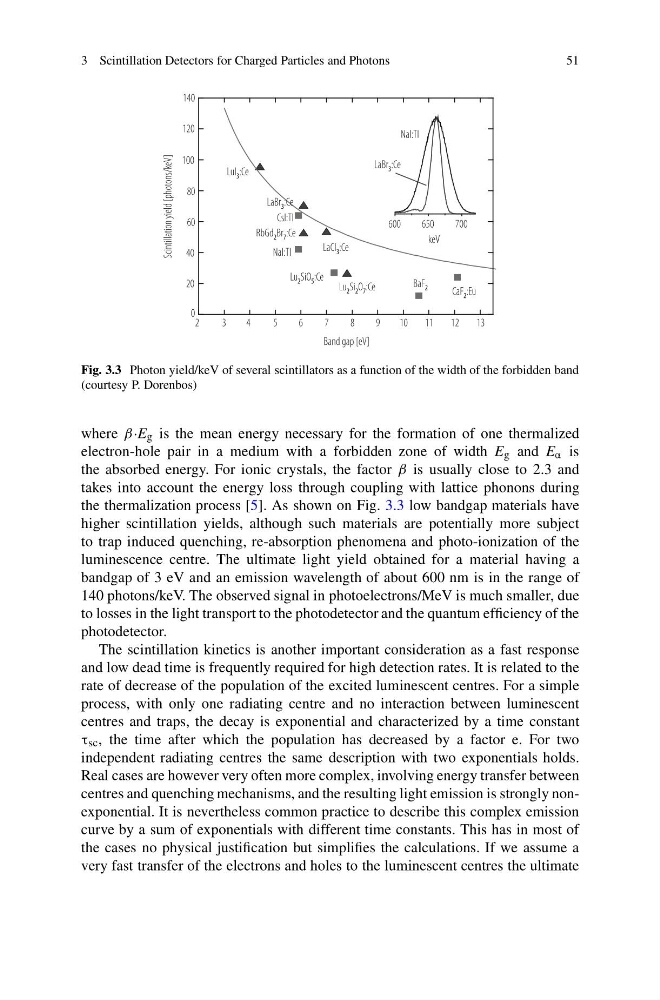
Fig. 3.3 Photon yield/keV of several scintillators as a function of the width of the forbidden band
(courtesy P. Dorenbos)
where β·E g is the mean energy necessary for the formation of one thermalized
electron-hole pair in a medium with a forbidden zone of width E g and E α is
the absorbed energy. For ionic crystals, the factor β is usually close to 2.3 and
takes into account the energy loss through coupling with lattice phonons during
the thermalization process [5]. As shown on Fig. 3.3 low bandgap materials have
higher scintillation yields, although such materials are potentially more subject
to trap induced quenching, re-absorption phenomena and photo-ionization of the
luminescence centre. The ultimate light yield obtained for a material having a
bandgap of 3 eV and an emission wavelength of about 600 nm is in the range of
140 photons/keV. The observed signal in photoelectrons/MeV is much smaller, due
to losses in the light transport to the photodetector and the quantum efficiency of the
photodetector.
The scintillation kinetics is another important consideration as a fast response
and low dead time is frequently required for high detection rates. It is related to the
rate of decrease of the population of the excited luminescent centres. For a simple
process, with only one radiating centre and no interaction between luminescent
centres and traps, the decay is exponential and characterized by a time constant
τ sc , the time after which the population has decreased by a factor e. For two
independent radiating centres the same description with two exponentials holds.
Real cases are however very often more complex, involving energy transfer between
centres and quenching mechanisms, and the resulting light emission is strongly nonexponential. It is nevertheless common practice to describe this complex emission
curve by a sum of exponentials with different time constants. This has in most of
the cases no physical justification but simplifies the calculations. If we assume a
very fast transfer of the electrons and holes to the luminescent centres the ultimate
51
Fig. 3.3 Photon yield/keV of several scintillators as a function of the width of the forbidden band
(courtesy P. Dorenbos)
where β·E g is the mean energy necessary for the formation of one thermalized
electron-hole pair in a medium with a forbidden zone of width E g and E α is
the absorbed energy. For ionic crystals, the factor β is usually close to 2.3 and
takes into account the energy loss through coupling with lattice phonons during
the thermalization process [5]. As shown on Fig. 3.3 low bandgap materials have
higher scintillation yields, although such materials are potentially more subject
to trap induced quenching, re-absorption phenomena and photo-ionization of the
luminescence centre. The ultimate light yield obtained for a material having a
bandgap of 3 eV and an emission wavelength of about 600 nm is in the range of
140 photons/keV. The observed signal in photoelectrons/MeV is much smaller, due
to losses in the light transport to the photodetector and the quantum efficiency of the
photodetector.
The scintillation kinetics is another important consideration as a fast response
and low dead time is frequently required for high detection rates. It is related to the
rate of decrease of the population of the excited luminescent centres. For a simple
process, with only one radiating centre and no interaction between luminescent
centres and traps, the decay is exponential and characterized by a time constant
τ sc , the time after which the population has decreased by a factor e. For two
independent radiating centres the same description with two exponentials holds.
Real cases are however very often more complex, involving energy transfer between
centres and quenching mechanisms, and the resulting light emission is strongly nonexponential. It is nevertheless common practice to describe this complex emission
curve by a sum of exponentials with different time constants. This has in most of
the cases no physical justification but simplifies the calculations. If we assume a
very fast transfer of the electrons and holes to the luminescent centres the ultimate