

13 Pattern Recognition and Reconstruction
603
abseta
0 0.2 0.4 0.6 0.8 1 1.2 1.4 1.6 1.8 2 2.2 2.4
Efficiency
0.8
0.9
1
CMS Preliminary
-1
= 13 TeV, L = 36 fb
s
2016,
Data, All-tracks
Simulation
|
η
muon |
0 0.2 0.4 0.6 0.8 1 1.2 1.4 1.6 1.8 2 2.2 2.4
Data/Sim. ratio
0.9
0.95
1
Efficiency
0.8
0.9
1
CMS Preliminary
Data, All-tracks
Simulation
vtx
N
0
5
10 15 20 25 30 35 40 45
Data/Sim. ratio
0.9
0.95
1
2016, s = 13 TeV, L = 36 fb -1
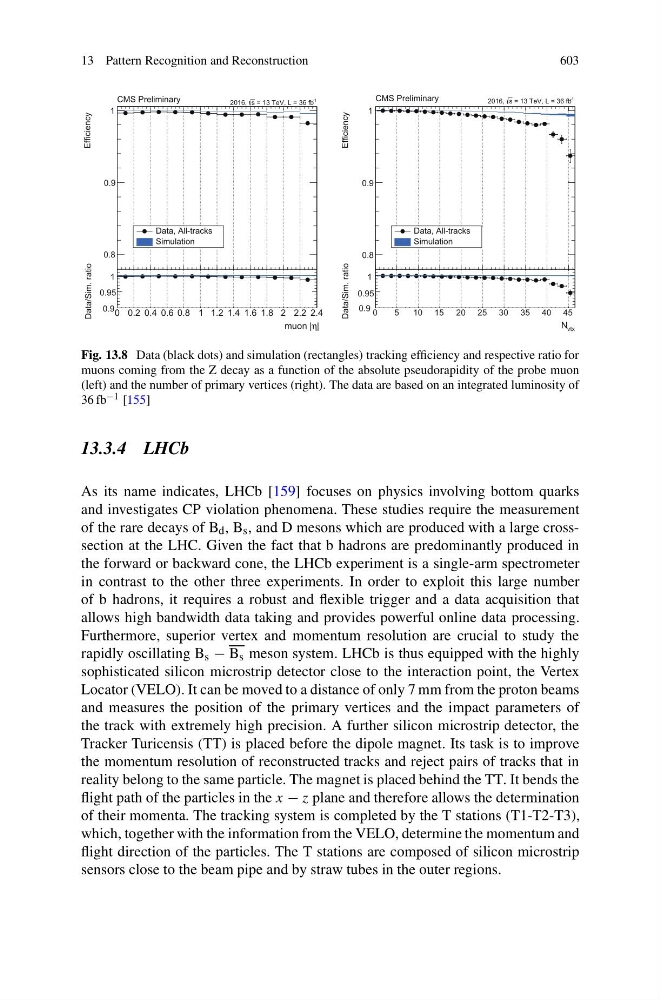
Fig. 13.8 Data (black dots) and simulation (rectangles) tracking efficiency and respective ratio for
muons coming from the Z decay as a function of the absolute pseudorapidity of the probe muon
(left) and the number of primary vertices (right). The data are based on an integrated luminosity of
36 fb −1 [155]
13.3.4 LHCb
As its name indicates, LHCb [159] focuses on physics involving bottom quarks
and investigates CP violation phenomena. These studies require the measurement
of the rare decays of B d , B s , and D mesons which are produced with a large crosssection at the LHC. Given the fact that b hadrons are predominantly produced in
the forward or backward cone, the LHCb experiment is a single-arm spectrometer
in contrast to the other three experiments. In order to exploit this large number
of b hadrons, it requires a robust and flexible trigger and a data acquisition that
allows high bandwidth data taking and provides powerful online data processing.
Furthermore, superior vertex and momentum resolution are crucial to study the
rapidly oscillating B s − B s meson system. LHCb is thus equipped with the highly
sophisticated silicon microstrip detector close to the interaction point, the Vertex
Locator (VELO). It can be moved to a distance of only 7 mm from the proton beams
and measures the position of the primary vertices and the impact parameters of
the track with extremely high precision. A further silicon microstrip detector, the
Tracker Turicensis (TT) is placed before the dipole magnet. Its task is to improve
the momentum resolution of reconstructed tracks and reject pairs of tracks that in
reality belong to the same particle. The magnet is placed behind the TT. It bends the
flight path of the particles in the x − z plane and therefore allows the determination
of their momenta. The tracking system is completed by the T stations (T1-T2-T3),
which, together with the information from the VELO, determine the momentum and
flight direction of the particles. The T stations are composed of silicon microstrip
sensors close to the beam pipe and by straw tubes in the outer regions.
603
abseta
0 0.2 0.4 0.6 0.8 1 1.2 1.4 1.6 1.8 2 2.2 2.4
Efficiency
0.8
0.9
1
CMS Preliminary
-1
= 13 TeV, L = 36 fb
s
2016,
Data, All-tracks
Simulation
|
η
muon |
0 0.2 0.4 0.6 0.8 1 1.2 1.4 1.6 1.8 2 2.2 2.4
Data/Sim. ratio
0.9
0.95
1
Efficiency
0.8
0.9
1
CMS Preliminary
Data, All-tracks
Simulation
vtx
N
0
5
10 15 20 25 30 35 40 45
Data/Sim. ratio
0.9
0.95
1
2016, s = 13 TeV, L = 36 fb -1
Fig. 13.8 Data (black dots) and simulation (rectangles) tracking efficiency and respective ratio for
muons coming from the Z decay as a function of the absolute pseudorapidity of the probe muon
(left) and the number of primary vertices (right). The data are based on an integrated luminosity of
36 fb −1 [155]
13.3.4 LHCb
As its name indicates, LHCb [159] focuses on physics involving bottom quarks
and investigates CP violation phenomena. These studies require the measurement
of the rare decays of B d , B s , and D mesons which are produced with a large crosssection at the LHC. Given the fact that b hadrons are predominantly produced in
the forward or backward cone, the LHCb experiment is a single-arm spectrometer
in contrast to the other three experiments. In order to exploit this large number
of b hadrons, it requires a robust and flexible trigger and a data acquisition that
allows high bandwidth data taking and provides powerful online data processing.
Furthermore, superior vertex and momentum resolution are crucial to study the
rapidly oscillating B s − B s meson system. LHCb is thus equipped with the highly
sophisticated silicon microstrip detector close to the interaction point, the Vertex
Locator (VELO). It can be moved to a distance of only 7 mm from the proton beams
and measures the position of the primary vertices and the impact parameters of
the track with extremely high precision. A further silicon microstrip detector, the
Tracker Turicensis (TT) is placed before the dipole magnet. Its task is to improve
the momentum resolution of reconstructed tracks and reject pairs of tracks that in
reality belong to the same particle. The magnet is placed behind the TT. It bends the
flight path of the particles in the x − z plane and therefore allows the determination
of their momenta. The tracking system is completed by the T stations (T1-T2-T3),
which, together with the information from the VELO, determine the momentum and
flight direction of the particles. The T stations are composed of silicon microstrip
sensors close to the beam pipe and by straw tubes in the outer regions.