

572
R. Frühwirth et al.
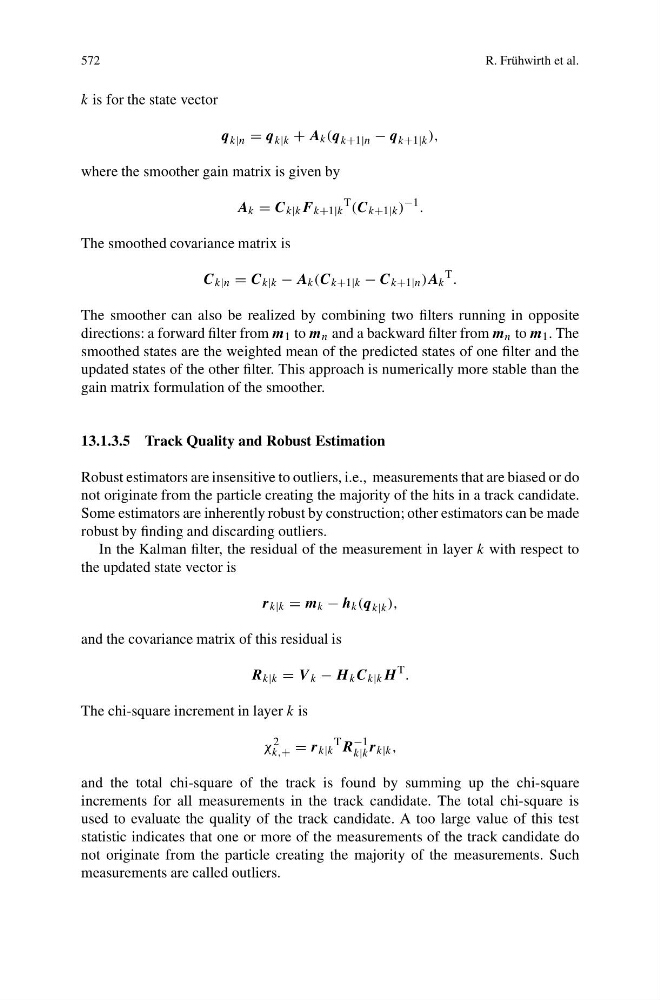
k is for the state vector
q k|n = q k|k + A k (q k+1|n − q k+1|k ),
where the smoother gain matrix is given by
A k = C k|k F k+1|k
T (C k+1|k )
−1 .
The smoothed covariance matrix is
C k|n = C k|k − A k (C k+1|k − C k+1|n )A k
T .
The smoother can also be realized by combining two filters running in opposite
directions: a forward filter from m 1 to m n and a backward filter from m n to m 1 . The
smoothed states are the weighted mean of the predicted states of one filter and the
updated states of the other filter. This approach is numerically more stable than the
gain matrix formulation of the smoother.
13.1.3.5 Track Quality and Robust Estimation
Robust estimators are insensitive to outliers, i.e., measurements that are biased or do
not originate from the particle creating the majority of the hits in a track candidate.
Some estimators are inherently robust by construction; other estimators can be made
robust by finding and discarding outliers.
In the Kalman filter, the residual of the measurement in layer k with respect to
the updated state vector is
r k|k = m k − h k (q k|k ),
and the covariance matrix of this residual is
R k|k = V k − H k C k|k H
T .
The chi-square increment in layer k is
χ
2
k,+ = r k|k
T R
−1
k|k r k|k ,
and the total chi-square of the track is found by summing up the chi-square
increments for all measurements in the track candidate. The total chi-square is
used to evaluate the quality of the track candidate. A too large value of this test
statistic indicates that one or more of the measurements of the track candidate do
not originate from the particle creating the majority of the measurements. Such
measurements are called outliers.
R. Frühwirth et al.
k is for the state vector
q k|n = q k|k + A k (q k+1|n − q k+1|k ),
where the smoother gain matrix is given by
A k = C k|k F k+1|k
T (C k+1|k )
−1 .
The smoothed covariance matrix is
C k|n = C k|k − A k (C k+1|k − C k+1|n )A k
T .
The smoother can also be realized by combining two filters running in opposite
directions: a forward filter from m 1 to m n and a backward filter from m n to m 1 . The
smoothed states are the weighted mean of the predicted states of one filter and the
updated states of the other filter. This approach is numerically more stable than the
gain matrix formulation of the smoother.
13.1.3.5 Track Quality and Robust Estimation
Robust estimators are insensitive to outliers, i.e., measurements that are biased or do
not originate from the particle creating the majority of the hits in a track candidate.
Some estimators are inherently robust by construction; other estimators can be made
robust by finding and discarding outliers.
In the Kalman filter, the residual of the measurement in layer k with respect to
the updated state vector is
r k|k = m k − h k (q k|k ),
and the covariance matrix of this residual is
R k|k = V k − H k C k|k H
T .
The chi-square increment in layer k is
χ
2
k,+ = r k|k
T R
−1
k|k r k|k ,
and the total chi-square of the track is found by summing up the chi-square
increments for all measurements in the track candidate. The total chi-square is
used to evaluate the quality of the track candidate. A too large value of this test
statistic indicates that one or more of the measurements of the track candidate do
not originate from the particle creating the majority of the measurements. Such
measurements are called outliers.