

3 Scintillation Detectors for Charged Particles and Photons
47
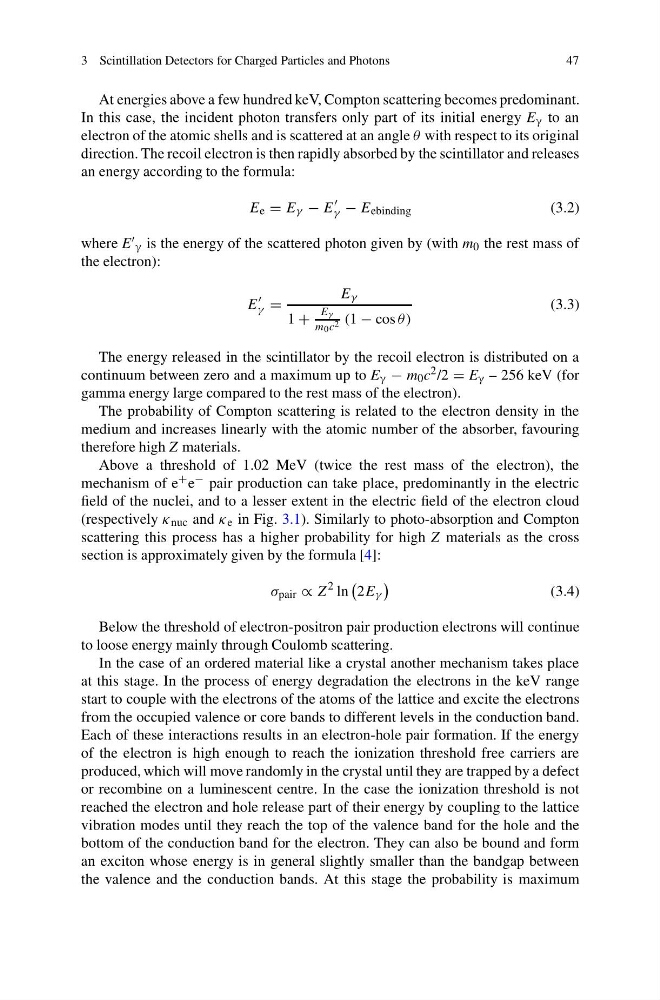
At energies above a few hundred keV, Compton scattering becomes predominant.
In this case, the incident photon transfers only part of its initial energy E γ to an
electron of the atomic shells and is scattered at an angle θ with respect to its original
direction. The recoil electron is then rapidly absorbed by the scintillator and releases
an energy according to the formula:
E e = E γ − E
γ − E ebinding
(3.2)
where E γ is the energy of the scattered photon given by (with m 0 the rest mass of
the electron):
E
γ =
E γ
1 +
E γ
m 0 c 2 (1 − cos θ )
(3.3)
The energy released in the scintillator by the recoil electron is distributed on a
continuum between zero and a maximum up to E γ − m 0 c 2 /2 = E γ – 256 keV (for
gamma energy large compared to the rest mass of the electron).
The probability of Compton scattering is related to the electron density in the
medium and increases linearly with the atomic number of the absorber, favouring
therefore high Z materials.
Above a threshold of 1.02 MeV (twice the rest mass of the electron), the
mechanism of e + e − pair production can take place, predominantly in the electric
field of the nuclei, and to a lesser extent in the electric field of the electron cloud
(respectively κ nuc and κ e in Fig. 3.1). Similarly to photo-absorption and Compton
scattering this process has a higher probability for high Z materials as the cross
section is approximately given by the formula [4]:
σ pair ∝ Z
2 ln
2E γ
(3.4)
Below the threshold of electron-positron pair production electrons will continue
to loose energy mainly through Coulomb scattering.
In the case of an ordered material like a crystal another mechanism takes place
at this stage. In the process of energy degradation the electrons in the keV range
start to couple with the electrons of the atoms of the lattice and excite the electrons
from the occupied valence or core bands to different levels in the conduction band.
Each of these interactions results in an electron-hole pair formation. If the energy
of the electron is high enough to reach the ionization threshold free carriers are
produced, which will move randomly in the crystal until they are trapped by a defect
or recombine on a luminescent centre. In the case the ionization threshold is not
reached the electron and hole release part of their energy by coupling to the lattice
vibration modes until they reach the top of the valence band for the hole and the
bottom of the conduction band for the electron. They can also be bound and form
an exciton whose energy is in general slightly smaller than the bandgap between
the valence and the conduction bands. At this stage the probability is maximum
47
At energies above a few hundred keV, Compton scattering becomes predominant.
In this case, the incident photon transfers only part of its initial energy E γ to an
electron of the atomic shells and is scattered at an angle θ with respect to its original
direction. The recoil electron is then rapidly absorbed by the scintillator and releases
an energy according to the formula:
E e = E γ − E
γ − E ebinding
(3.2)
where E γ is the energy of the scattered photon given by (with m 0 the rest mass of
the electron):
E
γ =
E γ
1 +
E γ
m 0 c 2 (1 − cos θ )
(3.3)
The energy released in the scintillator by the recoil electron is distributed on a
continuum between zero and a maximum up to E γ − m 0 c 2 /2 = E γ – 256 keV (for
gamma energy large compared to the rest mass of the electron).
The probability of Compton scattering is related to the electron density in the
medium and increases linearly with the atomic number of the absorber, favouring
therefore high Z materials.
Above a threshold of 1.02 MeV (twice the rest mass of the electron), the
mechanism of e + e − pair production can take place, predominantly in the electric
field of the nuclei, and to a lesser extent in the electric field of the electron cloud
(respectively κ nuc and κ e in Fig. 3.1). Similarly to photo-absorption and Compton
scattering this process has a higher probability for high Z materials as the cross
section is approximately given by the formula [4]:
σ pair ∝ Z
2 ln
2E γ
(3.4)
Below the threshold of electron-positron pair production electrons will continue
to loose energy mainly through Coulomb scattering.
In the case of an ordered material like a crystal another mechanism takes place
at this stage. In the process of energy degradation the electrons in the keV range
start to couple with the electrons of the atoms of the lattice and excite the electrons
from the occupied valence or core bands to different levels in the conduction band.
Each of these interactions results in an electron-hole pair formation. If the energy
of the electron is high enough to reach the ionization threshold free carriers are
produced, which will move randomly in the crystal until they are trapped by a defect
or recombine on a luminescent centre. In the case the ionization threshold is not
reached the electron and hole release part of their energy by coupling to the lattice
vibration modes until they reach the top of the valence band for the hole and the
bottom of the conduction band for the electron. They can also be bound and form
an exciton whose energy is in general slightly smaller than the bandgap between
the valence and the conduction bands. At this stage the probability is maximum