

46
P. Lecoq
In the case of X- or γ- rays, the three fundamental mechanisms of electromagnetic interaction are [3]:
• Photo-absorption
• Compton scattering
• Electron-positron pair production
The dominant process at low energy (up to a few hundred keV for heavy
materials) is the photoelectric absorption. The interacting photon transfers its energy
to an electron from one of the electron shells of the absorber atom (usually
from a deep shell). The resulting photoelectron is ejected with a kinetic energy
corresponding to the incident photon energy minus the binding energy of the
electron on its shell. This is followed by a rapid reorganization of the electron cloud
to fill the electron vacancy, which results in the emission of characteristic X-Rays
or Auger electrons. The photoelectric process has the highest probability when the
incident photon has an energy comparable to the kinetic energy of the electron on
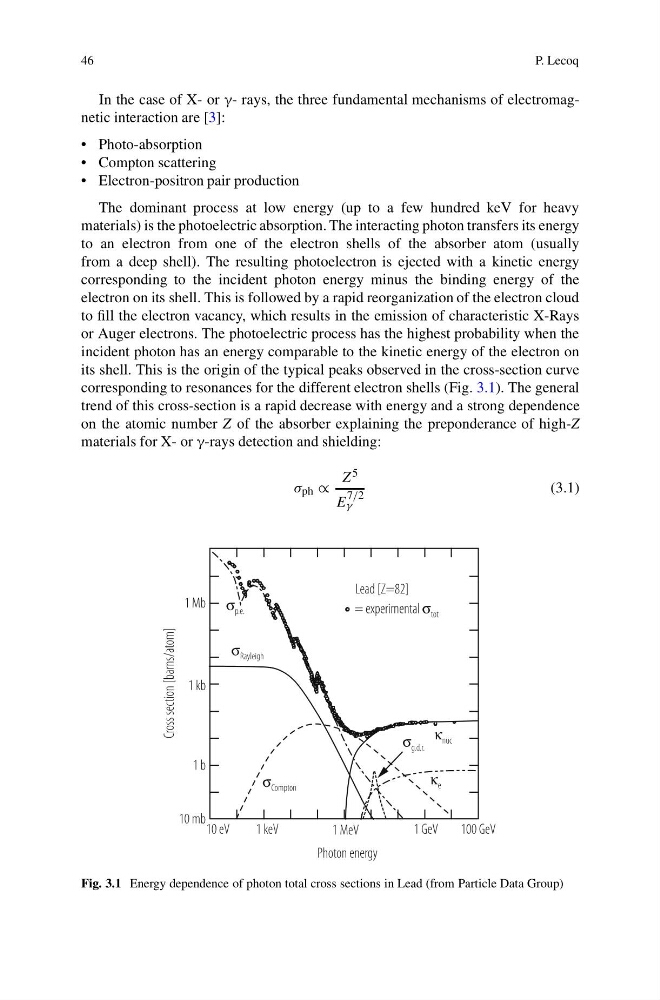
its shell. This is the origin of the typical peaks observed in the cross-section curve
corresponding to resonances for the different electron shells (Fig. 3.1). The general
trend of this cross-section is a rapid decrease with energy and a strong dependence
on the atomic number Z of the absorber explaining the preponderance of high-Z
materials for X- or γ-rays detection and shielding:
σ ph ∝
Z 5
E
7/2
γ
(3.1)
Fig. 3.1 Energy dependence of photon total cross sections in Lead (from Particle Data Group)
P. Lecoq
In the case of X- or γ- rays, the three fundamental mechanisms of electromagnetic interaction are [3]:
• Photo-absorption
• Compton scattering
• Electron-positron pair production
The dominant process at low energy (up to a few hundred keV for heavy
materials) is the photoelectric absorption. The interacting photon transfers its energy
to an electron from one of the electron shells of the absorber atom (usually
from a deep shell). The resulting photoelectron is ejected with a kinetic energy
corresponding to the incident photon energy minus the binding energy of the
electron on its shell. This is followed by a rapid reorganization of the electron cloud
to fill the electron vacancy, which results in the emission of characteristic X-Rays
or Auger electrons. The photoelectric process has the highest probability when the
incident photon has an energy comparable to the kinetic energy of the electron on
its shell. This is the origin of the typical peaks observed in the cross-section curve
corresponding to resonances for the different electron shells (Fig. 3.1). The general
trend of this cross-section is a rapid decrease with energy and a strong dependence
on the atomic number Z of the absorber explaining the preponderance of high-Z
materials for X- or γ-rays detection and shielding:
σ ph ∝
Z 5
E
7/2
γ
(3.1)
Fig. 3.1 Energy dependence of photon total cross sections in Lead (from Particle Data Group)