

12 Triggering and High-Level Data Selection
539
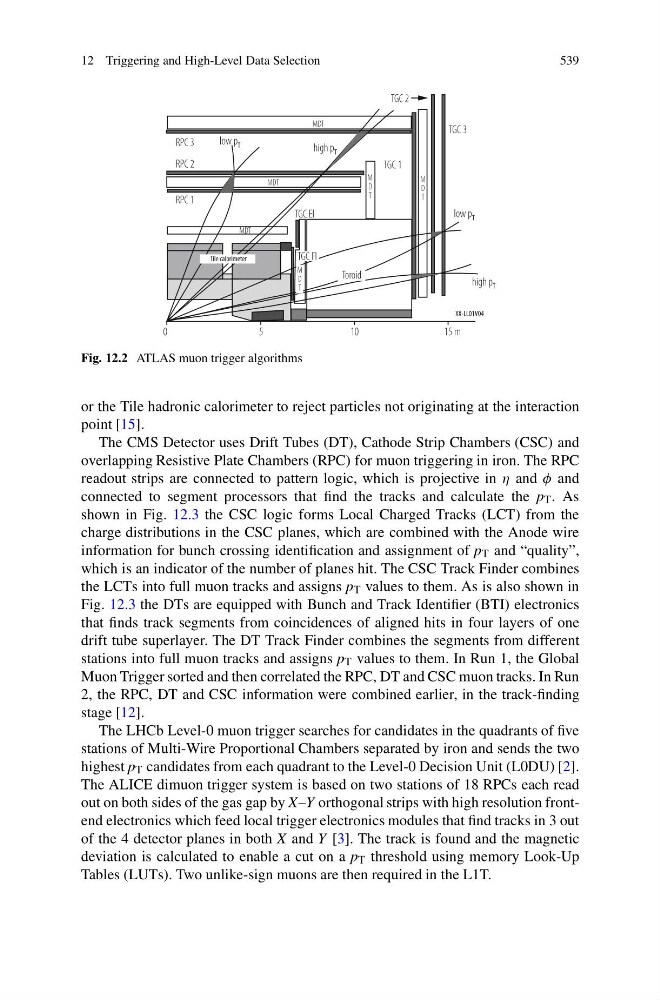
Fig. 12.2 ATLAS muon trigger algorithms
or the Tile hadronic calorimeter to reject particles not originating at the interaction
point [15].
The CMS Detector uses Drift Tubes (DT), Cathode Strip Chambers (CSC) and
overlapping Resistive Plate Chambers (RPC) for muon triggering in iron. The RPC
readout strips are connected to pattern logic, which is projective in η and φ and
connected to segment processors that find the tracks and calculate the p T . As
shown in Fig. 12.3 the CSC logic forms Local Charged Tracks (LCT) from the
charge distributions in the CSC planes, which are combined with the Anode wire
information for bunch crossing identification and assignment of p T and “quality”,
which is an indicator of the number of planes hit. The CSC Track Finder combines
the LCTs into full muon tracks and assigns p T values to them. As is also shown in
Fig. 12.3 the DTs are equipped with Bunch and Track Identifier (BTI) electronics
that finds track segments from coincidences of aligned hits in four layers of one
drift tube superlayer. The DT Track Finder combines the segments from different
stations into full muon tracks and assigns p T values to them. In Run 1, the Global
Muon Trigger sorted and then correlated the RPC, DT and CSC muon tracks. In Run
2, the RPC, DT and CSC information were combined earlier, in the track-finding
stage [12].
The LHCb Level-0 muon trigger searches for candidates in the quadrants of five
stations of Multi-Wire Proportional Chambers separated by iron and sends the two
highest p T candidates from each quadrant to the Level-0 Decision Unit (L0DU) [2].
The ALICE dimuon trigger system is based on two stations of 18 RPCs each read
out on both sides of the gas gap by X–Y orthogonal strips with high resolution frontend electronics which feed local trigger electronics modules that find tracks in 3 out
of the 4 detector planes in both X and Y [3]. The track is found and the magnetic
deviation is calculated to enable a cut on a p T threshold using memory Look-Up
Tables (LUTs). Two unlike-sign muons are then required in the L1T.
539
Fig. 12.2 ATLAS muon trigger algorithms
or the Tile hadronic calorimeter to reject particles not originating at the interaction
point [15].
The CMS Detector uses Drift Tubes (DT), Cathode Strip Chambers (CSC) and
overlapping Resistive Plate Chambers (RPC) for muon triggering in iron. The RPC
readout strips are connected to pattern logic, which is projective in η and φ and
connected to segment processors that find the tracks and calculate the p T . As
shown in Fig. 12.3 the CSC logic forms Local Charged Tracks (LCT) from the
charge distributions in the CSC planes, which are combined with the Anode wire
information for bunch crossing identification and assignment of p T and “quality”,
which is an indicator of the number of planes hit. The CSC Track Finder combines
the LCTs into full muon tracks and assigns p T values to them. As is also shown in
Fig. 12.3 the DTs are equipped with Bunch and Track Identifier (BTI) electronics
that finds track segments from coincidences of aligned hits in four layers of one
drift tube superlayer. The DT Track Finder combines the segments from different
stations into full muon tracks and assigns p T values to them. In Run 1, the Global
Muon Trigger sorted and then correlated the RPC, DT and CSC muon tracks. In Run
2, the RPC, DT and CSC information were combined earlier, in the track-finding
stage [12].
The LHCb Level-0 muon trigger searches for candidates in the quadrants of five
stations of Multi-Wire Proportional Chambers separated by iron and sends the two
highest p T candidates from each quadrant to the Level-0 Decision Unit (L0DU) [2].
The ALICE dimuon trigger system is based on two stations of 18 RPCs each read
out on both sides of the gas gap by X–Y orthogonal strips with high resolution frontend electronics which feed local trigger electronics modules that find tracks in 3 out
of the 4 detector planes in both X and Y [3]. The track is found and the magnetic
deviation is calculated to enable a cut on a p T threshold using memory Look-Up
Tables (LUTs). Two unlike-sign muons are then required in the L1T.