

466
V. Radeka
10.7 Equipartition and kTC Noise
Integration of the power spectrum (spectral density) arising on a capacitance from
the thermal noise current, i 2
n = 4kT /R, of the resistor results in the total fluctuation
of charge (and voltage), which is independent of the value of the resistance R. The
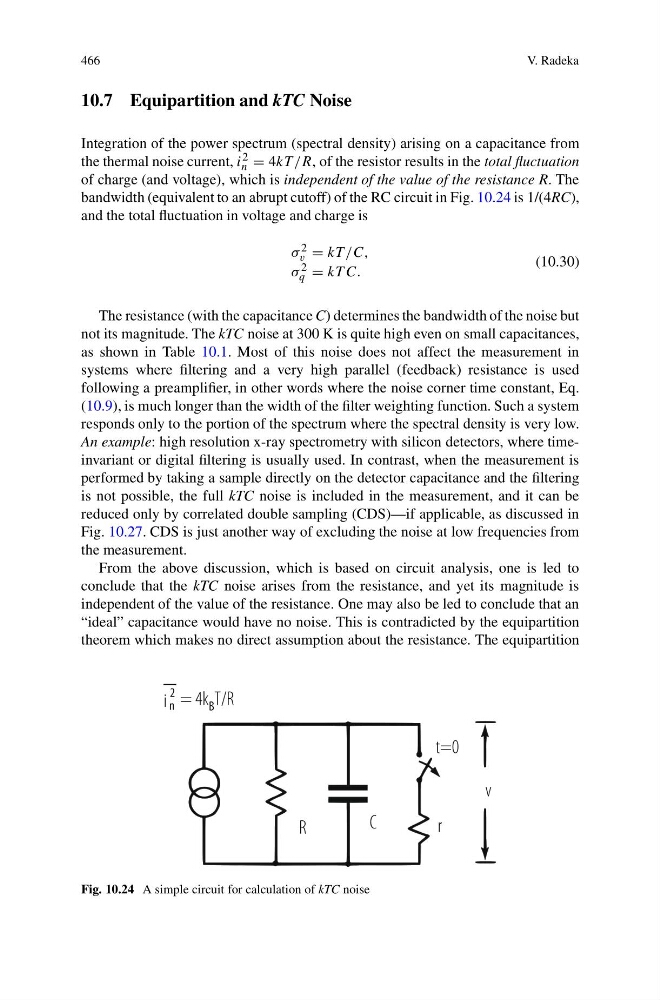
bandwidth (equivalent to an abrupt cutoff) of the RC circuit in Fig. 10.24 is 1/(4RC),
and the total fluctuation in voltage and charge is
σ 2
v = kT /C,
σ 2
q = kT C.
(10.30)
The resistance (with the capacitance C) determines the bandwidth of the noise but
not its magnitude. The kTC noise at 300 K is quite high even on small capacitances,
as shown in Table 10.1. Most of this noise does not affect the measurement in
systems where filtering and a very high parallel (feedback) resistance is used
following a preamplifier, in other words where the noise corner time constant, Eq.
(10.9), is much longer than the width of the filter weighting function. Such a system
responds only to the portion of the spectrum where the spectral density is very low.
An example: high resolution x-ray spectrometry with silicon detectors, where timeinvariant or digital filtering is usually used. In contrast, when the measurement is
performed by taking a sample directly on the detector capacitance and the filtering
is not possible, the full kTC noise is included in the measurement, and it can be
reduced only by correlated double sampling (CDS)—if applicable, as discussed in
Fig. 10.27. CDS is just another way of excluding the noise at low frequencies from
the measurement.
From the above discussion, which is based on circuit analysis, one is led to
conclude that the kTC noise arises from the resistance, and yet its magnitude is
independent of the value of the resistance. One may also be led to conclude that an
“ideal” capacitance would have no noise. This is contradicted by the equipartition
theorem which makes no direct assumption about the resistance. The equipartition
Fig. 10.24 A simple circuit for calculation of kTC noise
V. Radeka
10.7 Equipartition and kTC Noise
Integration of the power spectrum (spectral density) arising on a capacitance from
the thermal noise current, i 2
n = 4kT /R, of the resistor results in the total fluctuation
of charge (and voltage), which is independent of the value of the resistance R. The
bandwidth (equivalent to an abrupt cutoff) of the RC circuit in Fig. 10.24 is 1/(4RC),
and the total fluctuation in voltage and charge is
σ 2
v = kT /C,
σ 2
q = kT C.
(10.30)
The resistance (with the capacitance C) determines the bandwidth of the noise but
not its magnitude. The kTC noise at 300 K is quite high even on small capacitances,
as shown in Table 10.1. Most of this noise does not affect the measurement in
systems where filtering and a very high parallel (feedback) resistance is used
following a preamplifier, in other words where the noise corner time constant, Eq.
(10.9), is much longer than the width of the filter weighting function. Such a system
responds only to the portion of the spectrum where the spectral density is very low.
An example: high resolution x-ray spectrometry with silicon detectors, where timeinvariant or digital filtering is usually used. In contrast, when the measurement is
performed by taking a sample directly on the detector capacitance and the filtering
is not possible, the full kTC noise is included in the measurement, and it can be
reduced only by correlated double sampling (CDS)—if applicable, as discussed in
Fig. 10.27. CDS is just another way of excluding the noise at low frequencies from
the measurement.
From the above discussion, which is based on circuit analysis, one is led to
conclude that the kTC noise arises from the resistance, and yet its magnitude is
independent of the value of the resistance. One may also be led to conclude that an
“ideal” capacitance would have no noise. This is contradicted by the equipartition
theorem which makes no direct assumption about the resistance. The equipartition
Fig. 10.24 A simple circuit for calculation of kTC noise