

464
V. Radeka
Accurate noise calculations usually rely upon the measured or known noise
spectral density for a particular device and have to include parasitic capacitances
and resistances, as indicated in Fig. 10.20.
10.6 Weighting Function Realizations: Time Invariant
and Time Variant
10.6.1 Time-Invariant Signal Processing
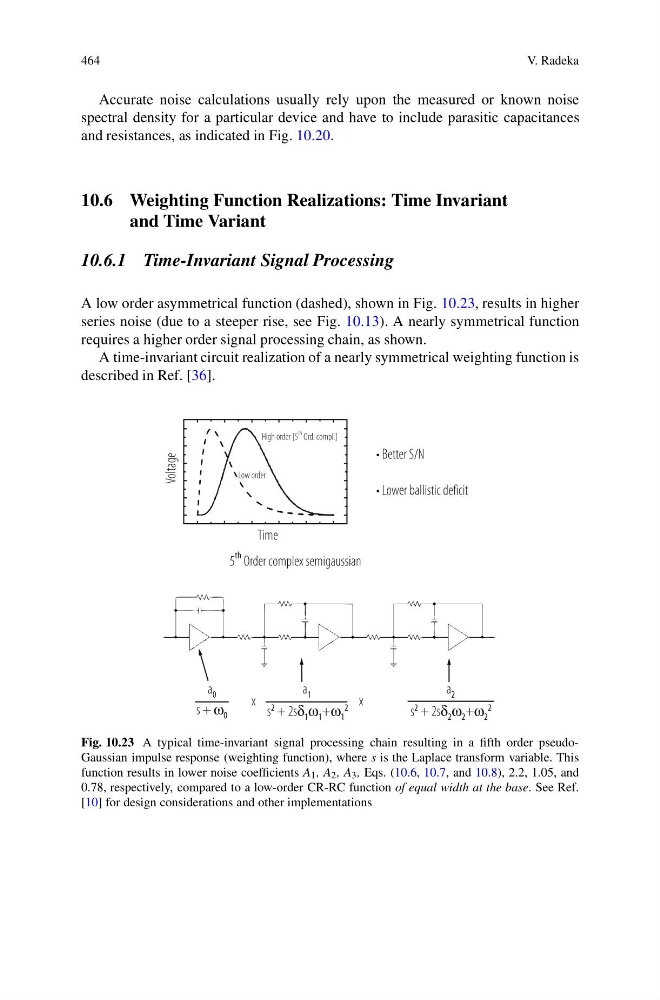
A low order asymmetrical function (dashed), shown in Fig. 10.23, results in higher
series noise (due to a steeper rise, see Fig. 10.13). A nearly symmetrical function
requires a higher order signal processing chain, as shown.
A time-invariant circuit realization of a nearly symmetrical weighting function is
described in Ref. [36].
Fig. 10.23 A typical time-invariant signal processing chain resulting in a fifth order pseudoGaussian impulse response (weighting function), where s is the Laplace transform variable. This
function results in lower noise coefficients A 1 , A 2 , A 3 , Eqs. (10.6, 10.7, and 10.8), 2.2, 1.05, and
0.78, respectively, compared to a low-order CR-RC function of equal width at the base. See Ref.
[10] for design considerations and other implementations
V. Radeka
Accurate noise calculations usually rely upon the measured or known noise
spectral density for a particular device and have to include parasitic capacitances
and resistances, as indicated in Fig. 10.20.
10.6 Weighting Function Realizations: Time Invariant
and Time Variant
10.6.1 Time-Invariant Signal Processing
A low order asymmetrical function (dashed), shown in Fig. 10.23, results in higher
series noise (due to a steeper rise, see Fig. 10.13). A nearly symmetrical function
requires a higher order signal processing chain, as shown.
A time-invariant circuit realization of a nearly symmetrical weighting function is
described in Ref. [36].
Fig. 10.23 A typical time-invariant signal processing chain resulting in a fifth order pseudoGaussian impulse response (weighting function), where s is the Laplace transform variable. This
function results in lower noise coefficients A 1 , A 2 , A 3 , Eqs. (10.6, 10.7, and 10.8), 2.2, 1.05, and
0.78, respectively, compared to a low-order CR-RC function of equal width at the base. See Ref.
[10] for design considerations and other implementations