

460
V. Radeka
ranges from 10 −27 J for junction field-effect transistors (JFETs) to ~10 −25 J for
p-channel and ~ 10 −24 J for n-channel MOS transistors.
For an accurate calculation of the noise charge for noise spectra departing from
the three-term power-law representation (“white series voltage noise”, “1/f series
voltage noise”, and “white parallel current noise”), circuit simulation and numerical
calculation are the tools of choice to obtain accurate results. The discussion here was
intended to provide some insight: ENC f depends only on the shape of the weighting
function but not on the time scale.
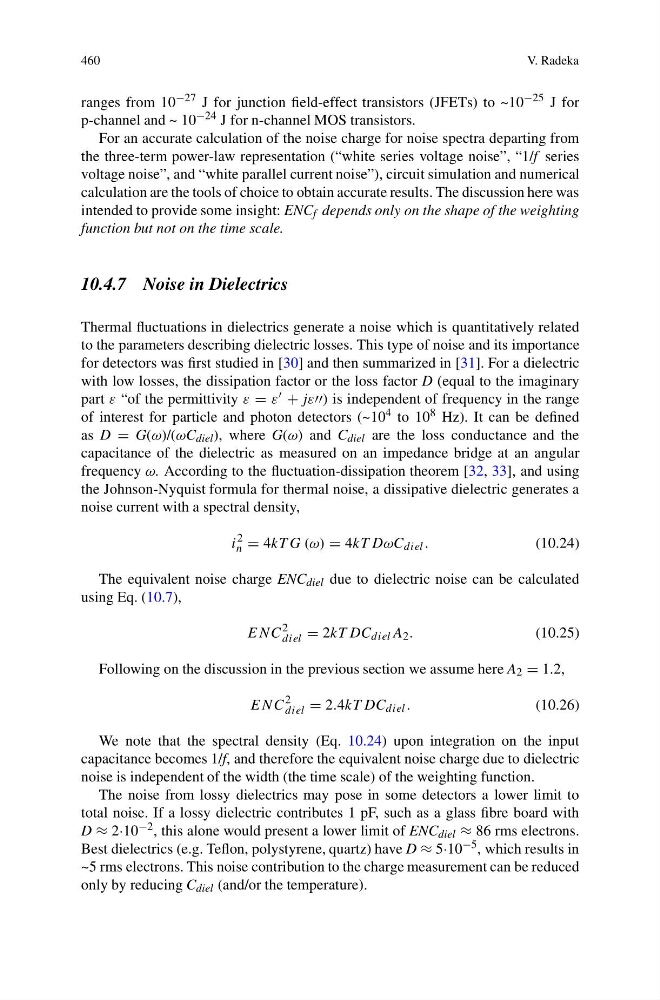
10.4.7 Noise in Dielectrics
Thermal fluctuations in dielectrics generate a noise which is quantitatively related
to the parameters describing dielectric losses. This type of noise and its importance
for detectors was first studied in [30] and then summarized in [31]. For a dielectric
with low losses, the dissipation factor or the loss factor D (equal to the imaginary
part ε “of the permittivity ε = ε + jε) is independent of frequency in the range
of interest for particle and photon detectors (~10 4 to 10 8 Hz). It can be defined
as D = G(ω)/(ωC diel ), where G(ω) and C diel are the loss conductance and the
capacitance of the dielectric as measured on an impedance bridge at an angular
frequency ω. According to the fluctuation-dissipation theorem [32, 33], and using
the Johnson-Nyquist formula for thermal noise, a dissipative dielectric generates a
noise current with a spectral density,
i
2
n = 4kT G (ω) = 4kT DωC diel .
(10.24)
The equivalent noise charge ENC diel due to dielectric noise can be calculated
using Eq. (10.7),
ENC
2
diel = 2kT DC diel A 2 .
(10.25)
Following on the discussion in the previous section we assume here A 2 = 1.2,
ENC
2
diel = 2.4kT DC diel .
(10.26)
We note that the spectral density (Eq. 10.24) upon integration on the input
capacitance becomes 1/f, and therefore the equivalent noise charge due to dielectric
noise is independent of the width (the time scale) of the weighting function.
The noise from lossy dielectrics may pose in some detectors a lower limit to
total noise. If a lossy dielectric contributes 1 pF, such as a glass fibre board with
D ≈ 2·10 −2 , this alone would present a lower limit of ENC diel ≈ 86 rms electrons.
Best dielectrics (e.g. Teflon, polystyrene, quartz) have D ≈ 5·10 −5 , which results in
~5 rms electrons. This noise contribution to the charge measurement can be reduced
only by reducing C diel (and/or the temperature).
V. Radeka
ranges from 10 −27 J for junction field-effect transistors (JFETs) to ~10 −25 J for
p-channel and ~ 10 −24 J for n-channel MOS transistors.
For an accurate calculation of the noise charge for noise spectra departing from
the three-term power-law representation (“white series voltage noise”, “1/f series
voltage noise”, and “white parallel current noise”), circuit simulation and numerical
calculation are the tools of choice to obtain accurate results. The discussion here was
intended to provide some insight: ENC f depends only on the shape of the weighting
function but not on the time scale.
10.4.7 Noise in Dielectrics
Thermal fluctuations in dielectrics generate a noise which is quantitatively related
to the parameters describing dielectric losses. This type of noise and its importance
for detectors was first studied in [30] and then summarized in [31]. For a dielectric
with low losses, the dissipation factor or the loss factor D (equal to the imaginary
part ε “of the permittivity ε = ε + jε) is independent of frequency in the range
of interest for particle and photon detectors (~10 4 to 10 8 Hz). It can be defined
as D = G(ω)/(ωC diel ), where G(ω) and C diel are the loss conductance and the
capacitance of the dielectric as measured on an impedance bridge at an angular
frequency ω. According to the fluctuation-dissipation theorem [32, 33], and using
the Johnson-Nyquist formula for thermal noise, a dissipative dielectric generates a
noise current with a spectral density,
i
2
n = 4kT G (ω) = 4kT DωC diel .
(10.24)
The equivalent noise charge ENC diel due to dielectric noise can be calculated
using Eq. (10.7),
ENC
2
diel = 2kT DC diel A 2 .
(10.25)
Following on the discussion in the previous section we assume here A 2 = 1.2,
ENC
2
diel = 2.4kT DC diel .
(10.26)
We note that the spectral density (Eq. 10.24) upon integration on the input
capacitance becomes 1/f, and therefore the equivalent noise charge due to dielectric
noise is independent of the width (the time scale) of the weighting function.
The noise from lossy dielectrics may pose in some detectors a lower limit to
total noise. If a lossy dielectric contributes 1 pF, such as a glass fibre board with
D ≈ 2·10 −2 , this alone would present a lower limit of ENC diel ≈ 86 rms electrons.
Best dielectrics (e.g. Teflon, polystyrene, quartz) have D ≈ 5·10 −5 , which results in
~5 rms electrons. This noise contribution to the charge measurement can be reduced
only by reducing C diel (and/or the temperature).