

9 Nuclear Emulsions
429
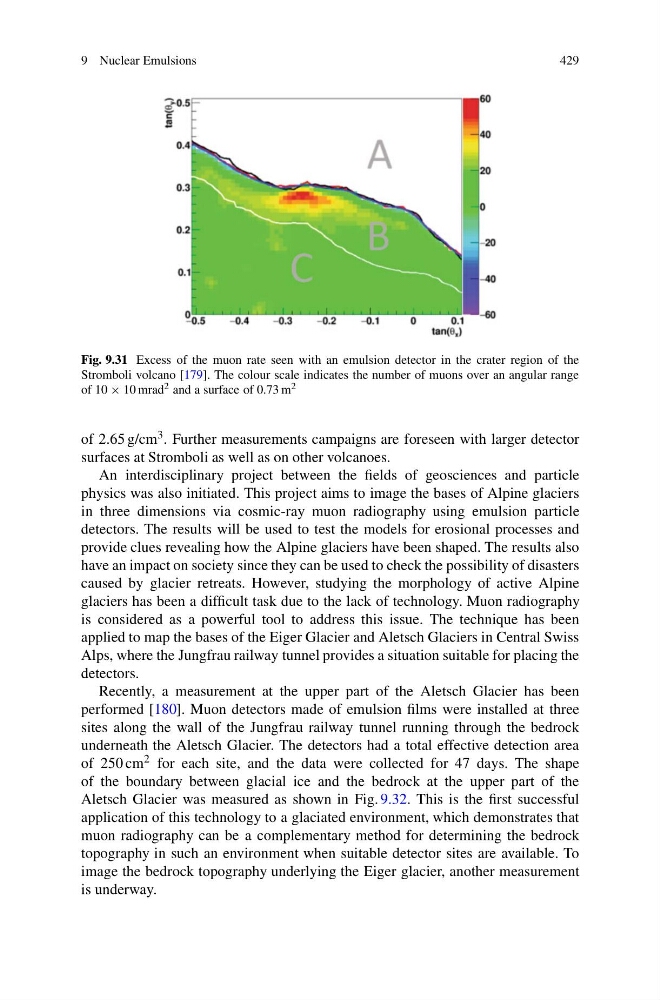
Fig. 9.31 Excess of the muon rate seen with an emulsion detector in the crater region of the
Stromboli volcano [179]. The colour scale indicates the number of muons over an angular range
of 10 × 10 mrad 2 and a surface of 0.73 m 2
of 2.65 g/cm 3 . Further measurements campaigns are foreseen with larger detector
surfaces at Stromboli as well as on other volcanoes.
An interdisciplinary project between the fields of geosciences and particle
physics was also initiated. This project aims to image the bases of Alpine glaciers
in three dimensions via cosmic-ray muon radiography using emulsion particle
detectors. The results will be used to test the models for erosional processes and
provide clues revealing how the Alpine glaciers have been shaped. The results also
have an impact on society since they can be used to check the possibility of disasters
caused by glacier retreats. However, studying the morphology of active Alpine
glaciers has been a difficult task due to the lack of technology. Muon radiography
is considered as a powerful tool to address this issue. The technique has been
applied to map the bases of the Eiger Glacier and Aletsch Glaciers in Central Swiss
Alps, where the Jungfrau railway tunnel provides a situation suitable for placing the
detectors.
Recently, a measurement at the upper part of the Aletsch Glacier has been
performed [180]. Muon detectors made of emulsion films were installed at three
sites along the wall of the Jungfrau railway tunnel running through the bedrock
underneath the Aletsch Glacier. The detectors had a total effective detection area
of 250 cm 2 for each site, and the data were collected for 47 days. The shape
of the boundary between glacial ice and the bedrock at the upper part of the
Aletsch Glacier was measured as shown in Fig. 9.32. This is the first successful
application of this technology to a glaciated environment, which demonstrates that
muon radiography can be a complementary method for determining the bedrock
topography in such an environment when suitable detector sites are available. To
image the bedrock topography underlying the Eiger glacier, another measurement
is underway.
429
Fig. 9.31 Excess of the muon rate seen with an emulsion detector in the crater region of the
Stromboli volcano [179]. The colour scale indicates the number of muons over an angular range
of 10 × 10 mrad 2 and a surface of 0.73 m 2
of 2.65 g/cm 3 . Further measurements campaigns are foreseen with larger detector
surfaces at Stromboli as well as on other volcanoes.
An interdisciplinary project between the fields of geosciences and particle
physics was also initiated. This project aims to image the bases of Alpine glaciers
in three dimensions via cosmic-ray muon radiography using emulsion particle
detectors. The results will be used to test the models for erosional processes and
provide clues revealing how the Alpine glaciers have been shaped. The results also
have an impact on society since they can be used to check the possibility of disasters
caused by glacier retreats. However, studying the morphology of active Alpine
glaciers has been a difficult task due to the lack of technology. Muon radiography
is considered as a powerful tool to address this issue. The technique has been
applied to map the bases of the Eiger Glacier and Aletsch Glaciers in Central Swiss
Alps, where the Jungfrau railway tunnel provides a situation suitable for placing the
detectors.
Recently, a measurement at the upper part of the Aletsch Glacier has been
performed [180]. Muon detectors made of emulsion films were installed at three
sites along the wall of the Jungfrau railway tunnel running through the bedrock
underneath the Aletsch Glacier. The detectors had a total effective detection area
of 250 cm 2 for each site, and the data were collected for 47 days. The shape
of the boundary between glacial ice and the bedrock at the upper part of the
Aletsch Glacier was measured as shown in Fig. 9.32. This is the first successful
application of this technology to a glaciated environment, which demonstrates that
muon radiography can be a complementary method for determining the bedrock
topography in such an environment when suitable detector sites are available. To
image the bedrock topography underlying the Eiger glacier, another measurement
is underway.