

9 Nuclear Emulsions
403
the grain density of tracks accumulated before the refreshing goes from 30 to less
than 10 grains/100 μm, thus erasing about 96% of the stored tracks, including those
from Compton electrons and cosmic-rays. The industrially produced films also
feature a rather low track distortion induced by the development, as well as a limited
level of fog density, with an initial value of 2.9 fog grains/1000 μm 3 ).
9.5.2 The OPERA Experiment
The OPERA experiment was designed to unambiguously prove ν μ → ν τ oscillations in appearance mode. Indeed, studies of atmospheric neutrinos had shown
the disappearance of muon neutrinos [94], later confirmed by accelerator experiments [95] and interpreted in terms of ν μ → ν τ oscillations. Therefore, the
appearance of tau neutrinos in a pure muon neutrino beam was the missing tile
in the coherent scenario of neutrino mixing.
The conceptual design of the experiment was originally proposed in [96–98]
and the detector is extensively described in [99, 100]. The distinctive feature of ν τ
charged-current interactions is the production of a short-lived τ lepton (cτ = 87 μm).
Thus, one has to accomplish the very difficult task of detecting sub-millimeter τ
decay topologies out of a huge background of ν μ reactions in a target of more than a
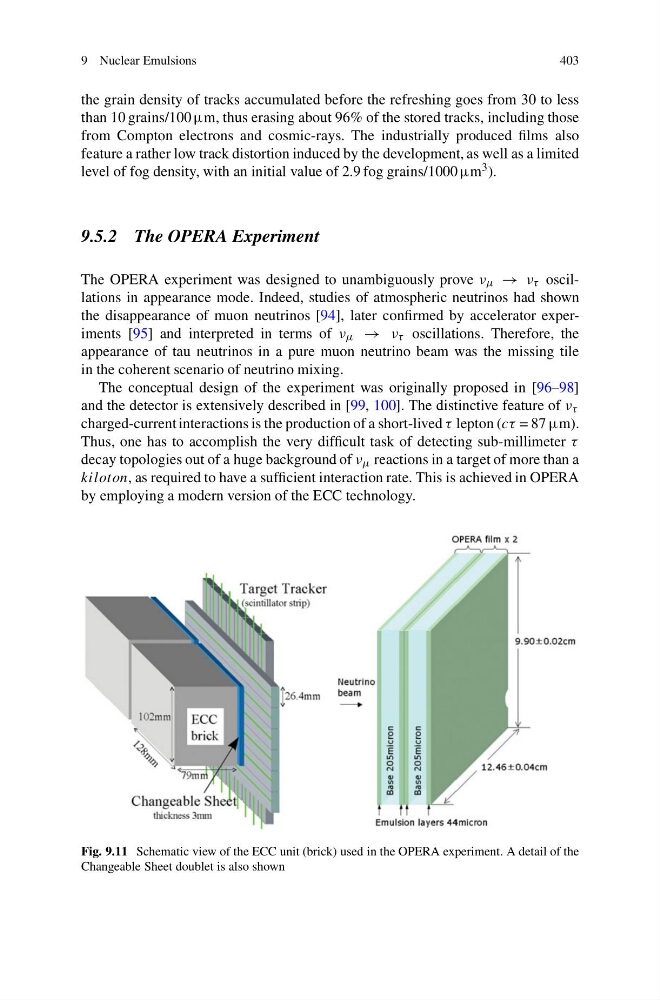
kiloton, as required to have a sufficient interaction rate. This is achieved in OPERA
by employing a modern version of the ECC technology.
Fig. 9.11 Schematic view of the ECC unit (brick) used in the OPERA experiment. A detail of the
Changeable Sheet doublet is also shown
403
the grain density of tracks accumulated before the refreshing goes from 30 to less
than 10 grains/100 μm, thus erasing about 96% of the stored tracks, including those
from Compton electrons and cosmic-rays. The industrially produced films also
feature a rather low track distortion induced by the development, as well as a limited
level of fog density, with an initial value of 2.9 fog grains/1000 μm 3 ).
9.5.2 The OPERA Experiment
The OPERA experiment was designed to unambiguously prove ν μ → ν τ oscillations in appearance mode. Indeed, studies of atmospheric neutrinos had shown
the disappearance of muon neutrinos [94], later confirmed by accelerator experiments [95] and interpreted in terms of ν μ → ν τ oscillations. Therefore, the
appearance of tau neutrinos in a pure muon neutrino beam was the missing tile
in the coherent scenario of neutrino mixing.
The conceptual design of the experiment was originally proposed in [96–98]
and the detector is extensively described in [99, 100]. The distinctive feature of ν τ
charged-current interactions is the production of a short-lived τ lepton (cτ = 87 μm).
Thus, one has to accomplish the very difficult task of detecting sub-millimeter τ
decay topologies out of a huge background of ν μ reactions in a target of more than a
kiloton, as required to have a sufficient interaction rate. This is achieved in OPERA
by employing a modern version of the ECC technology.
Fig. 9.11 Schematic view of the ECC unit (brick) used in the OPERA experiment. A detail of the
Changeable Sheet doublet is also shown