

9 Nuclear Emulsions
401
× 400 μm 2 ) are scanned by repeating the data acquisition sequence on a grid of
adjacent fields of view. The stage is moved to the desired position and the images
are grabbed after it stops, with a stop-and-go algorithm. The images are grabbed
by a Mpixel camera at the speed of 376 frames per second while the camera is
moving in the Z direction. The whole system can work at a sustained speed of
20 cm 2 /h/layer, 24 h/day, with an average data rate as large as 4 GB/day/microscope
still preserving the intrinsic emulsion accuracy. A different setup of this system
makes no use of immersion oil as interface between the objective lens and the film
being scanned [92].
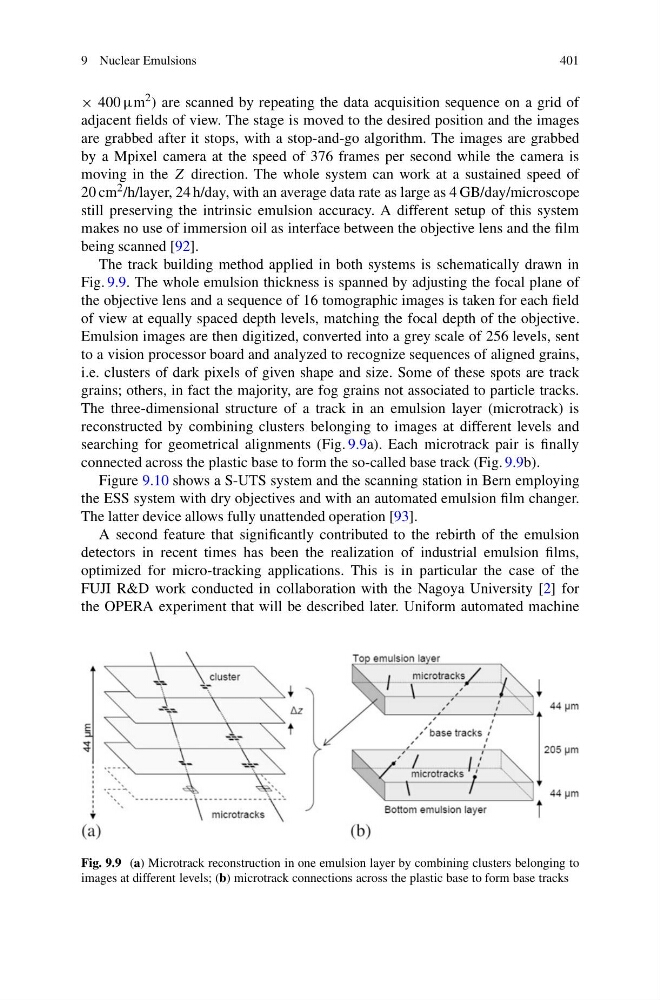
The track building method applied in both systems is schematically drawn in
Fig. 9.9. The whole emulsion thickness is spanned by adjusting the focal plane of
the objective lens and a sequence of 16 tomographic images is taken for each field
of view at equally spaced depth levels, matching the focal depth of the objective.
Emulsion images are then digitized, converted into a grey scale of 256 levels, sent
to a vision processor board and analyzed to recognize sequences of aligned grains,
i.e. clusters of dark pixels of given shape and size. Some of these spots are track
grains; others, in fact the majority, are fog grains not associated to particle tracks.
The three-dimensional structure of a track in an emulsion layer (microtrack) is
reconstructed by combining clusters belonging to images at different levels and
searching for geometrical alignments (Fig. 9.9a). Each microtrack pair is finally
connected across the plastic base to form the so-called base track (Fig. 9.9b).
Figure 9.10 shows a S-UTS system and the scanning station in Bern employing
the ESS system with dry objectives and with an automated emulsion film changer.
The latter device allows fully unattended operation [93].
A second feature that significantly contributed to the rebirth of the emulsion
detectors in recent times has been the realization of industrial emulsion films,
optimized for micro-tracking applications. This is in particular the case of the
FUJI R&D work conducted in collaboration with the Nagoya University [2] for
the OPERA experiment that will be described later. Uniform automated machine
Fig. 9.9 (a) Microtrack reconstruction in one emulsion layer by combining clusters belonging to
images at different levels; (b) microtrack connections across the plastic base to form base tracks
401
× 400 μm 2 ) are scanned by repeating the data acquisition sequence on a grid of
adjacent fields of view. The stage is moved to the desired position and the images
are grabbed after it stops, with a stop-and-go algorithm. The images are grabbed
by a Mpixel camera at the speed of 376 frames per second while the camera is
moving in the Z direction. The whole system can work at a sustained speed of
20 cm 2 /h/layer, 24 h/day, with an average data rate as large as 4 GB/day/microscope
still preserving the intrinsic emulsion accuracy. A different setup of this system
makes no use of immersion oil as interface between the objective lens and the film
being scanned [92].
The track building method applied in both systems is schematically drawn in
Fig. 9.9. The whole emulsion thickness is spanned by adjusting the focal plane of
the objective lens and a sequence of 16 tomographic images is taken for each field
of view at equally spaced depth levels, matching the focal depth of the objective.
Emulsion images are then digitized, converted into a grey scale of 256 levels, sent
to a vision processor board and analyzed to recognize sequences of aligned grains,
i.e. clusters of dark pixels of given shape and size. Some of these spots are track
grains; others, in fact the majority, are fog grains not associated to particle tracks.
The three-dimensional structure of a track in an emulsion layer (microtrack) is
reconstructed by combining clusters belonging to images at different levels and
searching for geometrical alignments (Fig. 9.9a). Each microtrack pair is finally
connected across the plastic base to form the so-called base track (Fig. 9.9b).
Figure 9.10 shows a S-UTS system and the scanning station in Bern employing
the ESS system with dry objectives and with an automated emulsion film changer.
The latter device allows fully unattended operation [93].
A second feature that significantly contributed to the rebirth of the emulsion
detectors in recent times has been the realization of industrial emulsion films,
optimized for micro-tracking applications. This is in particular the case of the
FUJI R&D work conducted in collaboration with the Nagoya University [2] for
the OPERA experiment that will be described later. Uniform automated machine
Fig. 9.9 (a) Microtrack reconstruction in one emulsion layer by combining clusters belonging to
images at different levels; (b) microtrack connections across the plastic base to form base tracks