

9 Nuclear Emulsions
399
Higher sensitivity follow-ups of the CHORUS experiment were proposed, with
the purpose of increasing by more than one order of magnitude its sensitivity in the
measurement of the oscillations (smaller mixing angle). We mention in particular
the COSMOS proposal at Fermilab [82]. The use of emulsions as large-surface
trackers for the high-resolution measurement of hadron and muon momenta was
proposed in [83] and then applied for the proposal of the TOSCA experiment at
CERN [84]. Eventually, all those experiments were not realized mainly due to
the first strong indications for ν μ ↔ ν τ oscillations detected with atmospheric
neutrinos, in disappearance mode, in a complementary region of the oscillation
parameters.
The DONUT experiment at Fermilab aimed at the first direct detection of ν τ s, in
this case promptly produced in a 800 GeV proton beam dump and not coming from
the possible oscillation mechanism as in CHORUS. The experimental apparatus
and the detection techniques used in the experiment are described in [68, 85].
The DONUT Collaboration employed an iron/emulsion ECC target able to offer a
sufficiently high mass to the interaction of the neutrinos and to provide the detection
of the interaction vertex, as well as a clear observation of the short track of the τ
lepton (up to a few mm) produced in the ν τ charged current interaction. The ECC
was complemented by high-precision fiber trackers to drive the scan back in the
emulsions.
The emulsion target eventually integrated a relatively high muon background.
In a first analysis, 203 neutrino interactions were located in the ECC target,
observing 4 ν τ candidate events with an estimated background of 0.34 events [86].
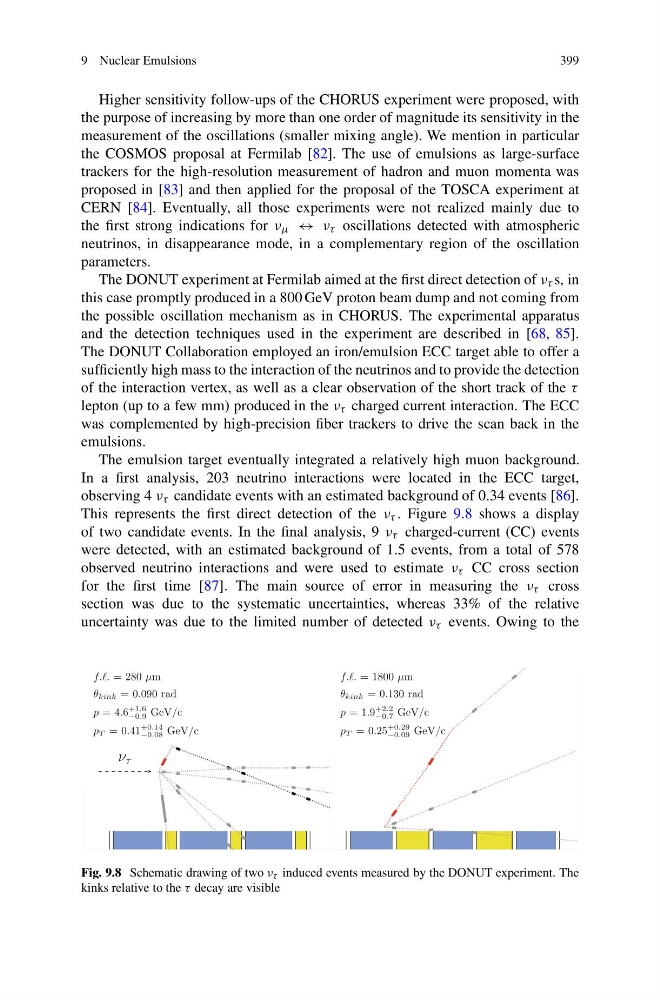
This represents the first direct detection of the ν τ . Figure 9.8 shows a display
of two candidate events. In the final analysis, 9 ν τ charged-current (CC) events
were detected, with an estimated background of 1.5 events, from a total of 578
observed neutrino interactions and were used to estimate ν τ CC cross section
for the first time [87]. The main source of error in measuring the ν τ cross
section was due to the systematic uncertainties, whereas 33% of the relative
uncertainty was due to the limited number of detected ν τ events. Owing to the
F.L.=280μm
θ kink =0.090rad
P t =414
+144
-81 Mev/c
P=4.6
+1.6
-0.9 Gev/c
ν τ
F.L.=1800μm
θ kink =0.130rad
P t =246
+285
-90 Mev/c
P=1.9
+2.2
-0.7 Gev/c
f... = 280 μm
θ kink = 0.090 rad
p = 4.6
+1.6
−0.9 GeV/c
p T = 0.41
+0.14
−0.08 GeV/c
ν τ
f... = 1800 μm
θ kink = 0.130 rad
p = 1.9
+2.2
−0.7 GeV/c
p T = 0.25
+0.29
−0.09 GeV/c
Fig. 9.8 Schematic drawing of two ν τ induced events measured by the DONUT experiment. The
kinks relative to the τ decay are visible
399
Higher sensitivity follow-ups of the CHORUS experiment were proposed, with
the purpose of increasing by more than one order of magnitude its sensitivity in the
measurement of the oscillations (smaller mixing angle). We mention in particular
the COSMOS proposal at Fermilab [82]. The use of emulsions as large-surface
trackers for the high-resolution measurement of hadron and muon momenta was
proposed in [83] and then applied for the proposal of the TOSCA experiment at
CERN [84]. Eventually, all those experiments were not realized mainly due to
the first strong indications for ν μ ↔ ν τ oscillations detected with atmospheric
neutrinos, in disappearance mode, in a complementary region of the oscillation
parameters.
The DONUT experiment at Fermilab aimed at the first direct detection of ν τ s, in
this case promptly produced in a 800 GeV proton beam dump and not coming from
the possible oscillation mechanism as in CHORUS. The experimental apparatus
and the detection techniques used in the experiment are described in [68, 85].
The DONUT Collaboration employed an iron/emulsion ECC target able to offer a
sufficiently high mass to the interaction of the neutrinos and to provide the detection
of the interaction vertex, as well as a clear observation of the short track of the τ
lepton (up to a few mm) produced in the ν τ charged current interaction. The ECC
was complemented by high-precision fiber trackers to drive the scan back in the
emulsions.
The emulsion target eventually integrated a relatively high muon background.
In a first analysis, 203 neutrino interactions were located in the ECC target,
observing 4 ν τ candidate events with an estimated background of 0.34 events [86].
This represents the first direct detection of the ν τ . Figure 9.8 shows a display
of two candidate events. In the final analysis, 9 ν τ charged-current (CC) events
were detected, with an estimated background of 1.5 events, from a total of 578
observed neutrino interactions and were used to estimate ν τ CC cross section
for the first time [87]. The main source of error in measuring the ν τ cross
section was due to the systematic uncertainties, whereas 33% of the relative
uncertainty was due to the limited number of detected ν τ events. Owing to the
F.L.=280μm
θ kink =0.090rad
P t =414
+144
-81 Mev/c
P=4.6
+1.6
-0.9 Gev/c
ν τ
F.L.=1800μm
θ kink =0.130rad
P t =246
+285
-90 Mev/c
P=1.9
+2.2
-0.7 Gev/c
f... = 280 μm
θ kink = 0.090 rad
p = 4.6
+1.6
−0.9 GeV/c
p T = 0.41
+0.14
−0.08 GeV/c
ν τ
f... = 1800 μm
θ kink = 0.130 rad
p = 1.9
+2.2
−0.7 GeV/c
p T = 0.25
+0.29
−0.09 GeV/c
Fig. 9.8 Schematic drawing of two ν τ induced events measured by the DONUT experiment. The
kinks relative to the τ decay are visible