

398
A. Ariga et al.
primary and secondary vertices making used of the “stack” configuration. Decay
topologies could be well separated from ordinary nuclear interactions, since the
latter usually exhibit fragments from nuclear break-up or so-called “blobs” from
nuclear recoil.
More than 100,000 neutrino interactions were located in CHORUS. The search
for oscillations was negative and an upper limit to the oscillation probability was
eventually set [77]. CHORUS reported the first observation of the associated charm
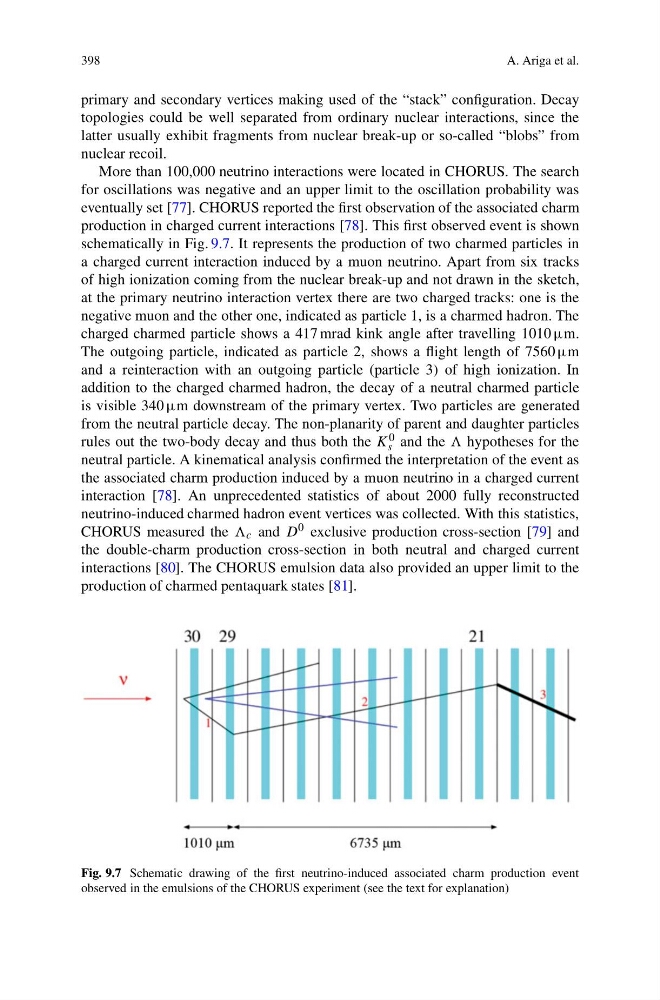
production in charged current interactions [78]. This first observed event is shown
schematically in Fig. 9.7. It represents the production of two charmed particles in
a charged current interaction induced by a muon neutrino. Apart from six tracks
of high ionization coming from the nuclear break-up and not drawn in the sketch,
at the primary neutrino interaction vertex there are two charged tracks: one is the
negative muon and the other one, indicated as particle 1, is a charmed hadron. The
charged charmed particle shows a 417 mrad kink angle after travelling 1010 μm.
The outgoing particle, indicated as particle 2, shows a flight length of 7560 μm
and a reinteraction with an outgoing particle (particle 3) of high ionization. In
addition to the charged charmed hadron, the decay of a neutral charmed particle
is visible 340 μm downstream of the primary vertex. Two particles are generated
from the neutral particle decay. The non-planarity of parent and daughter particles
rules out the two-body decay and thus both the K 0
s and the hypotheses for the
neutral particle. A kinematical analysis confirmed the interpretation of the event as
the associated charm production induced by a muon neutrino in a charged current
interaction [78]. An unprecedented statistics of about 2000 fully reconstructed
neutrino-induced charmed hadron event vertices was collected. With this statistics,
CHORUS measured the c and D 0 exclusive production cross-section [79] and
the double-charm production cross-section in both neutral and charged current
interactions [80]. The CHORUS emulsion data also provided an upper limit to the
production of charmed pentaquark states [81].
Fig. 9.7 Schematic drawing of the first neutrino-induced associated charm production event
observed in the emulsions of the CHORUS experiment (see the text for explanation)
A. Ariga et al.
primary and secondary vertices making used of the “stack” configuration. Decay
topologies could be well separated from ordinary nuclear interactions, since the
latter usually exhibit fragments from nuclear break-up or so-called “blobs” from
nuclear recoil.
More than 100,000 neutrino interactions were located in CHORUS. The search
for oscillations was negative and an upper limit to the oscillation probability was
eventually set [77]. CHORUS reported the first observation of the associated charm
production in charged current interactions [78]. This first observed event is shown
schematically in Fig. 9.7. It represents the production of two charmed particles in
a charged current interaction induced by a muon neutrino. Apart from six tracks
of high ionization coming from the nuclear break-up and not drawn in the sketch,
at the primary neutrino interaction vertex there are two charged tracks: one is the
negative muon and the other one, indicated as particle 1, is a charmed hadron. The
charged charmed particle shows a 417 mrad kink angle after travelling 1010 μm.
The outgoing particle, indicated as particle 2, shows a flight length of 7560 μm
and a reinteraction with an outgoing particle (particle 3) of high ionization. In
addition to the charged charmed hadron, the decay of a neutral charmed particle
is visible 340 μm downstream of the primary vertex. Two particles are generated
from the neutral particle decay. The non-planarity of parent and daughter particles
rules out the two-body decay and thus both the K 0
s and the hypotheses for the
neutral particle. A kinematical analysis confirmed the interpretation of the event as
the associated charm production induced by a muon neutrino in a charged current
interaction [78]. An unprecedented statistics of about 2000 fully reconstructed
neutrino-induced charmed hadron event vertices was collected. With this statistics,
CHORUS measured the c and D 0 exclusive production cross-section [79] and
the double-charm production cross-section in both neutral and charged current
interactions [80]. The CHORUS emulsion data also provided an upper limit to the
production of charmed pentaquark states [81].
Fig. 9.7 Schematic drawing of the first neutrino-induced associated charm production event
observed in the emulsions of the CHORUS experiment (see the text for explanation)