

9 Nuclear Emulsions
387
difficulties of processing increased rapidly with the thickness and new difficulties
appeared in the visual inspection, due to the larger scattering of light in the
emulsions and the loss of optical contrast.
Plates were arranged in pairs with emulsions face to face, thus doubling the
effective thickness. In 1952 a new approach was established [11–13]. Once a batch
of plates was produced, the emulsions were stripped from the glass and packed
together to form an almost solid sensitive mass, named stack. After exposure,
the emulsions were dipped in a solution of glycerine with gelatine and then
made to adhere to specially prepared glass plates. The use of a penetrating Xray beam defined a reference frame to connect consecutive emulsion layers. With
such a procedure, tracks of single particles could be quickly followed through the
successive emulsions of a stack. The use of stripped emulsions became popular and
allowed to make important contributions to many experiments in particle physics,
as we will see in the following.
Photographic plates with 600 μm thickness were manufactured by means of
newly produced emulsion gel able to record and detect the passage of ionizing
particles. In parallel, dedicated microscopes were developed to observe and measure
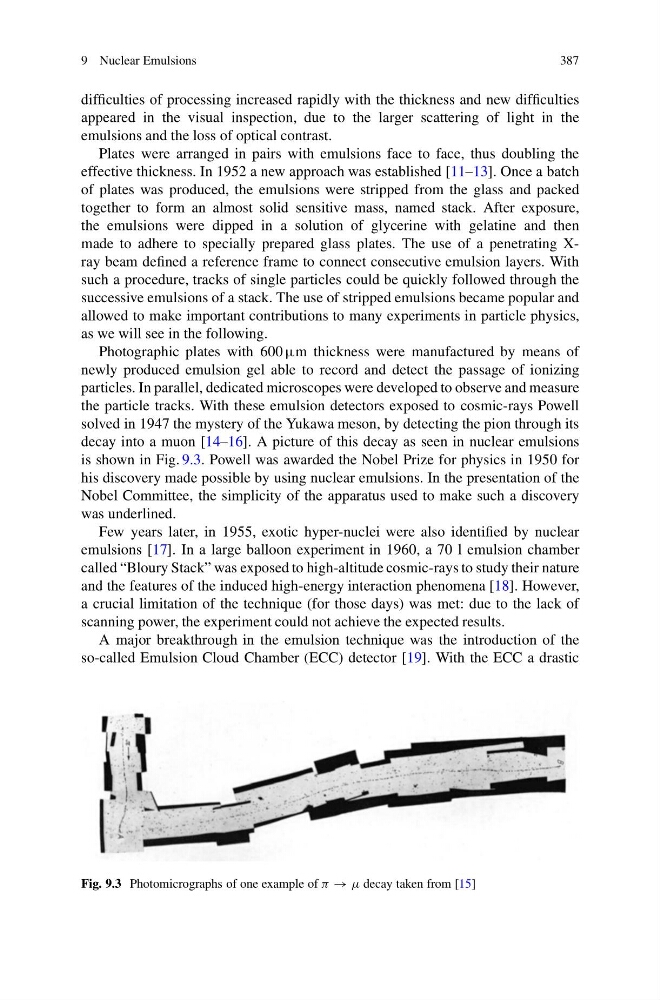
the particle tracks. With these emulsion detectors exposed to cosmic-rays Powell
solved in 1947 the mystery of the Yukawa meson, by detecting the pion through its
decay into a muon [14–16]. A picture of this decay as seen in nuclear emulsions
is shown in Fig. 9.3. Powell was awarded the Nobel Prize for physics in 1950 for
his discovery made possible by using nuclear emulsions. In the presentation of the
Nobel Committee, the simplicity of the apparatus used to make such a discovery
was underlined.
Few years later, in 1955, exotic hyper-nuclei were also identified by nuclear
emulsions [17]. In a large balloon experiment in 1960, a 70 l emulsion chamber
called “Bloury Stack” was exposed to high-altitude cosmic-rays to study their nature
and the features of the induced high-energy interaction phenomena [18]. However,
a crucial limitation of the technique (for those days) was met: due to the lack of
scanning power, the experiment could not achieve the expected results.
A major breakthrough in the emulsion technique was the introduction of the
so-called Emulsion Cloud Chamber (ECC) detector [19]. With the ECC a drastic
Fig. 9.3 Photomicrographs of one example of π → μ decay taken from [15]
387
difficulties of processing increased rapidly with the thickness and new difficulties
appeared in the visual inspection, due to the larger scattering of light in the
emulsions and the loss of optical contrast.
Plates were arranged in pairs with emulsions face to face, thus doubling the
effective thickness. In 1952 a new approach was established [11–13]. Once a batch
of plates was produced, the emulsions were stripped from the glass and packed
together to form an almost solid sensitive mass, named stack. After exposure,
the emulsions were dipped in a solution of glycerine with gelatine and then
made to adhere to specially prepared glass plates. The use of a penetrating Xray beam defined a reference frame to connect consecutive emulsion layers. With
such a procedure, tracks of single particles could be quickly followed through the
successive emulsions of a stack. The use of stripped emulsions became popular and
allowed to make important contributions to many experiments in particle physics,
as we will see in the following.
Photographic plates with 600 μm thickness were manufactured by means of
newly produced emulsion gel able to record and detect the passage of ionizing
particles. In parallel, dedicated microscopes were developed to observe and measure
the particle tracks. With these emulsion detectors exposed to cosmic-rays Powell
solved in 1947 the mystery of the Yukawa meson, by detecting the pion through its
decay into a muon [14–16]. A picture of this decay as seen in nuclear emulsions
is shown in Fig. 9.3. Powell was awarded the Nobel Prize for physics in 1950 for
his discovery made possible by using nuclear emulsions. In the presentation of the
Nobel Committee, the simplicity of the apparatus used to make such a discovery
was underlined.
Few years later, in 1955, exotic hyper-nuclei were also identified by nuclear
emulsions [17]. In a large balloon experiment in 1960, a 70 l emulsion chamber
called “Bloury Stack” was exposed to high-altitude cosmic-rays to study their nature
and the features of the induced high-energy interaction phenomena [18]. However,
a crucial limitation of the technique (for those days) was met: due to the lack of
scanning power, the experiment could not achieve the expected results.
A major breakthrough in the emulsion technique was the introduction of the
so-called Emulsion Cloud Chamber (ECC) detector [19]. With the ECC a drastic
Fig. 9.3 Photomicrographs of one example of π → μ decay taken from [15]