

386
A. Ariga et al.
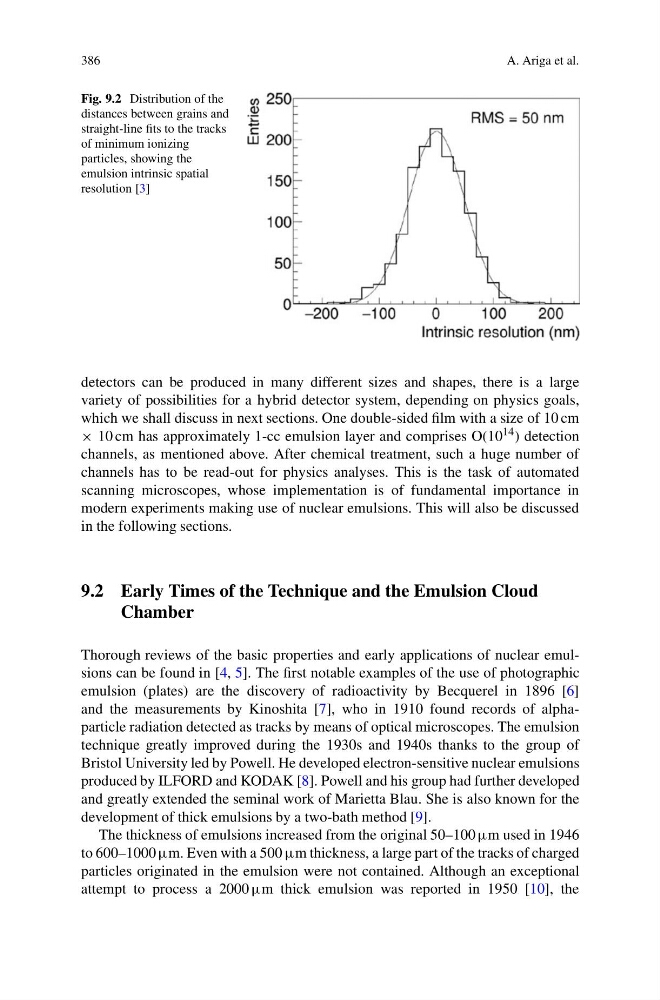
Fig. 9.2 Distribution of the
distances between grains and
straight-line fits to the tracks
of minimum ionizing
particles, showing the
emulsion intrinsic spatial
resolution [3]
detectors can be produced in many different sizes and shapes, there is a large
variety of possibilities for a hybrid detector system, depending on physics goals,
which we shall discuss in next sections. One double-sided film with a size of 10 cm
× 10 cm has approximately 1-cc emulsion layer and comprises O(10 14 ) detection
channels, as mentioned above. After chemical treatment, such a huge number of
channels has to be read-out for physics analyses. This is the task of automated
scanning microscopes, whose implementation is of fundamental importance in
modern experiments making use of nuclear emulsions. This will also be discussed
in the following sections.
9.2 Early Times of the Technique and the Emulsion Cloud
Chamber
Thorough reviews of the basic properties and early applications of nuclear emulsions can be found in [4, 5]. The first notable examples of the use of photographic
emulsion (plates) are the discovery of radioactivity by Becquerel in 1896 [6]
and the measurements by Kinoshita [7], who in 1910 found records of alphaparticle radiation detected as tracks by means of optical microscopes. The emulsion
technique greatly improved during the 1930s and 1940s thanks to the group of
Bristol University led by Powell. He developed electron-sensitive nuclear emulsions
produced by ILFORD and KODAK [8]. Powell and his group had further developed
and greatly extended the seminal work of Marietta Blau. She is also known for the
development of thick emulsions by a two-bath method [9].
The thickness of emulsions increased from the original 50–100 μm used in 1946
to 600–1000 μm. Even with a 500 μm thickness, a large part of the tracks of charged
particles originated in the emulsion were not contained. Although an exceptional
attempt to process a 2000 μm thick emulsion was reported in 1950 [10], the
A. Ariga et al.
Fig. 9.2 Distribution of the
distances between grains and
straight-line fits to the tracks
of minimum ionizing
particles, showing the
emulsion intrinsic spatial
resolution [3]
detectors can be produced in many different sizes and shapes, there is a large
variety of possibilities for a hybrid detector system, depending on physics goals,
which we shall discuss in next sections. One double-sided film with a size of 10 cm
× 10 cm has approximately 1-cc emulsion layer and comprises O(10 14 ) detection
channels, as mentioned above. After chemical treatment, such a huge number of
channels has to be read-out for physics analyses. This is the task of automated
scanning microscopes, whose implementation is of fundamental importance in
modern experiments making use of nuclear emulsions. This will also be discussed
in the following sections.
9.2 Early Times of the Technique and the Emulsion Cloud
Chamber
Thorough reviews of the basic properties and early applications of nuclear emulsions can be found in [4, 5]. The first notable examples of the use of photographic
emulsion (plates) are the discovery of radioactivity by Becquerel in 1896 [6]
and the measurements by Kinoshita [7], who in 1910 found records of alphaparticle radiation detected as tracks by means of optical microscopes. The emulsion
technique greatly improved during the 1930s and 1940s thanks to the group of
Bristol University led by Powell. He developed electron-sensitive nuclear emulsions
produced by ILFORD and KODAK [8]. Powell and his group had further developed
and greatly extended the seminal work of Marietta Blau. She is also known for the
development of thick emulsions by a two-bath method [9].
The thickness of emulsions increased from the original 50–100 μm used in 1946
to 600–1000 μm. Even with a 500 μm thickness, a large part of the tracks of charged
particles originated in the emulsion were not contained. Although an exceptional
attempt to process a 2000 μm thick emulsion was reported in 1950 [10], the