

372
L. Camilleri
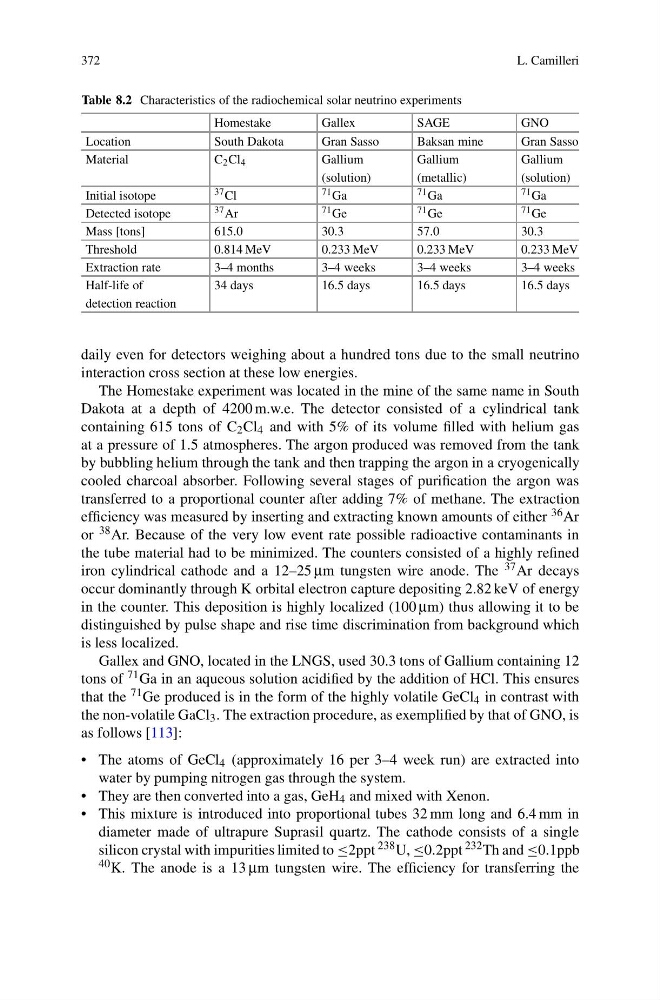
Table 8.2 Characteristics of the radiochemical solar neutrino experiments
Homestake
Gallex
SAGE
GNO
Location
South Dakota
Gran Sasso
Baksan mine
Gran Sasso
Material
C 2 Cl 4
Gallium
Gallium
Gallium
(solution)
(metallic)
(solution)
Initial isotope
37 Cl
71 Ga
71 Ga
71 Ga
Detected isotope
37 Ar
71 Ge
71 Ge
71 Ge
Mass [tons]
615.0
30.3
57.0
30.3
Threshold
0.814 MeV
0.233 MeV
0.233 MeV
0.233 MeV
Extraction rate
3–4 months
3–4 weeks
3–4 weeks
3–4 weeks
Half-life of
34 days
16.5 days
16.5 days
16.5 days
detection reaction
daily even for detectors weighing about a hundred tons due to the small neutrino
interaction cross section at these low energies.
The Homestake experiment was located in the mine of the same name in South
Dakota at a depth of 4200 m.w.e. The detector consisted of a cylindrical tank
containing 615 tons of C 2 Cl 4 and with 5% of its volume filled with helium gas
at a pressure of 1.5 atmospheres. The argon produced was removed from the tank
by bubbling helium through the tank and then trapping the argon in a cryogenically
cooled charcoal absorber. Following several stages of purification the argon was
transferred to a proportional counter after adding 7% of methane. The extraction
efficiency was measured by inserting and extracting known amounts of either 36 Ar
or 38 Ar. Because of the very low event rate possible radioactive contaminants in
the tube material had to be minimized. The counters consisted of a highly refined
iron cylindrical cathode and a 12–25 μm tungsten wire anode. The 37 Ar decays
occur dominantly through K orbital electron capture depositing 2.82 keV of energy
in the counter. This deposition is highly localized (100 μm) thus allowing it to be
distinguished by pulse shape and rise time discrimination from background which
is less localized.
Gallex and GNO, located in the LNGS, used 30.3 tons of Gallium containing 12
tons of 71 Ga in an aqueous solution acidified by the addition of HCl. This ensures
that the 71 Ge produced is in the form of the highly volatile GeCl 4 in contrast with
the non-volatile GaCl 3 . The extraction procedure, as exemplified by that of GNO, is
as follows [113]:
• The atoms of GeCl 4 (approximately 16 per 3–4 week run) are extracted into
water by pumping nitrogen gas through the system.
• They are then converted into a gas, GeH 4 and mixed with Xenon.
• This mixture is introduced into proportional tubes 32 mm long and 6.4 mm in
diameter made of ultrapure Suprasil quartz. The cathode consists of a single
silicon crystal with impurities limited to ≤2ppt 238 U, ≤0.2ppt 232 Th and ≤0.1ppb
40 K. The anode is a 13 μm tungsten wire. The efficiency for transferring the
L. Camilleri
Table 8.2 Characteristics of the radiochemical solar neutrino experiments
Homestake
Gallex
SAGE
GNO
Location
South Dakota
Gran Sasso
Baksan mine
Gran Sasso
Material
C 2 Cl 4
Gallium
Gallium
Gallium
(solution)
(metallic)
(solution)
Initial isotope
37 Cl
71 Ga
71 Ga
71 Ga
Detected isotope
37 Ar
71 Ge
71 Ge
71 Ge
Mass [tons]
615.0
30.3
57.0
30.3
Threshold
0.814 MeV
0.233 MeV
0.233 MeV
0.233 MeV
Extraction rate
3–4 months
3–4 weeks
3–4 weeks
3–4 weeks
Half-life of
34 days
16.5 days
16.5 days
16.5 days
detection reaction
daily even for detectors weighing about a hundred tons due to the small neutrino
interaction cross section at these low energies.
The Homestake experiment was located in the mine of the same name in South
Dakota at a depth of 4200 m.w.e. The detector consisted of a cylindrical tank
containing 615 tons of C 2 Cl 4 and with 5% of its volume filled with helium gas
at a pressure of 1.5 atmospheres. The argon produced was removed from the tank
by bubbling helium through the tank and then trapping the argon in a cryogenically
cooled charcoal absorber. Following several stages of purification the argon was
transferred to a proportional counter after adding 7% of methane. The extraction
efficiency was measured by inserting and extracting known amounts of either 36 Ar
or 38 Ar. Because of the very low event rate possible radioactive contaminants in
the tube material had to be minimized. The counters consisted of a highly refined
iron cylindrical cathode and a 12–25 μm tungsten wire anode. The 37 Ar decays
occur dominantly through K orbital electron capture depositing 2.82 keV of energy
in the counter. This deposition is highly localized (100 μm) thus allowing it to be
distinguished by pulse shape and rise time discrimination from background which
is less localized.
Gallex and GNO, located in the LNGS, used 30.3 tons of Gallium containing 12
tons of 71 Ga in an aqueous solution acidified by the addition of HCl. This ensures
that the 71 Ge produced is in the form of the highly volatile GeCl 4 in contrast with
the non-volatile GaCl 3 . The extraction procedure, as exemplified by that of GNO, is
as follows [113]:
• The atoms of GeCl 4 (approximately 16 per 3–4 week run) are extracted into
water by pumping nitrogen gas through the system.
• They are then converted into a gas, GeH 4 and mixed with Xenon.
• This mixture is introduced into proportional tubes 32 mm long and 6.4 mm in
diameter made of ultrapure Suprasil quartz. The cathode consists of a single
silicon crystal with impurities limited to ≤2ppt 238 U, ≤0.2ppt 232 Th and ≤0.1ppb
40 K. The anode is a 13 μm tungsten wire. The efficiency for transferring the