

8 Neutrino Detectors
371
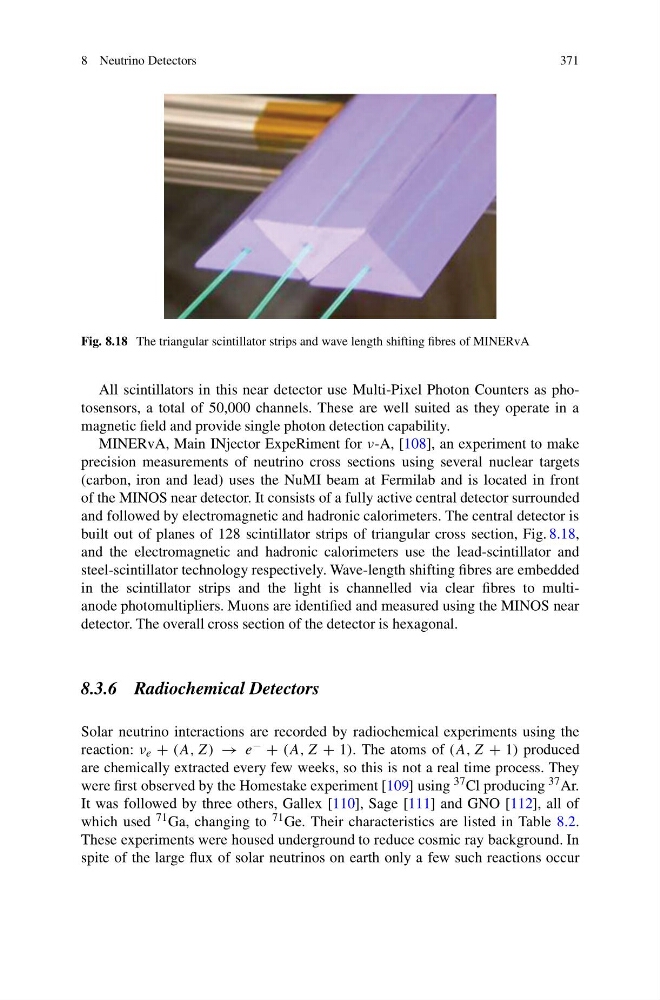
Fig. 8.18 The triangular scintillator strips and wave length shifting fibres of MINERvA
All scintillators in this near detector use Multi-Pixel Photon Counters as photosensors, a total of 50,000 channels. These are well suited as they operate in a
magnetic field and provide single photon detection capability.
MINERvA, Main INjector ExpeRiment for ν-A, [108], an experiment to make
precision measurements of neutrino cross sections using several nuclear targets
(carbon, iron and lead) uses the NuMI beam at Fermilab and is located in front
of the MINOS near detector. It consists of a fully active central detector surrounded
and followed by electromagnetic and hadronic calorimeters. The central detector is
built out of planes of 128 scintillator strips of triangular cross section, Fig. 8.18,
and the electromagnetic and hadronic calorimeters use the lead-scintillator and
steel-scintillator technology respectively. Wave-length shifting fibres are embedded
in the scintillator strips and the light is channelled via clear fibres to multianode photomultipliers. Muons are identified and measured using the MINOS near
detector. The overall cross section of the detector is hexagonal.
8.3.6 Radiochemical Detectors
Solar neutrino interactions are recorded by radiochemical experiments using the
reaction: ν e + (A, Z) → e − + (A, Z + 1). The atoms of (A, Z + 1) produced
are chemically extracted every few weeks, so this is not a real time process. They
were first observed by the Homestake experiment [109] using 37 Cl producing 37 Ar.
It was followed by three others, Gallex [110], Sage [111] and GNO [112], all of
which used 71 Ga, changing to 71 Ge. Their characteristics are listed in Table 8.2.
These experiments were housed underground to reduce cosmic ray background. In
spite of the large flux of solar neutrinos on earth only a few such reactions occur
371
Fig. 8.18 The triangular scintillator strips and wave length shifting fibres of MINERvA
All scintillators in this near detector use Multi-Pixel Photon Counters as photosensors, a total of 50,000 channels. These are well suited as they operate in a
magnetic field and provide single photon detection capability.
MINERvA, Main INjector ExpeRiment for ν-A, [108], an experiment to make
precision measurements of neutrino cross sections using several nuclear targets
(carbon, iron and lead) uses the NuMI beam at Fermilab and is located in front
of the MINOS near detector. It consists of a fully active central detector surrounded
and followed by electromagnetic and hadronic calorimeters. The central detector is
built out of planes of 128 scintillator strips of triangular cross section, Fig. 8.18,
and the electromagnetic and hadronic calorimeters use the lead-scintillator and
steel-scintillator technology respectively. Wave-length shifting fibres are embedded
in the scintillator strips and the light is channelled via clear fibres to multianode photomultipliers. Muons are identified and measured using the MINOS near
detector. The overall cross section of the detector is hexagonal.
8.3.6 Radiochemical Detectors
Solar neutrino interactions are recorded by radiochemical experiments using the
reaction: ν e + (A, Z) → e − + (A, Z + 1). The atoms of (A, Z + 1) produced
are chemically extracted every few weeks, so this is not a real time process. They
were first observed by the Homestake experiment [109] using 37 Cl producing 37 Ar.
It was followed by three others, Gallex [110], Sage [111] and GNO [112], all of
which used 71 Ga, changing to 71 Ge. Their characteristics are listed in Table 8.2.
These experiments were housed underground to reduce cosmic ray background. In
spite of the large flux of solar neutrinos on earth only a few such reactions occur