

368
L. Camilleri
Emulsion "grains"
track segment
ν τ
ν τ
ν e ,ν μ
τ
e, μ
Decay "kink"
Pb ES
Pb
ES
1 mm
50 200 50
[μm]
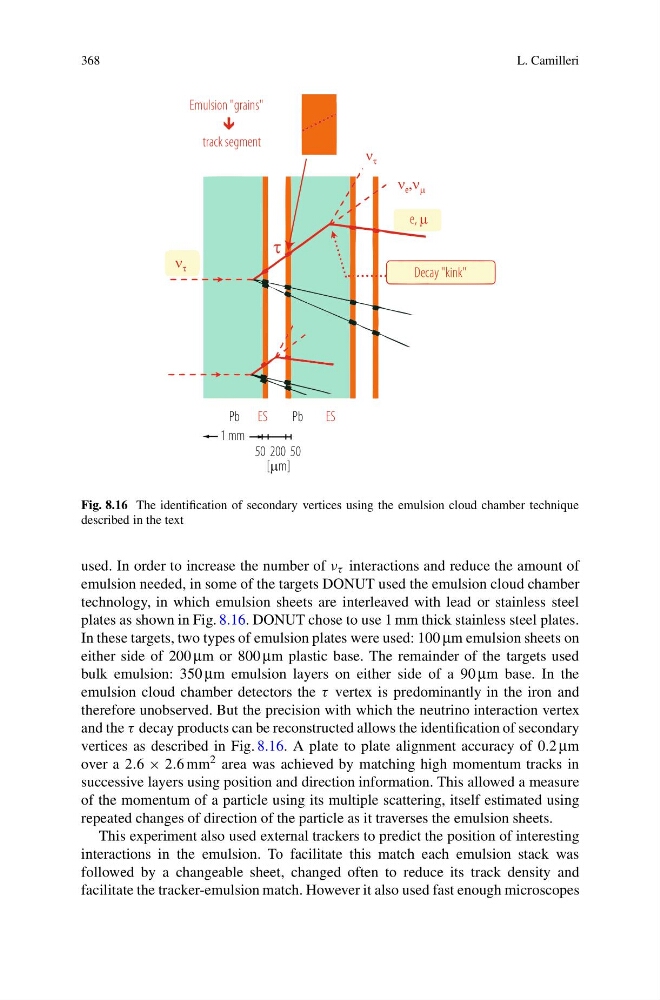
Fig. 8.16 The identification of secondary vertices using the emulsion cloud chamber technique
described in the text
used. In order to increase the number of ν τ interactions and reduce the amount of
emulsion needed, in some of the targets DONUT used the emulsion cloud chamber
technology, in which emulsion sheets are interleaved with lead or stainless steel
plates as shown in Fig. 8.16. DONUT chose to use 1 mm thick stainless steel plates.
In these targets, two types of emulsion plates were used: 100 μm emulsion sheets on
either side of 200 μm or 800 μm plastic base. The remainder of the targets used
bulk emulsion: 350 μm emulsion layers on either side of a 90 μm base. In the
emulsion cloud chamber detectors the τ vertex is predominantly in the iron and
therefore unobserved. But the precision with which the neutrino interaction vertex
and the τ decay products can be reconstructed allows the identification of secondary
vertices as described in Fig. 8.16. A plate to plate alignment accuracy of 0.2 μm
over a 2.6 × 2.6 mm 2 area was achieved by matching high momentum tracks in
successive layers using position and direction information. This allowed a measure
of the momentum of a particle using its multiple scattering, itself estimated using
repeated changes of direction of the particle as it traverses the emulsion sheets.
This experiment also used external trackers to predict the position of interesting
interactions in the emulsion. To facilitate this match each emulsion stack was
followed by a changeable sheet, changed often to reduce its track density and
facilitate the tracker-emulsion match. However it also used fast enough microscopes
L. Camilleri
Emulsion "grains"
track segment
ν τ
ν τ
ν e ,ν μ
τ
e, μ
Decay "kink"
Pb ES
Pb
ES
1 mm
50 200 50
[μm]
Fig. 8.16 The identification of secondary vertices using the emulsion cloud chamber technique
described in the text
used. In order to increase the number of ν τ interactions and reduce the amount of
emulsion needed, in some of the targets DONUT used the emulsion cloud chamber
technology, in which emulsion sheets are interleaved with lead or stainless steel
plates as shown in Fig. 8.16. DONUT chose to use 1 mm thick stainless steel plates.
In these targets, two types of emulsion plates were used: 100 μm emulsion sheets on
either side of 200 μm or 800 μm plastic base. The remainder of the targets used
bulk emulsion: 350 μm emulsion layers on either side of a 90 μm base. In the
emulsion cloud chamber detectors the τ vertex is predominantly in the iron and
therefore unobserved. But the precision with which the neutrino interaction vertex
and the τ decay products can be reconstructed allows the identification of secondary
vertices as described in Fig. 8.16. A plate to plate alignment accuracy of 0.2 μm
over a 2.6 × 2.6 mm 2 area was achieved by matching high momentum tracks in
successive layers using position and direction information. This allowed a measure
of the momentum of a particle using its multiple scattering, itself estimated using
repeated changes of direction of the particle as it traverses the emulsion sheets.
This experiment also used external trackers to predict the position of interesting
interactions in the emulsion. To facilitate this match each emulsion stack was
followed by a changeable sheet, changed often to reduce its track density and
facilitate the tracker-emulsion match. However it also used fast enough microscopes