

366
L. Camilleri
Antineutrino beam
1750
1500
1250
1000
750
500
250
0
0.01
0.02
0.03
0.04
0.05
0.06 0.07
Eθ
2 [GeV]
νN – νπ
D
N
ν e N – e
±
N
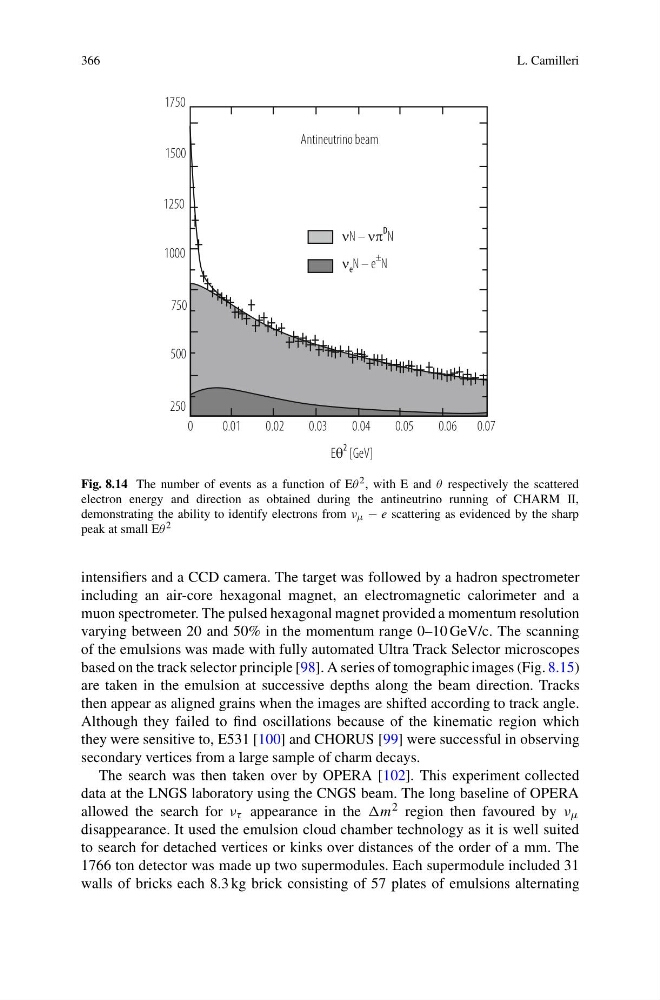
Fig. 8.14 The number of events as a function of Eθ 2 , with E and θ respectively the scattered
electron energy and direction as obtained during the antineutrino running of CHARM II,
demonstrating the ability to identify electrons from ν μ − e scattering as evidenced by the sharp
peak at small Eθ 2
intensifiers and a CCD camera. The target was followed by a hadron spectrometer
including an air-core hexagonal magnet, an electromagnetic calorimeter and a
muon spectrometer. The pulsed hexagonal magnet provided a momentum resolution
varying between 20 and 50% in the momentum range 0–10 GeV/c. The scanning
of the emulsions was made with fully automated Ultra Track Selector microscopes
based on the track selector principle [98]. A series of tomographic images (Fig. 8.15)
are taken in the emulsion at successive depths along the beam direction. Tracks
then appear as aligned grains when the images are shifted according to track angle.
Although they failed to find oscillations because of the kinematic region which
they were sensitive to, E531 [100] and CHORUS [99] were successful in observing
secondary vertices from a large sample of charm decays.
The search was then taken over by OPERA [102]. This experiment collected
data at the LNGS laboratory using the CNGS beam. The long baseline of OPERA
allowed the search for ν τ appearance in the m 2 region then favoured by ν μ
disappearance. It used the emulsion cloud chamber technology as it is well suited
to search for detached vertices or kinks over distances of the order of a mm. The
1766 ton detector was made up two supermodules. Each supermodule included 31
walls of bricks each 8.3 kg brick consisting of 57 plates of emulsions alternating
L. Camilleri
Antineutrino beam
1750
1500
1250
1000
750
500
250
0
0.01
0.02
0.03
0.04
0.05
0.06 0.07
Eθ
2 [GeV]
νN – νπ
D
N
ν e N – e
±
N
Fig. 8.14 The number of events as a function of Eθ 2 , with E and θ respectively the scattered
electron energy and direction as obtained during the antineutrino running of CHARM II,
demonstrating the ability to identify electrons from ν μ − e scattering as evidenced by the sharp
peak at small Eθ 2
intensifiers and a CCD camera. The target was followed by a hadron spectrometer
including an air-core hexagonal magnet, an electromagnetic calorimeter and a
muon spectrometer. The pulsed hexagonal magnet provided a momentum resolution
varying between 20 and 50% in the momentum range 0–10 GeV/c. The scanning
of the emulsions was made with fully automated Ultra Track Selector microscopes
based on the track selector principle [98]. A series of tomographic images (Fig. 8.15)
are taken in the emulsion at successive depths along the beam direction. Tracks
then appear as aligned grains when the images are shifted according to track angle.
Although they failed to find oscillations because of the kinematic region which
they were sensitive to, E531 [100] and CHORUS [99] were successful in observing
secondary vertices from a large sample of charm decays.
The search was then taken over by OPERA [102]. This experiment collected
data at the LNGS laboratory using the CNGS beam. The long baseline of OPERA
allowed the search for ν τ appearance in the m 2 region then favoured by ν μ
disappearance. It used the emulsion cloud chamber technology as it is well suited
to search for detached vertices or kinks over distances of the order of a mm. The
1766 ton detector was made up two supermodules. Each supermodule included 31
walls of bricks each 8.3 kg brick consisting of 57 plates of emulsions alternating