

8 Neutrino Detectors
353
5-20 MeV
Event/day/bin
2
1
0
–1.0
–0.5
0.0
0.5
1.0
COS θ Sun
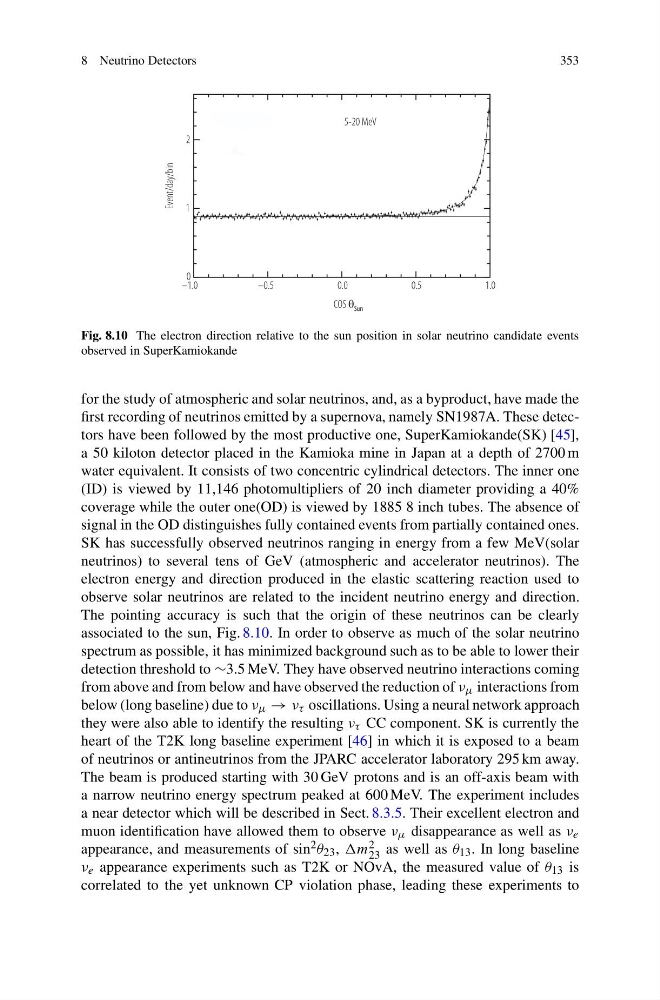
Fig. 8.10 The electron direction relative to the sun position in solar neutrino candidate events
observed in SuperKamiokande
for the study of atmospheric and solar neutrinos, and, as a byproduct, have made the
first recording of neutrinos emitted by a supernova, namely SN1987A. These detectors have been followed by the most productive one, SuperKamiokande(SK) [45],
a 50 kiloton detector placed in the Kamioka mine in Japan at a depth of 2700 m
water equivalent. It consists of two concentric cylindrical detectors. The inner one
(ID) is viewed by 11,146 photomultipliers of 20 inch diameter providing a 40%
coverage while the outer one(OD) is viewed by 1885 8 inch tubes. The absence of
signal in the OD distinguishes fully contained events from partially contained ones.
SK has successfully observed neutrinos ranging in energy from a few MeV(solar
neutrinos) to several tens of GeV (atmospheric and accelerator neutrinos). The
electron energy and direction produced in the elastic scattering reaction used to
observe solar neutrinos are related to the incident neutrino energy and direction.
The pointing accuracy is such that the origin of these neutrinos can be clearly
associated to the sun, Fig. 8.10. In order to observe as much of the solar neutrino
spectrum as possible, it has minimized background such as to be able to lower their
detection threshold to ∼3.5 MeV. They have observed neutrino interactions coming
from above and from below and have observed the reduction of ν μ interactions from
below (long baseline) due to ν μ → ν τ oscillations. Using a neural network approach
they were also able to identify the resulting ν τ CC component. SK is currently the
heart of the T2K long baseline experiment [46] in which it is exposed to a beam
of neutrinos or antineutrinos from the JPARC accelerator laboratory 295 km away.
The beam is produced starting with 30 GeV protons and is an off-axis beam with
a narrow neutrino energy spectrum peaked at 600 MeV. The experiment includes
a near detector which will be described in Sect. 8.3.5. Their excellent electron and
muon identification have allowed them to observe ν μ disappearance as well as ν e
appearance, and measurements of sin 2 θ 23 , m 2
23 as well as θ 13 . In long baseline
ν e appearance experiments such as T2K or NOvA, the measured value of θ 13 is
correlated to the yet unknown CP violation phase, leading these experiments to
353
5-20 MeV
Event/day/bin
2
1
0
–1.0
–0.5
0.0
0.5
1.0
COS θ Sun
Fig. 8.10 The electron direction relative to the sun position in solar neutrino candidate events
observed in SuperKamiokande
for the study of atmospheric and solar neutrinos, and, as a byproduct, have made the
first recording of neutrinos emitted by a supernova, namely SN1987A. These detectors have been followed by the most productive one, SuperKamiokande(SK) [45],
a 50 kiloton detector placed in the Kamioka mine in Japan at a depth of 2700 m
water equivalent. It consists of two concentric cylindrical detectors. The inner one
(ID) is viewed by 11,146 photomultipliers of 20 inch diameter providing a 40%
coverage while the outer one(OD) is viewed by 1885 8 inch tubes. The absence of
signal in the OD distinguishes fully contained events from partially contained ones.
SK has successfully observed neutrinos ranging in energy from a few MeV(solar
neutrinos) to several tens of GeV (atmospheric and accelerator neutrinos). The
electron energy and direction produced in the elastic scattering reaction used to
observe solar neutrinos are related to the incident neutrino energy and direction.
The pointing accuracy is such that the origin of these neutrinos can be clearly
associated to the sun, Fig. 8.10. In order to observe as much of the solar neutrino
spectrum as possible, it has minimized background such as to be able to lower their
detection threshold to ∼3.5 MeV. They have observed neutrino interactions coming
from above and from below and have observed the reduction of ν μ interactions from
below (long baseline) due to ν μ → ν τ oscillations. Using a neural network approach
they were also able to identify the resulting ν τ CC component. SK is currently the
heart of the T2K long baseline experiment [46] in which it is exposed to a beam
of neutrinos or antineutrinos from the JPARC accelerator laboratory 295 km away.
The beam is produced starting with 30 GeV protons and is an off-axis beam with
a narrow neutrino energy spectrum peaked at 600 MeV. The experiment includes
a near detector which will be described in Sect. 8.3.5. Their excellent electron and
muon identification have allowed them to observe ν μ disappearance as well as ν e
appearance, and measurements of sin 2 θ 23 , m 2
23 as well as θ 13 . In long baseline
ν e appearance experiments such as T2K or NOvA, the measured value of θ 13 is
correlated to the yet unknown CP violation phase, leading these experiments to