

352
L. Camilleri
Hg TARGET
PROTON BEAM
CENNS-10
(LAr)
SCIBATH
Nal
SANDIA
CAMERA
Csl
NIN Cubes
SHIELDING MONOLITH
d
=
2 8 . 4 m
d = 2 1 .1 m
d
=
19.3m
CONCRETE AND GRAVEL
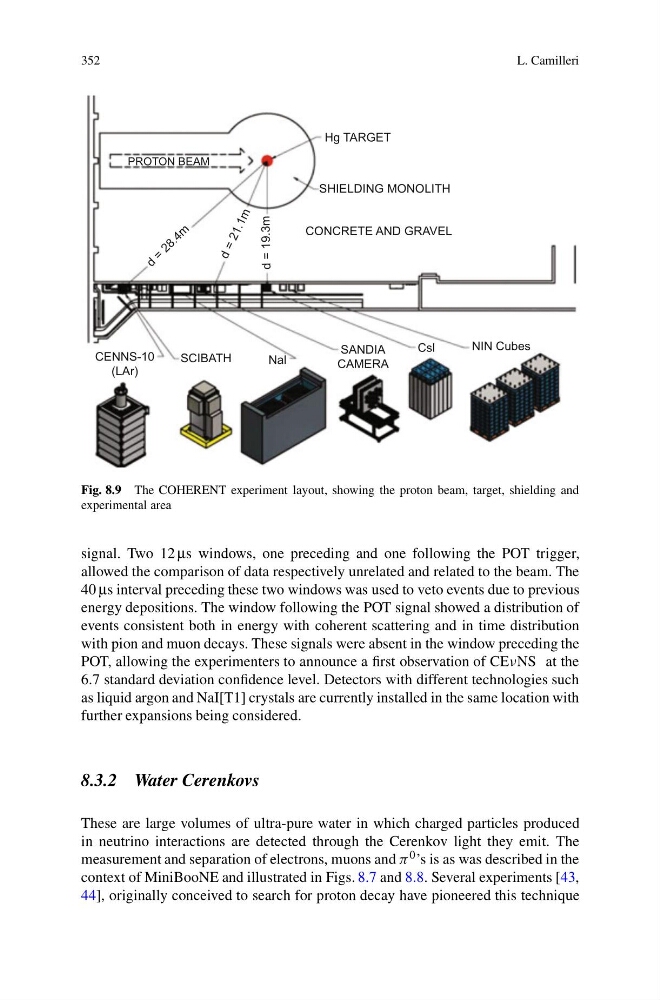
Fig. 8.9 The COHERENT experiment layout, showing the proton beam, target, shielding and
experimental area
signal. Two 12 μs windows, one preceding and one following the POT trigger,
allowed the comparison of data respectively unrelated and related to the beam. The
40 μs interval preceding these two windows was used to veto events due to previous
energy depositions. The window following the POT signal showed a distribution of
events consistent both in energy with coherent scattering and in time distribution
with pion and muon decays. These signals were absent in the window preceding the
POT, allowing the experimenters to announce a first observation of CEνNS at the
6.7 standard deviation confidence level. Detectors with different technologies such
as liquid argon and NaI[T1] crystals are currently installed in the same location with
further expansions being considered.
8.3.2 Water Cerenkovs
These are large volumes of ultra-pure water in which charged particles produced
in neutrino interactions are detected through the Cerenkov light they emit. The
measurement and separation of electrons, muons and π 0 ’s is as was described in the
context of MiniBooNE and illustrated in Figs. 8.7 and 8.8. Several experiments [43,
44], originally conceived to search for proton decay have pioneered this technique
L. Camilleri
Hg TARGET
PROTON BEAM
CENNS-10
(LAr)
SCIBATH
Nal
SANDIA
CAMERA
Csl
NIN Cubes
SHIELDING MONOLITH
d
=
2 8 . 4 m
d = 2 1 .1 m
d
=
19.3m
CONCRETE AND GRAVEL
Fig. 8.9 The COHERENT experiment layout, showing the proton beam, target, shielding and
experimental area
signal. Two 12 μs windows, one preceding and one following the POT trigger,
allowed the comparison of data respectively unrelated and related to the beam. The
40 μs interval preceding these two windows was used to veto events due to previous
energy depositions. The window following the POT signal showed a distribution of
events consistent both in energy with coherent scattering and in time distribution
with pion and muon decays. These signals were absent in the window preceding the
POT, allowing the experimenters to announce a first observation of CEνNS at the
6.7 standard deviation confidence level. Detectors with different technologies such
as liquid argon and NaI[T1] crystals are currently installed in the same location with
further expansions being considered.
8.3.2 Water Cerenkovs
These are large volumes of ultra-pure water in which charged particles produced
in neutrino interactions are detected through the Cerenkov light they emit. The
measurement and separation of electrons, muons and π 0 ’s is as was described in the
context of MiniBooNE and illustrated in Figs. 8.7 and 8.8. Several experiments [43,
44], originally conceived to search for proton decay have pioneered this technique