

24
H. Bichsel and H. Schindler
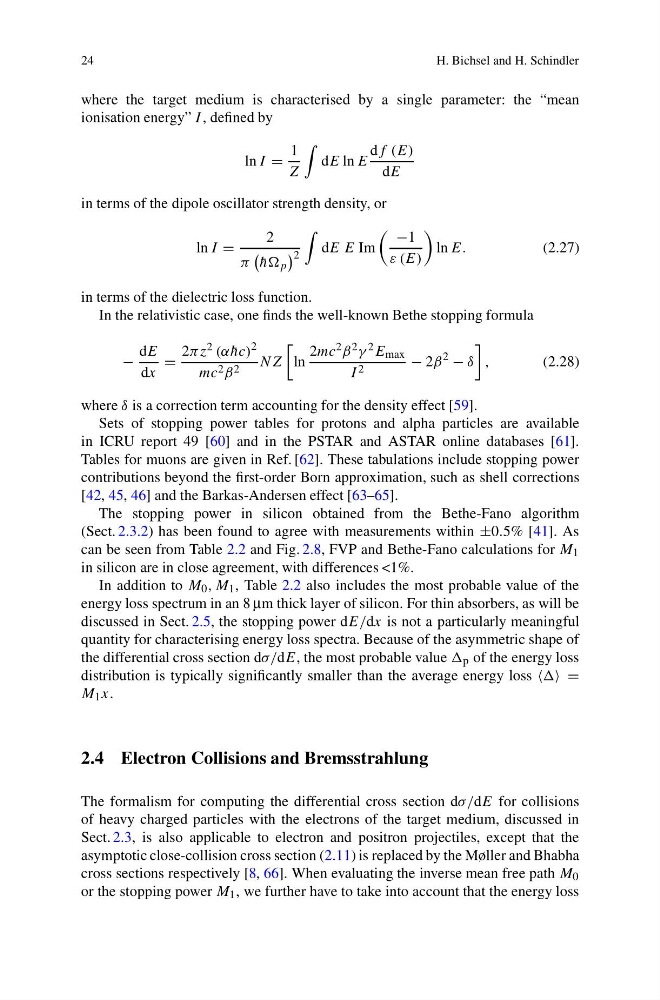
where the target medium is characterised by a single parameter: the “mean
ionisation energy” I , defined by
ln I =
1
Z
dE ln E
df (E)
dE
in terms of the dipole oscillator strength density, or
ln I =
2
π
¯
hh p
2
dE E Im
−1
ε (E)
ln E.
(2.27)
in terms of the dielectric loss function.
In the relativistic case, one finds the well-known Bethe stopping formula
−
dE
dx
=
2πz 2 (α ¯
hc)
2
mc 2 β 2 NZ
ln
2mc 2 β 2 γ 2 E max
I 2
− 2β
2
− δ
,
(2.28)
where δ is a correction term accounting for the density effect [59].
Sets of stopping power tables for protons and alpha particles are available
in ICRU report 49 [60] and in the PSTAR and ASTAR online databases [61].
Tables for muons are given in Ref. [62]. These tabulations include stopping power
contributions beyond the first-order Born approximation, such as shell corrections
[42, 45, 46] and the Barkas-Andersen effect [63–65].
The stopping power in silicon obtained from the Bethe-Fano algorithm
(Sect. 2.3.2) has been found to agree with measurements within ±0.5% [41]. As
can be seen from Table 2.2 and Fig. 2.8, FVP and Bethe-Fano calculations for M 1
in silicon are in close agreement, with differences <1%.
In addition to M 0 , M 1 , Table 2.2 also includes the most probable value of the
energy loss spectrum in an 8 μm thick layer of silicon. For thin absorbers, as will be
discussed in Sect. 2.5, the stopping power dE/dx is not a particularly meaningful
quantity for characterising energy loss spectra. Because of the asymmetric shape of
the differential cross section dσ/dE, the most probable value p of the energy loss
distribution is typically significantly smaller than the average energy loss =
M 1 x.
2.4 Electron Collisions and Bremsstrahlung
The formalism for computing the differential cross section dσ/dE for collisions
of heavy charged particles with the electrons of the target medium, discussed in
Sect. 2.3, is also applicable to electron and positron projectiles, except that the
asymptotic close-collision cross section (2.11) is replaced by the Møller and Bhabha
cross sections respectively [8, 66]. When evaluating the inverse mean free path M 0
or the stopping power M 1 , we further have to take into account that the energy loss
H. Bichsel and H. Schindler
where the target medium is characterised by a single parameter: the “mean
ionisation energy” I , defined by
ln I =
1
Z
dE ln E
df (E)
dE
in terms of the dipole oscillator strength density, or
ln I =
2
π
¯
hh p
2
dE E Im
−1
ε (E)
ln E.
(2.27)
in terms of the dielectric loss function.
In the relativistic case, one finds the well-known Bethe stopping formula
−
dE
dx
=
2πz 2 (α ¯
hc)
2
mc 2 β 2 NZ
ln
2mc 2 β 2 γ 2 E max
I 2
− 2β
2
− δ
,
(2.28)
where δ is a correction term accounting for the density effect [59].
Sets of stopping power tables for protons and alpha particles are available
in ICRU report 49 [60] and in the PSTAR and ASTAR online databases [61].
Tables for muons are given in Ref. [62]. These tabulations include stopping power
contributions beyond the first-order Born approximation, such as shell corrections
[42, 45, 46] and the Barkas-Andersen effect [63–65].
The stopping power in silicon obtained from the Bethe-Fano algorithm
(Sect. 2.3.2) has been found to agree with measurements within ±0.5% [41]. As
can be seen from Table 2.2 and Fig. 2.8, FVP and Bethe-Fano calculations for M 1
in silicon are in close agreement, with differences <1%.
In addition to M 0 , M 1 , Table 2.2 also includes the most probable value of the
energy loss spectrum in an 8 μm thick layer of silicon. For thin absorbers, as will be
discussed in Sect. 2.5, the stopping power dE/dx is not a particularly meaningful
quantity for characterising energy loss spectra. Because of the asymmetric shape of
the differential cross section dσ/dE, the most probable value p of the energy loss
distribution is typically significantly smaller than the average energy loss =
M 1 x.
2.4 Electron Collisions and Bremsstrahlung
The formalism for computing the differential cross section dσ/dE for collisions
of heavy charged particles with the electrons of the target medium, discussed in
Sect. 2.3, is also applicable to electron and positron projectiles, except that the
asymptotic close-collision cross section (2.11) is replaced by the Møller and Bhabha
cross sections respectively [8, 66]. When evaluating the inverse mean free path M 0
or the stopping power M 1 , we further have to take into account that the energy loss