

318
R. Forty and O. Ullaland
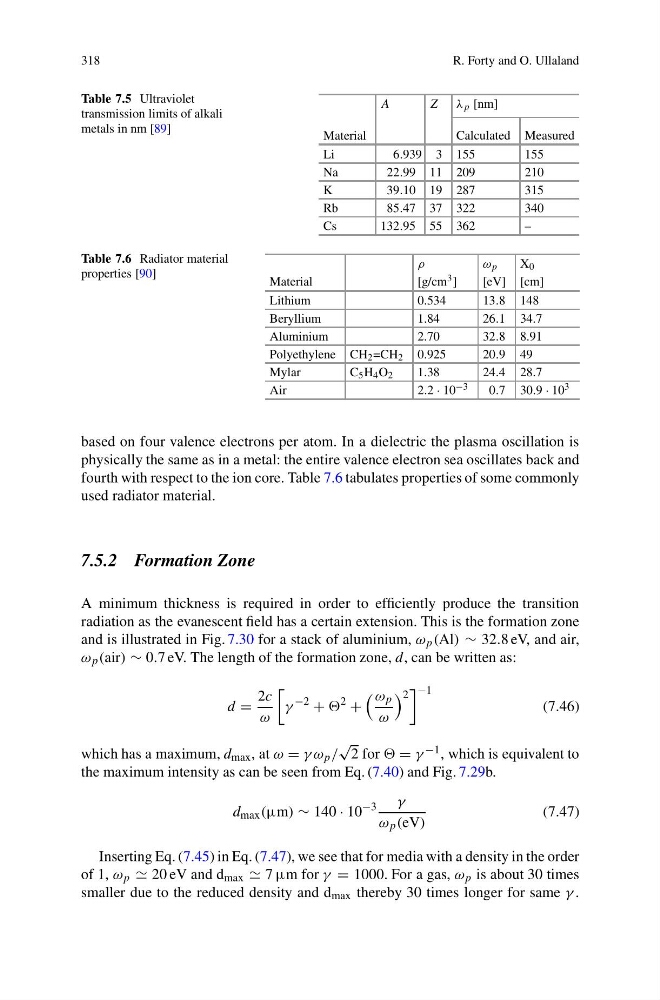
Table 7.5 Ultraviolet
transmission limits of alkali
metals in nm [89]
Material
A
Z λ p [nm]
Calculated Measured
Li
6.939 3 155
155
Na
22.99 11 209
210
K
39.10 19 287
315
Rb
85.47 37 322
340
Cs
132.95 55 362
–
Table 7.6 Radiator material
properties [90]
ρ
ω p
X 0
Material
[g/cm 3 ]
[eV] [cm]
Lithium
0.534
13.8 148
Beryllium
1.84
26.1 34.7
Aluminium
2.70
32.8 8.91
Polyethylene CH 2 =CH 2 0.925
20.9 49
Mylar
C 5 H 4 O 2
1.38
24.4 28.7
Air
2.2 · 10 −3
0.7 30.9 · 10 3
based on four valence electrons per atom. In a dielectric the plasma oscillation is
physically the same as in a metal: the entire valence electron sea oscillates back and
fourth with respect to the ion core. Table 7.6 tabulates properties of some commonly
used radiator material.
7.5.2 Formation Zone
A minimum thickness is required in order to efficiently produce the transition
radiation as the evanescent field has a certain extension. This is the formation zone
and is illustrated in Fig. 7.30 for a stack of aluminium, ω p (Al) ∼ 32.8 eV, and air,
ω p (air) ∼ 0.7 eV. The length of the formation zone, d, can be written as:
d =
2c
ω
γ
−2
+
2
+
ω p
ω
2
−1
(7.46)
which has a maximum, d max , at ω = γ ω p /
√
2 for = γ −1 , which is equivalent to
the maximum intensity as can be seen from Eq. (7.40) and Fig. 7.29b.
d max (μm) ∼ 140 · 10
−3
γ
ω p (eV)
(7.47)
Inserting Eq. (7.45) in Eq. (7.47), we see that for media with a density in the order
of 1, ω p 20 eV and d max 7 μm for γ = 1000. For a gas, ω p is about 30 times
smaller due to the reduced density and d max thereby 30 times longer for same γ .
R. Forty and O. Ullaland
Table 7.5 Ultraviolet
transmission limits of alkali
metals in nm [89]
Material
A
Z λ p [nm]
Calculated Measured
Li
6.939 3 155
155
Na
22.99 11 209
210
K
39.10 19 287
315
Rb
85.47 37 322
340
Cs
132.95 55 362
–
Table 7.6 Radiator material
properties [90]
ρ
ω p
X 0
Material
[g/cm 3 ]
[eV] [cm]
Lithium
0.534
13.8 148
Beryllium
1.84
26.1 34.7
Aluminium
2.70
32.8 8.91
Polyethylene CH 2 =CH 2 0.925
20.9 49
Mylar
C 5 H 4 O 2
1.38
24.4 28.7
Air
2.2 · 10 −3
0.7 30.9 · 10 3
based on four valence electrons per atom. In a dielectric the plasma oscillation is
physically the same as in a metal: the entire valence electron sea oscillates back and
fourth with respect to the ion core. Table 7.6 tabulates properties of some commonly
used radiator material.
7.5.2 Formation Zone
A minimum thickness is required in order to efficiently produce the transition
radiation as the evanescent field has a certain extension. This is the formation zone
and is illustrated in Fig. 7.30 for a stack of aluminium, ω p (Al) ∼ 32.8 eV, and air,
ω p (air) ∼ 0.7 eV. The length of the formation zone, d, can be written as:
d =
2c
ω
γ
−2
+
2
+
ω p
ω
2
−1
(7.46)
which has a maximum, d max , at ω = γ ω p /
√
2 for = γ −1 , which is equivalent to
the maximum intensity as can be seen from Eq. (7.40) and Fig. 7.29b.
d max (μm) ∼ 140 · 10
−3
γ
ω p (eV)
(7.47)
Inserting Eq. (7.45) in Eq. (7.47), we see that for media with a density in the order
of 1, ω p 20 eV and d max 7 μm for γ = 1000. For a gas, ω p is about 30 times
smaller due to the reduced density and d max thereby 30 times longer for same γ .