

7 Particle Detectors and Detector Systems
301
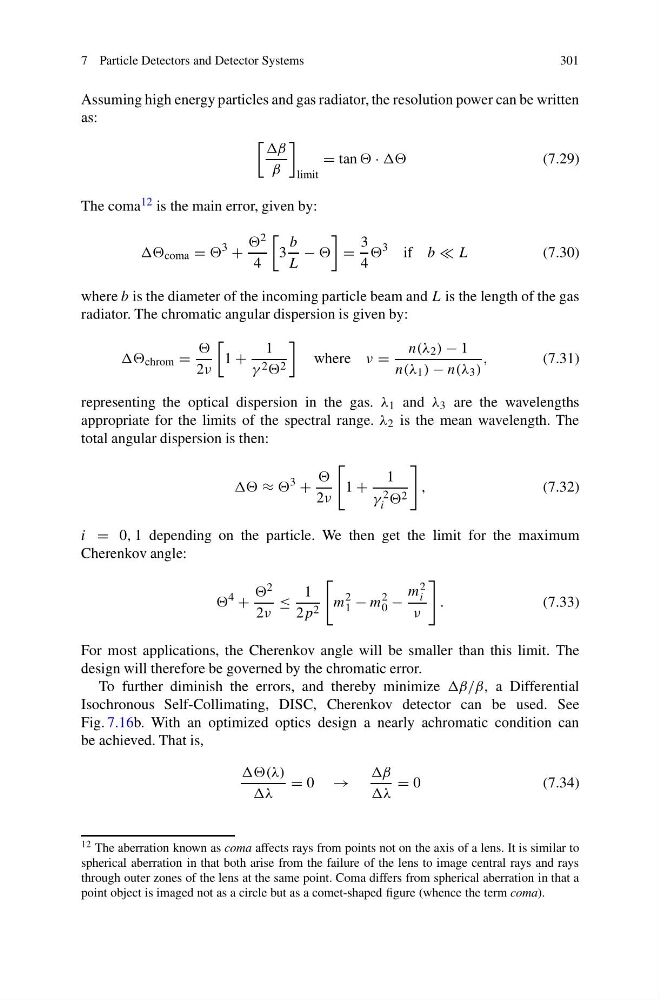
Assuming high energy particles and gas radiator, the resolution power can be written
as:
β
β
limit
= tan ·
(7.29)
The coma 12 is the main error, given by:
coma =
3
+
2
4
3
b
L
−
=
3
4
3 if b L
(7.30)
where b is the diameter of the incoming particle beam and L is the length of the gas
radiator. The chromatic angular dispersion is given by:
chrom =
2ν
1 +
1
γ 2 2
where ν =
n(λ 2 ) − 1
n(λ 1 ) − n(λ 3 )
,
(7.31)
representing the optical dispersion in the gas. λ 1 and λ 3 are the wavelengths
appropriate for the limits of the spectral range. λ 2 is the mean wavelength. The
total angular dispersion is then:
≈
3
+
2ν
1 +
1
γ 2
i 2
,
(7.32)
i = 0, 1 depending on the particle. We then get the limit for the maximum
Cherenkov angle:
4
+
2
2ν
≤
1
2p 2
m
2
1 − m
2
0 −
m 2
i
ν
.
(7.33)
For most applications, the Cherenkov angle will be smaller than this limit. The
design will therefore be governed by the chromatic error.
To further diminish the errors, and thereby minimize β/β, a Differential
Isochronous Self-Collimating, DISC, Cherenkov detector can be used. See
Fig. 7.16b. With an optimized optics design a nearly achromatic condition can
be achieved. That is,
(λ)
= 0 →
β
= 0
(7.34)
12 The aberration known as coma affects rays from points not on the axis of a lens. It is similar to
spherical aberration in that both arise from the failure of the lens to image central rays and rays
through outer zones of the lens at the same point. Coma differs from spherical aberration in that a
point object is imaged not as a circle but as a comet-shaped figure (whence the term coma).
301
Assuming high energy particles and gas radiator, the resolution power can be written
as:
β
β
limit
= tan ·
(7.29)
The coma 12 is the main error, given by:
coma =
3
+
2
4
3
b
L
−
=
3
4
3 if b L
(7.30)
where b is the diameter of the incoming particle beam and L is the length of the gas
radiator. The chromatic angular dispersion is given by:
chrom =
2ν
1 +
1
γ 2 2
where ν =
n(λ 2 ) − 1
n(λ 1 ) − n(λ 3 )
,
(7.31)
representing the optical dispersion in the gas. λ 1 and λ 3 are the wavelengths
appropriate for the limits of the spectral range. λ 2 is the mean wavelength. The
total angular dispersion is then:
≈
3
+
2ν
1 +
1
γ 2
i 2
,
(7.32)
i = 0, 1 depending on the particle. We then get the limit for the maximum
Cherenkov angle:
4
+
2
2ν
≤
1
2p 2
m
2
1 − m
2
0 −
m 2
i
ν
.
(7.33)
For most applications, the Cherenkov angle will be smaller than this limit. The
design will therefore be governed by the chromatic error.
To further diminish the errors, and thereby minimize β/β, a Differential
Isochronous Self-Collimating, DISC, Cherenkov detector can be used. See
Fig. 7.16b. With an optimized optics design a nearly achromatic condition can
be achieved. That is,
(λ)
= 0 →
β
= 0
(7.34)
12 The aberration known as coma affects rays from points not on the axis of a lens. It is similar to
spherical aberration in that both arise from the failure of the lens to image central rays and rays
through outer zones of the lens at the same point. Coma differs from spherical aberration in that a
point object is imaged not as a circle but as a comet-shaped figure (whence the term coma).