

2 The Interaction of Radiation with Matter
21
where
cos θ C =
1
β
√
ε
.
Cherenkov detectors are discussed in detail in Chap. 7 of this book.
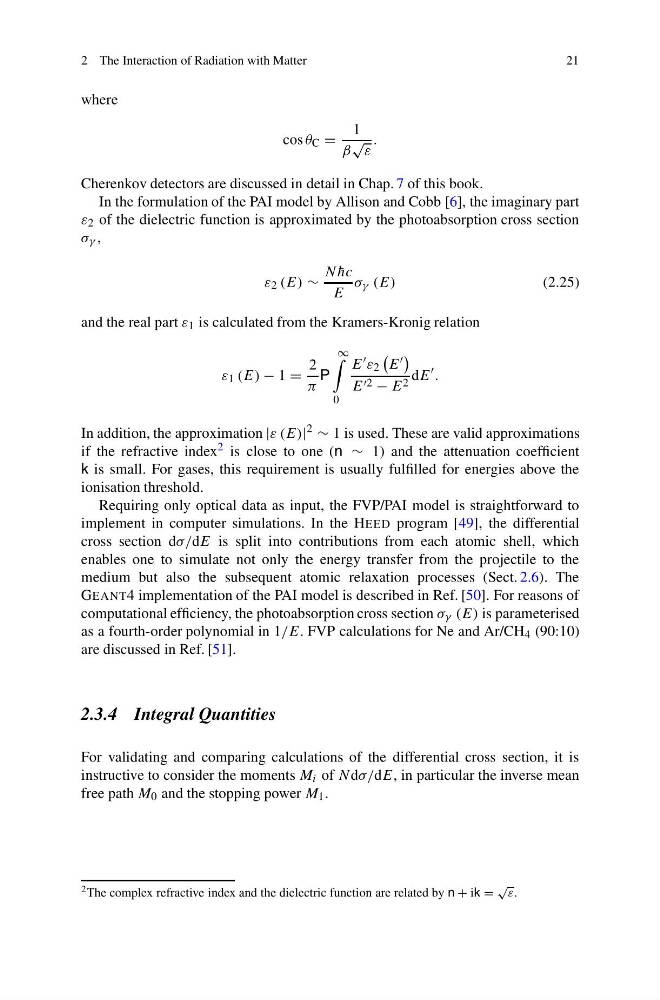
In the formulation of the PAI model by Allison and Cobb [6], the imaginary part
ε 2 of the dielectric function is approximated by the photoabsorption cross section
σ γ ,
ε 2 (E) ∼
N ¯
hc
E
σ γ (E)
(2.25)
and the real part ε 1 is calculated from the Kramers-Kronig relation
ε 1 (E) − 1 =
2
π
P
∞
0
E ε 2
E
E − E 2 dE
.
In addition, the approximation |ε (E)|
2
∼ 1 is used. These are valid approximations
if the refractive index 2 is close to one (n ∼ 1) and the attenuation coefficient
k is small. For gases, this requirement is usually fulfilled for energies above the
ionisation threshold.
Requiring only optical data as input, the FVP/PAI model is straightforward to
implement in computer simulations. In the HEED program [49], the differential
cross section dσ/dE is split into contributions from each atomic shell, which
enables one to simulate not only the energy transfer from the projectile to the
medium but also the subsequent atomic relaxation processes (Sect. 2.6). The
GEANT4 implementation of the PAI model is described in Ref. [50]. For reasons of
computational efficiency, the photoabsorption cross section σ γ (E) is parameterised
as a fourth-order polynomial in 1/E. FVP calculations for Ne and Ar/CH 4 (90:10)
are discussed in Ref. [51].
2.3.4 Integral Quantities
For validating and comparing calculations of the differential cross section, it is
instructive to consider the moments M i of Ndσ/dE, in particular the inverse mean
free path M 0 and the stopping power M 1 .
2 The complex refractive index and the dielectric function are related by n + ik =
√
ε.
21
where
cos θ C =
1
β
√
ε
.
Cherenkov detectors are discussed in detail in Chap. 7 of this book.
In the formulation of the PAI model by Allison and Cobb [6], the imaginary part
ε 2 of the dielectric function is approximated by the photoabsorption cross section
σ γ ,
ε 2 (E) ∼
N ¯
hc
E
σ γ (E)
(2.25)
and the real part ε 1 is calculated from the Kramers-Kronig relation
ε 1 (E) − 1 =
2
π
P
∞
0
E ε 2
E
E − E 2 dE
.
In addition, the approximation |ε (E)|
2
∼ 1 is used. These are valid approximations
if the refractive index 2 is close to one (n ∼ 1) and the attenuation coefficient
k is small. For gases, this requirement is usually fulfilled for energies above the
ionisation threshold.
Requiring only optical data as input, the FVP/PAI model is straightforward to
implement in computer simulations. In the HEED program [49], the differential
cross section dσ/dE is split into contributions from each atomic shell, which
enables one to simulate not only the energy transfer from the projectile to the
medium but also the subsequent atomic relaxation processes (Sect. 2.6). The
GEANT4 implementation of the PAI model is described in Ref. [50]. For reasons of
computational efficiency, the photoabsorption cross section σ γ (E) is parameterised
as a fourth-order polynomial in 1/E. FVP calculations for Ne and Ar/CH 4 (90:10)
are discussed in Ref. [51].
2.3.4 Integral Quantities
For validating and comparing calculations of the differential cross section, it is
instructive to consider the moments M i of Ndσ/dE, in particular the inverse mean
free path M 0 and the stopping power M 1 .
2 The complex refractive index and the dielectric function are related by n + ik =
√
ε.