

20
H. Bichsel and H. Schindler
2
10
3
10
4
10
5
10
[eV]
E
5
−
10
4
−
10
3
−
10
2
−
10
1
−
10
[Mb]
E
/d
d
E
= 4
γ
β
2
10
3
10
4
10
5
10
[eV]
E
5
−
10
4
−
10
3
−
10
2
−
10
1
−
10
[Mb]
E
/d
d
E
= 100
γ
β
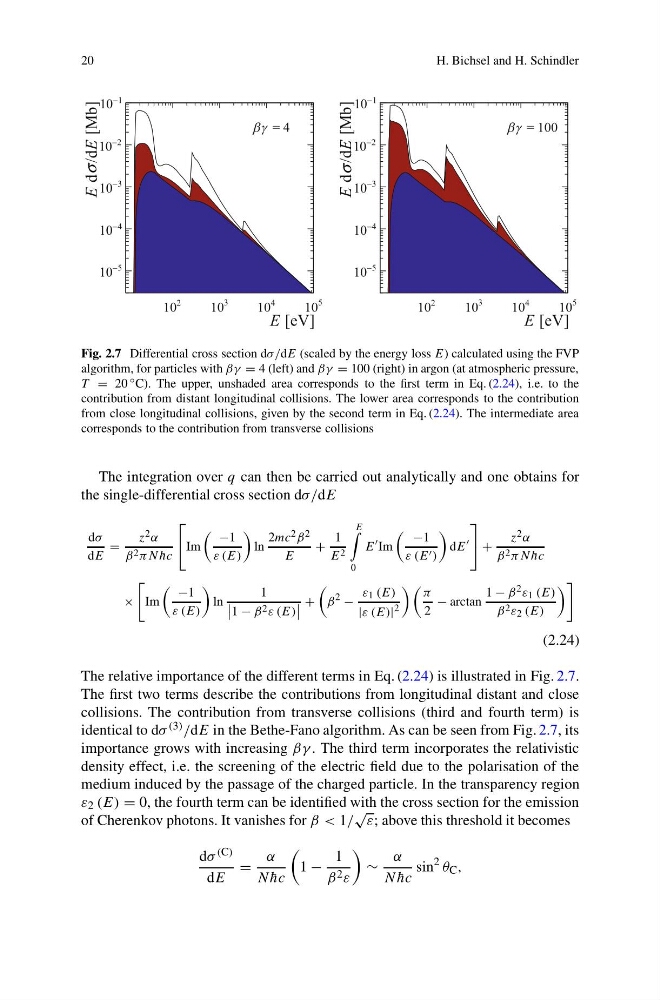
Fig. 2.7 Differential cross section dσ/dE (scaled by the energy loss E) calculated using the FVP
algorithm, for particles with βγ = 4 (left) and βγ = 100 (right) in argon (at atmospheric pressure,
T = 20 ◦ C). The upper, unshaded area corresponds to the first term in Eq. (2.24), i.e. to the
contribution from distant longitudinal collisions. The lower area corresponds to the contribution
from close longitudinal collisions, given by the second term in Eq. (2.24). The intermediate area
corresponds to the contribution from transverse collisions
The integration over q can then be carried out analytically and one obtains for
the single-differential cross section dσ/dE
dσ
dE
=
z 2 α
β 2 πN ¯
hc
⎡
⎣ Im
−1
ε (E)
ln
2mc 2 β 2
E
+
1
E 2
E
0
E
Im
−1
ε (E )
dE
⎤
⎦ +
z 2 α
β 2 πN ¯
hc
×
Im
−1
ε (E)
ln
1
1 − β 2 ε (E)
+
β
2 −
ε 1 (E)
|ε (E)|
2
π
2
− arctan
1 − β 2 ε 1 (E)
β 2 ε 2 (E)
(2.24)
The relative importance of the different terms in Eq. (2.24) is illustrated in Fig. 2.7.
The first two terms describe the contributions from longitudinal distant and close
collisions. The contribution from transverse collisions (third and fourth term) is
identical to dσ (3) /dE in the Bethe-Fano algorithm. As can be seen from Fig. 2.7, its
importance grows with increasing βγ . The third term incorporates the relativistic
density effect, i.e. the screening of the electric field due to the polarisation of the
medium induced by the passage of the charged particle. In the transparency region
ε 2 (E) = 0, the fourth term can be identified with the cross section for the emission
of Cherenkov photons. It vanishes for β < 1/
√
ε; above this threshold it becomes
dσ (C)
dE
=
α
N ¯
hc
1 −
1
β 2 ε
∼
α
N ¯
hc
sin
2 θ C ,
H. Bichsel and H. Schindler
2
10
3
10
4
10
5
10
[eV]
E
5
−
10
4
−
10
3
−
10
2
−
10
1
−
10
[Mb]
E
/d
d
E
= 4
γ
β
2
10
3
10
4
10
5
10
[eV]
E
5
−
10
4
−
10
3
−
10
2
−
10
1
−
10
[Mb]
E
/d
d
E
= 100
γ
β
Fig. 2.7 Differential cross section dσ/dE (scaled by the energy loss E) calculated using the FVP
algorithm, for particles with βγ = 4 (left) and βγ = 100 (right) in argon (at atmospheric pressure,
T = 20 ◦ C). The upper, unshaded area corresponds to the first term in Eq. (2.24), i.e. to the
contribution from distant longitudinal collisions. The lower area corresponds to the contribution
from close longitudinal collisions, given by the second term in Eq. (2.24). The intermediate area
corresponds to the contribution from transverse collisions
The integration over q can then be carried out analytically and one obtains for
the single-differential cross section dσ/dE
dσ
dE
=
z 2 α
β 2 πN ¯
hc
⎡
⎣ Im
−1
ε (E)
ln
2mc 2 β 2
E
+
1
E 2
E
0
E
Im
−1
ε (E )
dE
⎤
⎦ +
z 2 α
β 2 πN ¯
hc
×
Im
−1
ε (E)
ln
1
1 − β 2 ε (E)
+
β
2 −
ε 1 (E)
|ε (E)|
2
π
2
− arctan
1 − β 2 ε 1 (E)
β 2 ε 2 (E)
(2.24)
The relative importance of the different terms in Eq. (2.24) is illustrated in Fig. 2.7.
The first two terms describe the contributions from longitudinal distant and close
collisions. The contribution from transverse collisions (third and fourth term) is
identical to dσ (3) /dE in the Bethe-Fano algorithm. As can be seen from Fig. 2.7, its
importance grows with increasing βγ . The third term incorporates the relativistic
density effect, i.e. the screening of the electric field due to the polarisation of the
medium induced by the passage of the charged particle. In the transparency region
ε 2 (E) = 0, the fourth term can be identified with the cross section for the emission
of Cherenkov photons. It vanishes for β < 1/
√
ε; above this threshold it becomes
dσ (C)
dE
=
α
N ¯
hc
1 −
1
β 2 ε
∼
α
N ¯
hc
sin
2 θ C ,