

284
R. Forty and O. Ullaland
a large number of secondaries, one can use the feature that at least one particle will
have a velocity v ∼ = c and thereby use this one to define time zero.
The main work during the last years [4] has been in the improvement of the time
resolution and, as the detectors have gradually increased in size, in the cost/m 2 . The
occupancy and radiation tolerance are playing a very important role for detectors
that are proposed for the new high luminosity accelerators. We will here not explain
the working principle of the detectors themselves. The reader is referred to Chap. 3.
We will rather discuss the advantages and inconveniences of some of the most
commonly used detector set-ups.
7.2.1 Scintillator Hodoscopes
A scintillator, read out in both ends by a photomultiplier, is the classic element
of a Time of Flight hodoscope, Fig. 7.3b. The number of photons created is large.
Plastic scintillators, as discussed in Chap. 3, have a density ρ 1.03 g/cm 3 . About
10 4 photons/MeV are created with a mean wavelength of ∼400 nm and a time
constant τ ∼ 1.5 ns. The number of emitted photons per time unit, N, will be
approximately:
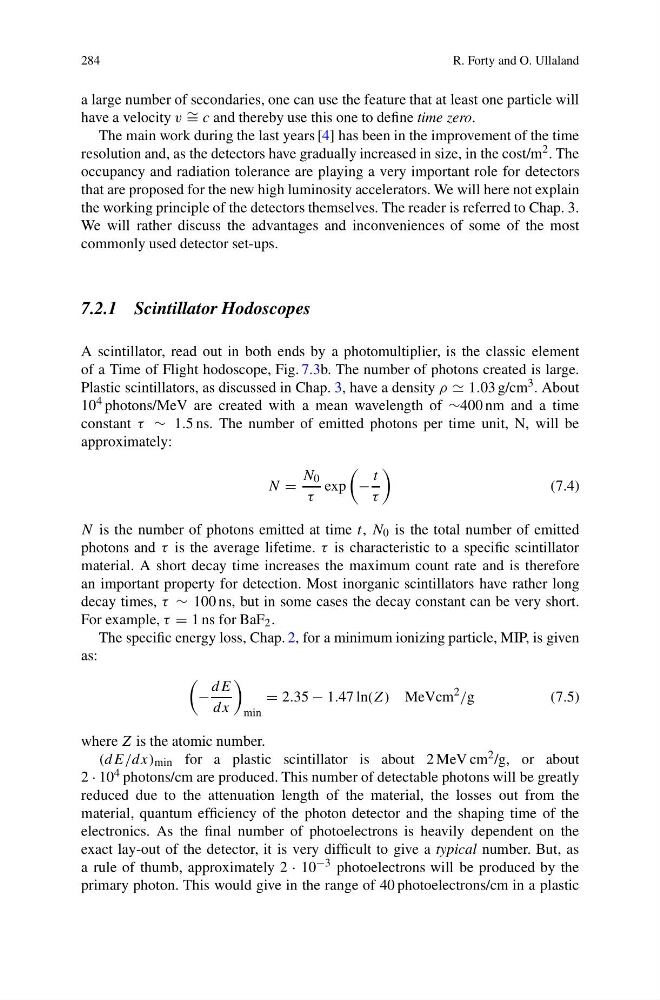
N =
N 0
τ
exp
−
t
τ
(7.4)
N is the number of photons emitted at time t, N 0 is the total number of emitted
photons and τ is the average lifetime. τ is characteristic to a specific scintillator
material. A short decay time increases the maximum count rate and is therefore
an important property for detection. Most inorganic scintillators have rather long
decay times, τ ∼ 100 ns, but in some cases the decay constant can be very short.
For example, τ = 1 ns for BaF 2 .
The specific energy loss, Chap. 2, for a minimum ionizing particle, MIP, is given
as:
−
dE
dx
min
= 2.35 − 1.47 ln(Z) MeVcm
2 /g
(7.5)
where Z is the atomic number.
(dE/dx) min for a plastic scintillator is about 2 MeV cm 2 /g, or about
2 · 10 4 photons/cm are produced. This number of detectable photons will be greatly
reduced due to the attenuation length of the material, the losses out from the
material, quantum efficiency of the photon detector and the shaping time of the
electronics. As the final number of photoelectrons is heavily dependent on the
exact lay-out of the detector, it is very difficult to give a typical number. But, as
a rule of thumb, approximately 2 · 10 −3 photoelectrons will be produced by the
primary photon. This would give in the range of 40 photoelectrons/cm in a plastic
R. Forty and O. Ullaland
a large number of secondaries, one can use the feature that at least one particle will
have a velocity v ∼ = c and thereby use this one to define time zero.
The main work during the last years [4] has been in the improvement of the time
resolution and, as the detectors have gradually increased in size, in the cost/m 2 . The
occupancy and radiation tolerance are playing a very important role for detectors
that are proposed for the new high luminosity accelerators. We will here not explain
the working principle of the detectors themselves. The reader is referred to Chap. 3.
We will rather discuss the advantages and inconveniences of some of the most
commonly used detector set-ups.
7.2.1 Scintillator Hodoscopes
A scintillator, read out in both ends by a photomultiplier, is the classic element
of a Time of Flight hodoscope, Fig. 7.3b. The number of photons created is large.
Plastic scintillators, as discussed in Chap. 3, have a density ρ 1.03 g/cm 3 . About
10 4 photons/MeV are created with a mean wavelength of ∼400 nm and a time
constant τ ∼ 1.5 ns. The number of emitted photons per time unit, N, will be
approximately:
N =
N 0
τ
exp
−
t
τ
(7.4)
N is the number of photons emitted at time t, N 0 is the total number of emitted
photons and τ is the average lifetime. τ is characteristic to a specific scintillator
material. A short decay time increases the maximum count rate and is therefore
an important property for detection. Most inorganic scintillators have rather long
decay times, τ ∼ 100 ns, but in some cases the decay constant can be very short.
For example, τ = 1 ns for BaF 2 .
The specific energy loss, Chap. 2, for a minimum ionizing particle, MIP, is given
as:
−
dE
dx
min
= 2.35 − 1.47 ln(Z) MeVcm
2 /g
(7.5)
where Z is the atomic number.
(dE/dx) min for a plastic scintillator is about 2 MeV cm 2 /g, or about
2 · 10 4 photons/cm are produced. This number of detectable photons will be greatly
reduced due to the attenuation length of the material, the losses out from the
material, quantum efficiency of the photon detector and the shaping time of the
electronics. As the final number of photoelectrons is heavily dependent on the
exact lay-out of the detector, it is very difficult to give a typical number. But, as
a rule of thumb, approximately 2 · 10 −3 photoelectrons will be produced by the
primary photon. This would give in the range of 40 photoelectrons/cm in a plastic